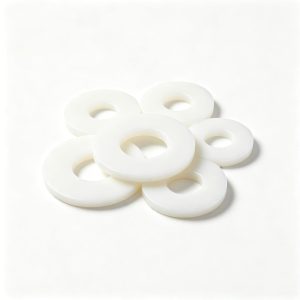
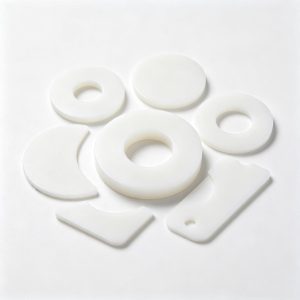
Custom Die-Cut PTFE Washers and Gaskets
Custom Die-Cut PTFE Washers and Gaskets for electrical insulation, chemical resistance and industrial sealing. Precision sizes, drawings and OEM orders.
Custom Die-Cut PTFE Washers and Gaskets
Precision PTFE Components for Electrical Insulation, Chemical Resistance and Industrial Sealing
Product Overview
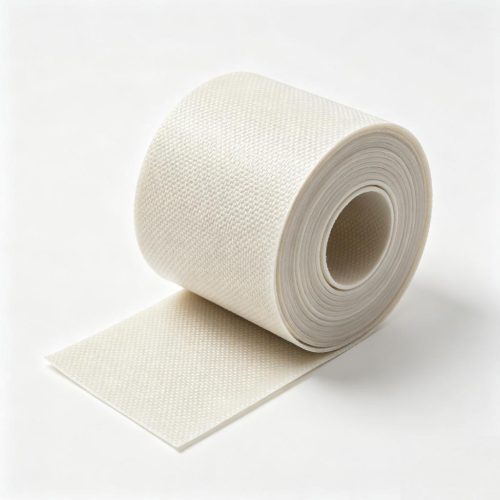
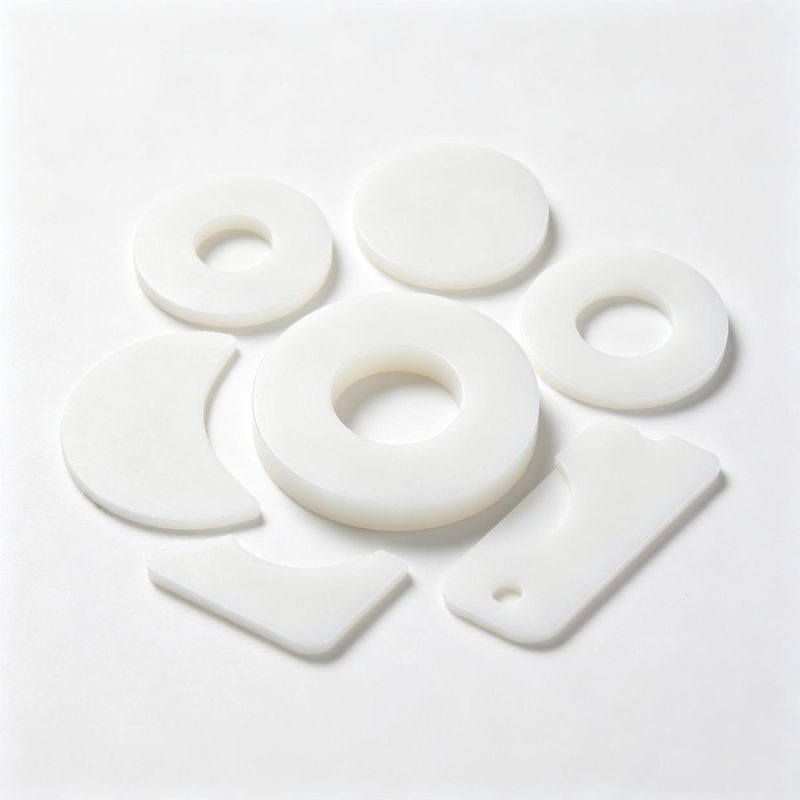
HighTemp Material supplies custom die-cut PTFE washers and gaskets for industrial applications requiring chemical resistance, electrical insulation, low friction, and thermal stability.
Manufactured from selected PTFE sheets or other suitable PTFE stock forms, these components can be customized to customer drawings, assembly dimensions, and operating conditions.
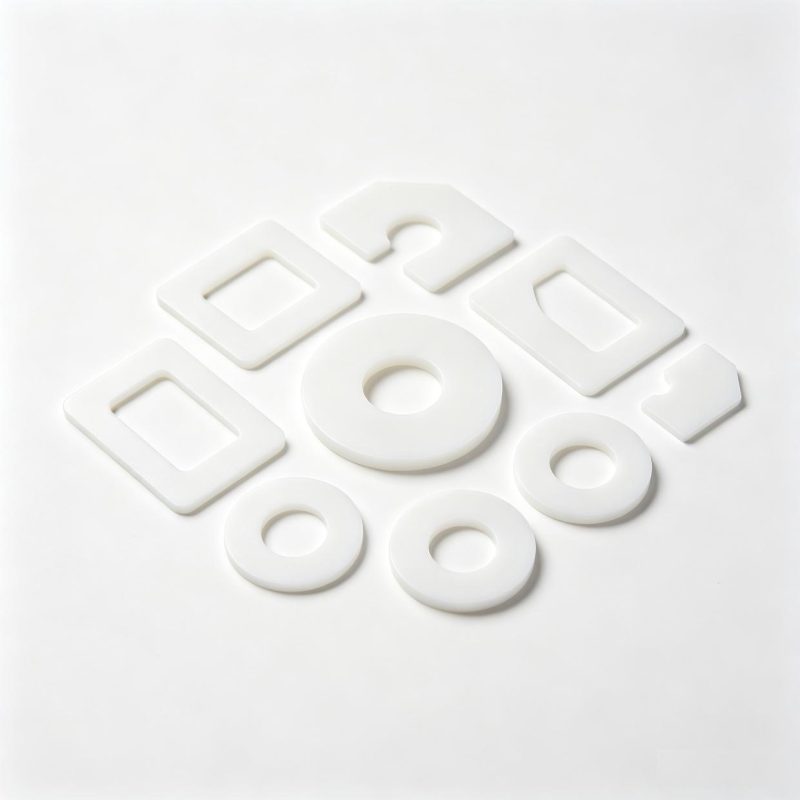
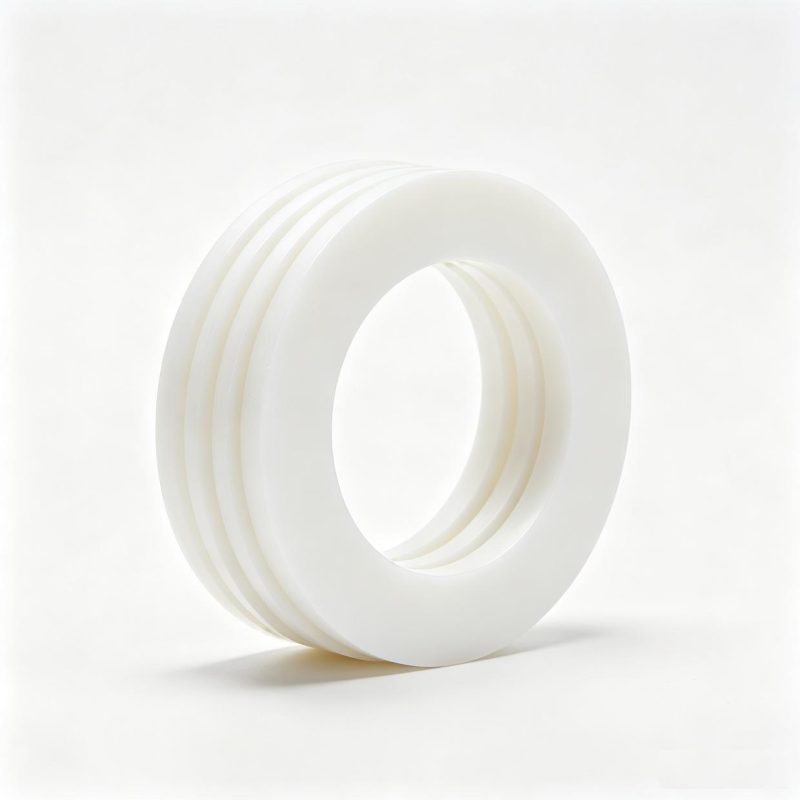
Our supply capabilities cover flat washers, annular rings, custom-shaped gaskets, insulating spacers, and other PTFE components. Depending on part geometry, thickness, quantity, and tolerance requirements, production may involve die cutting, precision cutting, or CNC machining through qualified manufacturing partners.
We support prototype evaluation, drawing-based quotations, and repeat OEM supply programs.
Key Features and Benefits
1. Excellent Chemical Resistance
PTFE offers broad resistance to many industrial chemicals, solvents, acids, and alkaline media.
This makes it a candidate for gaskets and washers used in chemical processing equipment, pumps, valves, and fluid-handling assemblies.
Chemical compatibility should always be checked against the specific media, concentration, temperature, and operating conditions.
2. High-Temperature Performance
PTFE is widely used in applications requiring thermal stability and is commonly associated with a continuous service temperature of approximately -200°C to +260°C under suitable conditions.
However, the allowable operating temperature of a finished washer or gasket depends on mechanical load, material grade, assembly design, and exposure duration.
For sealing applications, creep, stress relaxation, and compression behavior must also be considered.
3. Electrical Insulation Properties
PTFE has excellent dielectric properties and can be used for insulating washers, spacers, and separation components in electrical equipment.
Actual electrical performance depends on material grade, part thickness, geometry, contamination, and environmental conditions.
4. Low Friction and Non-Stick Surface
PTFE has a naturally low coefficient of friction and low surface energy.
These characteristics can be useful in selected sliding, spacing, and anti-adhesion applications.
5. Custom Geometry and Dimensions
PTFE components can be supplied according to customer drawings, including:
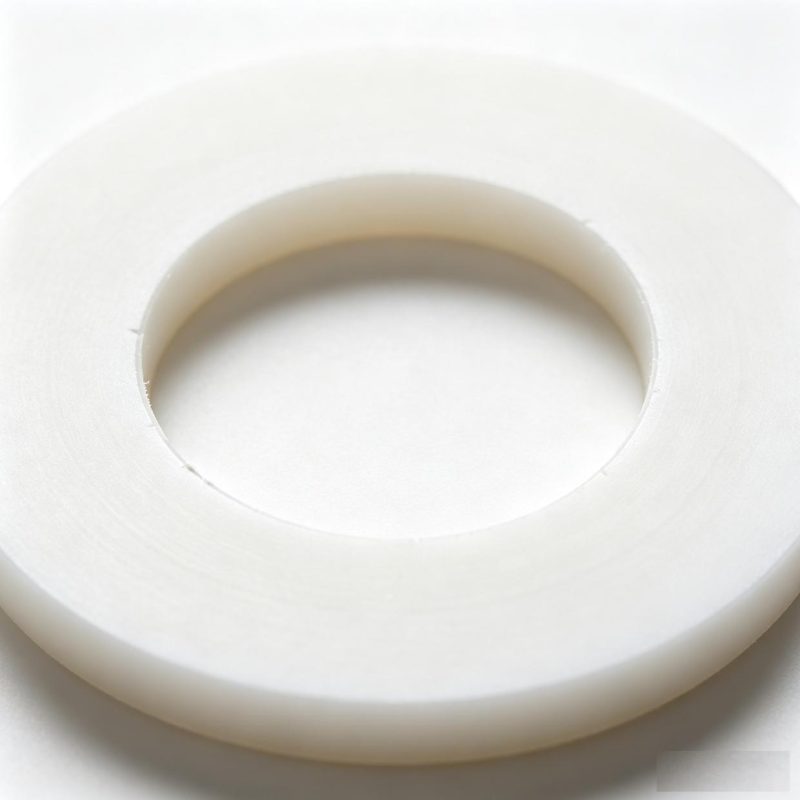
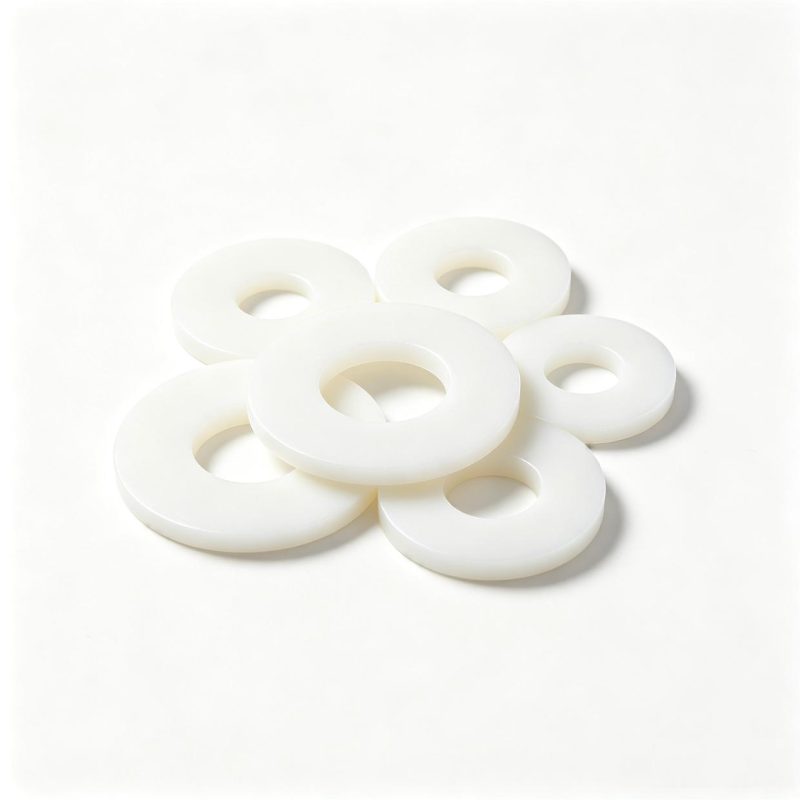
- Flat circular washers
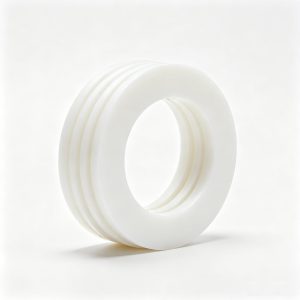
- Annular rings
- Rectangular and irregular-shaped gaskets
- Insulation spacers
- Gaskets with multiple mounting holes
- Custom die-cut insulation components
Part dimensions and tolerances are reviewed before production.
Material Options
Virgin PTFE
Unfilled PTFE is commonly selected for electrical insulation, chemical resistance, and applications requiring high material purity.
Modified PTFE
Selected modified PTFE grades may offer improved deformation behavior or other application-specific properties compared with conventional virgin PTFE.
Grade availability and suitability must be confirmed.
Filled PTFE
PTFE compounds containing fillers such as glass fiber, carbon, or graphite may be considered for specific wear, load-bearing, or mechanical applications.
Filled grades can have different electrical, chemical, and mechanical characteristics and should not automatically be substituted for virgin PTFE.
Typical Technical Specifications
| Property | Typical / Custom Requirement |
|---|---|
| Material | PTFE (Polytetrafluoroethylene) |
| Material Grades | Virgin PTFE; modified or filled grades upon review |
| Product Forms | Washers, rings, gaskets, spacers, custom profiles |
| Color | Typically white for virgin PTFE; grade-dependent |
| Thickness | According to selected stock material |
| Inner Diameter (ID) | Customer specified |
| Outer Diameter (OD) | Customer specified |
| Shape | Circular, rectangular, irregular, drawing-based |
| Dimensional Tolerance | Confirmed according to geometry and process |
| Processing | Die cutting, precision cutting, CNC machining |
| Temperature Reference | Approx. -200°C to +260°C for suitable PTFE applications |
| Chemical Compatibility | Medium- and condition-dependent |
| Electrical Insulation | Grade- and design-dependent |
| Packaging | Bulk, counted packs, or custom packaging upon agreement |
| Order Quantity | Based on dimensions, material grade, and processing |
Technical Note: The temperature range is general PTFE material guidance, not a guaranteed service rating for every finished part. All critical specifications require confirmation before production.
Applications
Electrical Insulation Washers
PTFE washers can be used to electrically separate conductive components, support fastener assemblies, and provide insulating barriers in selected electrical equipment.
Industrial Sealing Gaskets
Custom PTFE gaskets can be evaluated for flanges, pumps, valves, and other equipment requiring chemical-resistant sealing.
Sealing suitability depends on pressure, flange design, gasket compression, surface finish, and operating conditions.
Chemical Processing Equipment
PTFE components may be used in equipment exposed to aggressive chemicals where material compatibility is essential.
Mechanical Spacers and Low-Friction Components
PTFE washers and rings may serve as low-friction spacers, separation elements, or wear-related components where loading conditions permit.
OEM Equipment and Custom Assemblies
Drawing-based PTFE parts can be supplied for industrial equipment manufacturers requiring customized geometry, controlled dimensions, and repeat production.
Die Cutting vs CNC Machining: Which Process Should You Choose?
Die Cutting
Die cutting is commonly suitable for flat PTFE parts with repeatable shapes and appropriate thicknesses.
It can be cost-effective for medium- and high-volume production after tooling approval.
CNC Machining
CNC machining may be preferable for thicker components, complex profiles, tight tolerances, or geometries that cannot be efficiently produced by die cutting.
Other Precision Cutting Methods
Depending on the material and part design, alternative cutting methods may be evaluated.
The final process is selected according to thickness, tolerance, edge quality, quantity, and cost requirements.
Design Considerations for Custom PTFE Parts
Dimensional Tolerance
PTFE is softer and more deformable than many engineering plastics.
Part dimensions can be affected by cutting forces, material thickness, temperature, and measurement methods.
Critical tolerances should be identified on the engineering drawing.
Creep and Cold Flow
Under sustained mechanical load, PTFE may deform over time.
For bolted assemblies or pressure seals, this behavior should be considered during material and gasket design.
Compression and Sealing Performance
PTFE gasket suitability cannot be determined from chemical resistance alone.
Required bolt load, sealing pressure, flange surface condition, and compression behavior should be reviewed.
Material Selection
Virgin PTFE, modified PTFE, and filled PTFE may behave differently under load and in electrical or chemical environments.
The selected grade should match the application requirements.
Custom Manufacturing and Supply
HighTemp Material works with qualified converting and machining resources to supply PTFE components according to customer specifications.
Available services may include:
- Custom die cutting
- CNC machining
- Precision sheet cutting
- Prototype development
- Drawing-based dimensional inspection
- Batch packaging and labeling
Processing capabilities, inspection criteria, and documentation are confirmed during quotation.
How to Request a Quotation
For an accurate quotation, please provide:
- Engineering drawing in PDF, DXF, DWG, or STEP format, where available.
- Material grade or required properties.
- Thickness and critical dimensions.
- Dimensional tolerances.
- Operating temperature, pressure, and chemical exposure.
- Prototype and production quantities.
- Inspection, documentation, and packaging requirements.
If you do not have a completed drawing, a dimensioned sketch may be sufficient for an initial feasibility review.
Frequently Asked Questions
Can you manufacture PTFE washers according to our drawings?
Yes. Custom washers and gaskets can be evaluated according to customer drawings, dimensions, material grade, and quantity.
What is the difference between PTFE washers and PTFE gaskets?
PTFE washers may be used for spacing, electrical insulation, load separation, or selected sealing functions. PTFE gaskets are typically designed to create a seal between mating surfaces.
Can PTFE washers operate at 260°C?
PTFE has high thermal resistance, but suitability at 260°C depends on mechanical load, exposure time, and the specific application. Finished parts require application-specific assessment.
Can you supply tight-tolerance PTFE washers?
Tight tolerances may be possible for selected geometries and machining processes. Achievable values must be confirmed against the drawing and material behavior.
Are virgin PTFE and filled PTFE interchangeable?
Not necessarily. Fillers can change mechanical, electrical, frictional, and chemical properties. Material selection should be based on the application.
Can you provide samples before mass production?
Prototype or sample production can be evaluated depending on material availability, geometry, tooling, and order requirements.
Request Custom PTFE Washers and Gaskets
Looking for a reliable supply partner for custom PTFE insulation and sealing components?
HighTemp Material supports material selection, drawing review, custom converting, and OEM supply.
Send us your drawing, specifications, and estimated quantity to request a quotation.
HighTemp Material Co., Ltd.
Website: https://www.hightempmaterial.com/
Request a Quote | Submit Your Drawing | Ask for Material Guidance
Related products
Skived Pure PTFE Film
¥950.00Select options
This product has multiple variants. The options may be chosen on the product page