
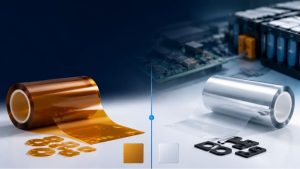


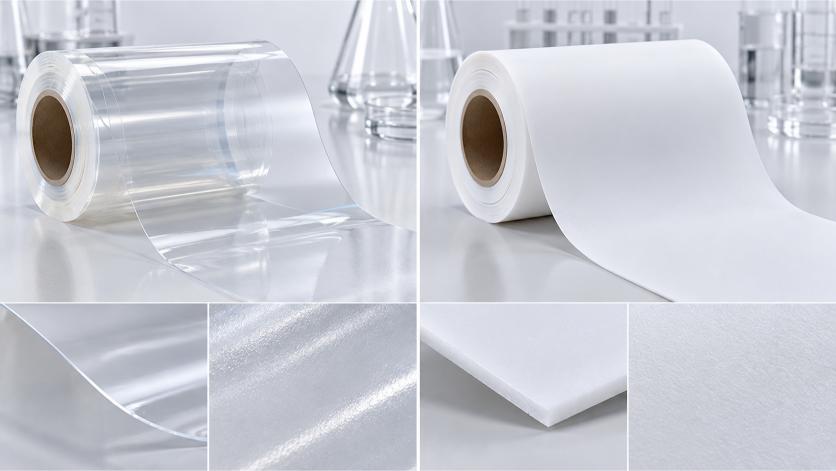
In practical terms, FEP film is often selected when transparency, thermoformability or heat sealing is required, while PTFE film is generally preferred for higher continuous temperature capability, extremely low friction and demanding non-stick applications. This guide explains the differences engineers and buyers should review before specifying either material.
Quick Answer: FEP or PTFE Film?
- Choose FEP film for optical clarity, melt processing, heat sealing, thermoforming and conformable encapsulation.
- Choose PTFE film for higher continuous service temperatures, lower friction, excellent non-stick behavior and broad chemical resistance.
- Confirm the exact grade, thickness, surface treatment and operating environment before final approval.
Table of Contents
- What Are FEP and PTFE Films?
- Processing: Extrusion vs Skiving
- FEP vs PTFE Film Comparison
- Temperature Performance
- Mechanical and Optical Properties
- Electrical and Chemical Performance
- Heat Sealing, Bonding and Converting
- Typical Applications
- How to Select the Right Film
- FAQ
What Are FEP and PTFE Films?
What is FEP film?
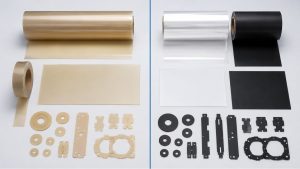
FEP, or fluorinated ethylene propylene, is a fully fluorinated copolymer. Unlike PTFE, FEP can be melted and processed using conventional thermoplastic techniques. Film can therefore be produced by melt extrusion and can be heat sealed or thermoformed. Natural FEP film is typically clear to translucent, making it useful where visual inspection, light transmission or transparent protection is important.
What is PTFE film?
PTFE, or polytetrafluoroethylene, has exceptionally high melt viscosity. It does not flow like a conventional melt-processable thermoplastic. Dense PTFE film is commonly produced by molding and sintering a billet, then skiving a continuous thin sheet from the billet. The resulting film is normally white to milky white and may show a directional surface associated with skiving.
Both materials may also be supplied in modified, filled, etched, adhesive-backed or specialty grades. Product data must therefore be reviewed at grade level rather than treating every FEP or PTFE film as identical.
Processing Difference: FEP Extrusion vs PTFE Skiving
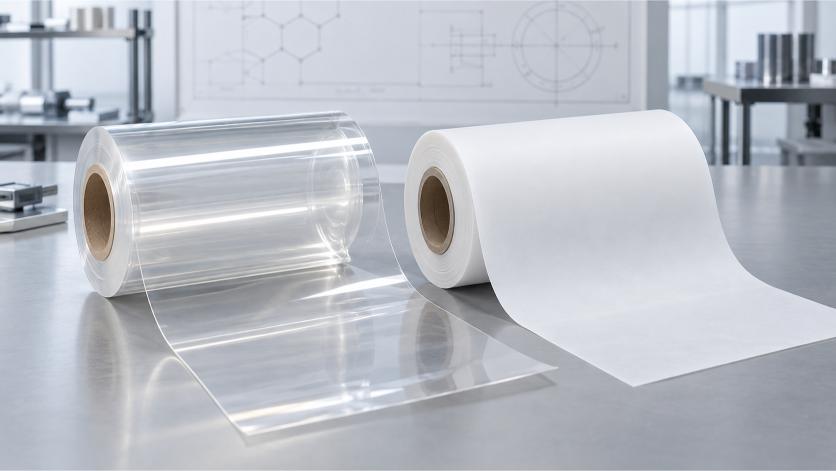
The manufacturing route is the most important difference between the two films because it affects appearance, thickness range, roll format, weldability and downstream fabrication.
How FEP film is produced
- FEP resin is heated above its melting region.
- The molten polymer is formed through a flat die.
- Chill rolls control cooling, thickness and surface finish.
- The film is trimmed, inspected and wound into rolls.
Because FEP is melt processable, it can also be welded, heat sealed, laminated and thermoformed. Processing conditions depend on resin grade, film thickness and equipment.
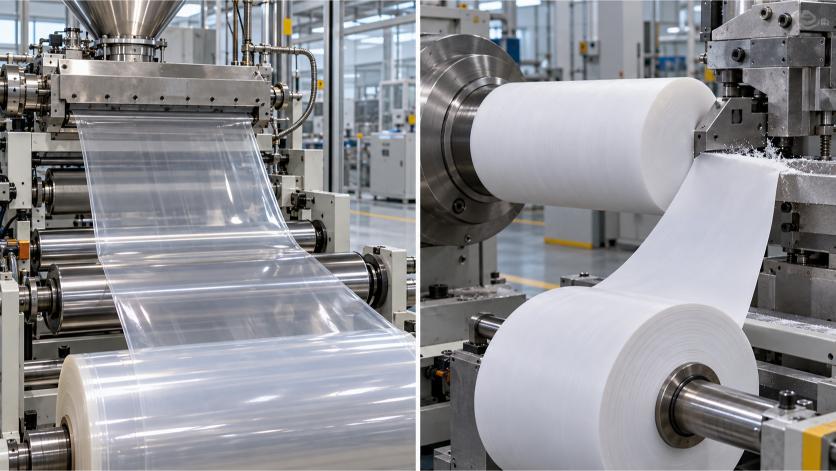
How PTFE film is produced
- PTFE powder is compressed into a cylindrical preform or billet.
- The billet is sintered under controlled conditions.
- A precision blade skives a continuous film from the rotating billet.
- The film is slit, surface treated or laminated as required.
PTFE cannot normally be melt extruded into film in the same way as FEP. Skiving enables useful thin-film formats, but thickness tolerance, surface texture and directional properties may differ from those of an extruded film.
FEP vs PTFE Film: Side-by-Side Comparison
| Property | FEP Film | PTFE Film |
|---|---|---|
| Polymer type | Fully fluorinated copolymer | Fluoropolymer of tetrafluoroethylene |
| Typical film process | Melt extrusion | Billet molding, sintering and skiving |
| Appearance | Clear to translucent | Milky white to opaque |
| Typical continuous-use reference | Up to about 200°C for many grades | Up to about 260°C for many grades |
| Heat sealing | Yes, with suitable process conditions | Not conventionally heat sealable by simple remelting |
| Thermoforming | Good relative to PTFE | Limited |
| Low-friction/non-stick performance | Excellent | Generally superior |
| Chemical resistance | Excellent | Excellent and extremely broad |
| Electrical insulation | Excellent | Excellent |
| Common converting | Slitting, heat sealing, thermoforming, die cutting | Slitting, die cutting, etching, adhesive lamination |
Values and capabilities are general selection references, not guaranteed specifications. Always use the supplier’s data sheet and test the finished construction under actual conditions.
Temperature Performance: Where PTFE Has the Advantage
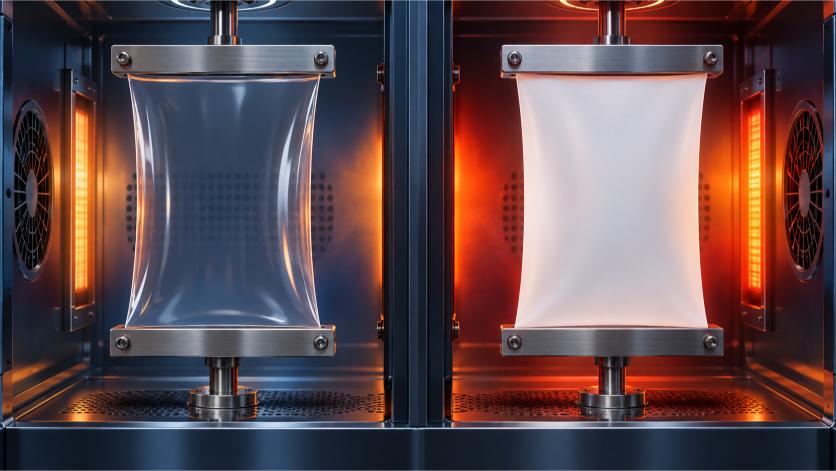
PTFE is commonly selected for the higher end of fluoropolymer film temperature requirements. Many commercial PTFE grades are referenced for continuous service around 260°C, while many FEP grades are used up to approximately 200°C. These are broad material-family references rather than universal design limits.
Real performance depends on exposure time, mechanical load, film thickness, chemical contact, atmosphere, thermal cycling and the presence of adhesives or other layers. For example, an adhesive-backed PTFE film may be limited by the adhesive long before the PTFE substrate reaches its own temperature capability.
For short-duration processes such as release layers, heat-sealing fixtures or electronics manufacturing, buyers should state both the peak temperature and the exposure time. For long-term insulation, specify the continuous operating temperature and any thermal cycling.
Mechanical, Surface and Optical Differences
Transparency
FEP film offers a clear optical advantage. It can allow inspection of a protected component, observation of fluid paths or light transmission. PTFE film is usually white or translucent and is not the first choice when optical clarity is required.
Flexibility and formability
FEP can be heat formed around components and can create sealed covers, sleeves and protective envelopes. PTFE remains highly flexible in thin gauges but is less suited to conventional thermoforming. Its extremely low surface energy also means that it tends not to adhere without surface treatment.
Friction and release
Both films provide non-stick and easy-release surfaces. PTFE is particularly valued when minimum friction or the strongest release behavior is the priority. This makes it useful for release layers, sliding interfaces and anti-stick barriers.
Dimensional behavior
Extruded FEP and skived PTFE can respond differently to heat, tension and orientation. Critical applications should define thickness tolerance, width tolerance, shrinkage, tensile direction and flatness instead of relying only on the nominal material name.
Electrical Insulation and Chemical Resistance
FEP and PTFE both offer strong dielectric performance and low moisture absorption, which makes them useful in wire and cable insulation, electronic assemblies, high-frequency components and chemically aggressive environments.
PTFE is widely known for its broad chemical inertness. FEP also resists a wide range of chemicals and solvents while providing easier fabrication. When a film will contact a specific chemical, confirm concentration, temperature, pressure, exposure time and mechanical stress. Permeation may matter even when the polymer itself is not visibly attacked.
For electrical applications, request grade-specific values for dielectric strength, dielectric constant, dissipation factor, volume resistivity and any required flammability or regulatory classification. Dielectric strength can vary with film thickness and test method.
Heat Sealing, Bonding and Custom Converting
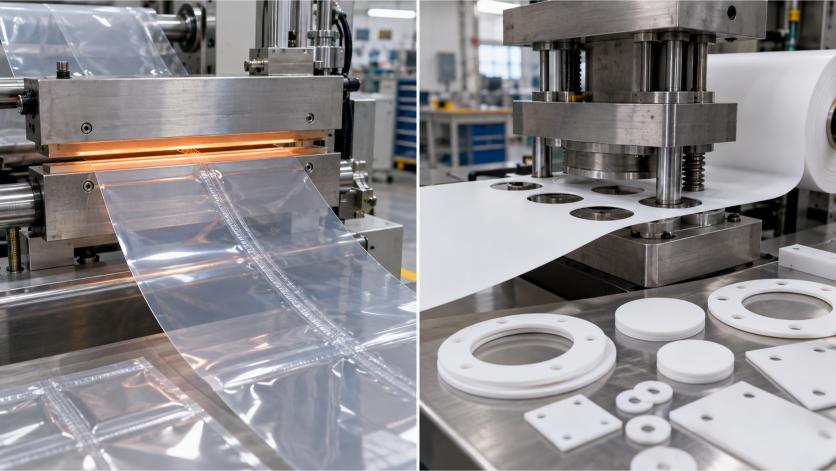
FEP film fabrication
- Heat sealing and thermal welding
- Thermoforming and conformable encapsulation
- Slitting and precision width conversion
- Die cutting and custom shapes
- Lamination to compatible high-temperature constructions
PTFE film fabrication
- Precision slitting and rewinding
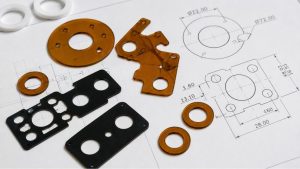
- Die cutting, CNC cutting and gasket conversion
- Chemical etching or plasma treatment to improve bondability
- Pressure-sensitive adhesive lamination
- Use as a release liner, low-friction layer or chemical barrier
Untreated fluoropolymer surfaces are difficult to bond. If the film must be laminated or adhesive backed, specify which side requires treatment, the target substrate, temperature range and peel-strength requirement. Surface treatment should be protected from contamination and evaluated for storage-life limitations.
Typical FEP and PTFE Film Applications
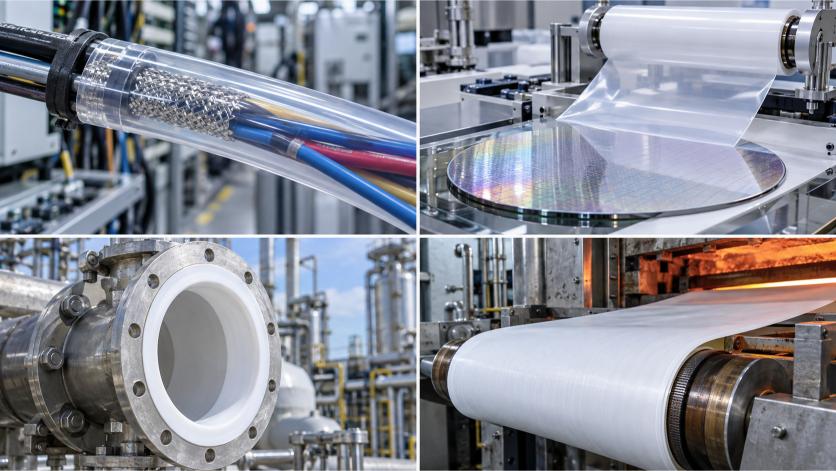
Common FEP film applications
- Wire, cable and coil insulation
- Transparent chemical barriers and protective covers
- Heat-sealed bags, sleeves and encapsulation
- Release film for composite, electronics and semiconductor processes
- Thermoformed insulation components
Common PTFE film applications
- High-temperature electrical insulation
- Release layers and non-stick process surfaces
- Chemical-resistant barriers, seals and gaskets
- Low-friction sliding and wear interfaces
- Die-cut insulation pads and precision components
In some constructions, the two materials can complement each other. An application may use PTFE where maximum temperature or release is required and FEP where a melt-bondable fluoropolymer layer is needed.
How to Choose Between FEP and PTFE Film
Use the following questions to build an effective material specification:
- What are the continuous and peak temperatures? Include exposure time and thermal cycles.
- Must the film be transparent? If yes, FEP will usually be the stronger candidate.
- Does the film need to be heat sealed or thermoformed? FEP is typically easier to process.
- Is maximum release or minimum friction critical? PTFE often has the advantage.
- What chemicals will contact the film? State chemical, concentration, temperature and duration.
- What electrical values are required? Use grade-specific, thickness-specific test data.
- Will the film be bonded? Define surface treatment, adhesive and substrate.
- What dimensions and tolerances are needed? Include thickness, width, roll length, core, flatness and cut-part tolerance.
- Are certificates or compliance documents required? Confirm these before sampling.
Simple selection rule
Select FEP when the design needs transparency, melt bonding, heat sealing or thermoforming. Select PTFE when the design prioritizes higher continuous temperature capability, the lowest friction or the strongest non-stick performance. When several factors compete, request samples and test the finished construction under actual operating conditions.
Frequently Asked Questions
Is FEP the same as PTFE?
No. They are both fully fluorinated polymers, but FEP is a melt-processable copolymer while PTFE has extremely high melt viscosity and is processed using specialized methods such as molding, sintering and skiving.
Which film has better temperature resistance?
PTFE generally provides higher continuous temperature capability. Many grades are referenced around 260°C, compared with approximately 200°C for many FEP grades. Verify the exact supplier data and finished construction.
Can FEP film be heat sealed?
Yes. FEP is melt processable and can be heat sealed or thermally welded under suitable time, temperature and pressure conditions.
Can PTFE film be bonded with adhesive?
Yes, but untreated PTFE is difficult to bond. The surface is commonly etched or otherwise treated before adhesive lamination. The treatment, adhesive and substrate must be matched to the application.
Which film is transparent?
Natural FEP film is typically clear to translucent. Skived PTFE film is generally milky white to opaque.
Which film is better for electrical insulation?
Both can provide excellent electrical insulation. The correct choice depends on temperature, thickness, dielectric requirements, frequency, mechanical design and fabrication method.
Need FEP or PTFE Film for Your Application?
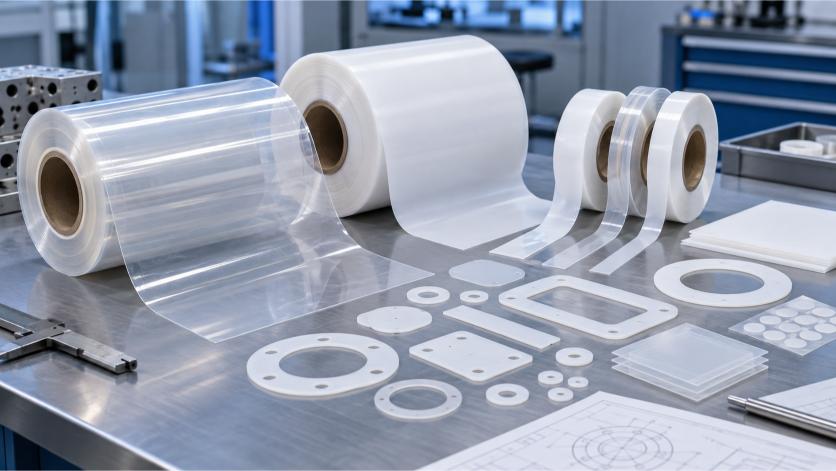
HighTemp Material supplies fluoropolymer films and custom converting support for industrial insulation, release, chemical protection and precision components. Available services include slitting, rewinding, laminating, adhesive backing, die cutting and CNC cutting.
Send us your target material, thickness, width, roll length or drawing, operating temperature, application and required quantity. Our team can help review the specification and prepare a suitable quotation or sample plan.