

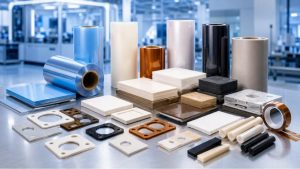
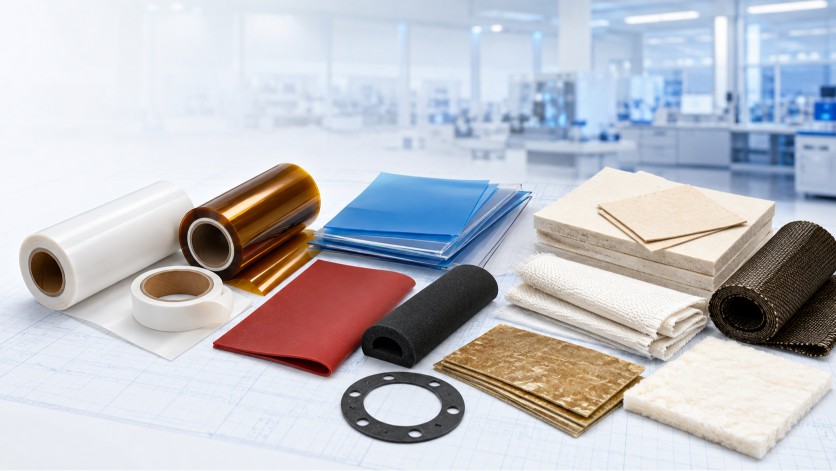
High-temperature materials are materials designed to maintain their required properties when exposed to elevated temperatures.
They are used in electronics, batteries, industrial furnaces, chemical equipment, automotive systems, solar energy, aerospace and many other industries where ordinary plastics, rubbers or fabrics may soften, shrink, deform or lose performance.
However, “high temperature” does not describe one specific material or temperature range. A film used at 180°C inside an electronic device and a ceramic fiber board used near an industrial furnace may both be considered high-temperature materials, even though their properties and functions are completely different.
This beginner’s guide explains the main types of high-temperature materials, how they work, where they are used and what information you need before choosing one.
What Does “High Temperature Material” Mean?
A high-temperature material is any polymer, elastomer, composite, mineral or fiber product designed to perform reliably above the temperature limits of conventional materials.
Depending on the application, it may need to maintain:
- Physical shape
- Mechanical strength
- Electrical insulation
- Chemical resistance
- Sealing pressure
- Flame resistance
- Thermal insulation
- Dimensional stability
- Surface release properties
- Adhesive performance
The most important point is that temperature resistance is always related to a specific function.
For example:
- A high-temperature tape must remain attached without leaving residue.
- An insulation film must maintain its dielectric properties.
- A gasket must continue sealing under pressure.
- A thermal barrier must reduce heat transfer.
- A fireproof fabric must resist heat or flame exposure.
- A release film must remain non-stick during processing.
A material may withstand heat without melting but still become unsuitable because it loses strength, changes dimensions or fails electrically.
Why Ordinary Materials Fail at High Temperatures
Heat increases molecular movement and can change the structure and behavior of a material.
Common effects include:
- Softening
- Melting
- Shrinkage
- Expansion
- Oxidation
- Brittleness
- Loss of tensile strength
- Reduced adhesive strength
- Increased compression set
- Electrical insulation failure
- Surface cracking
- Chemical degradation
These changes can cause equipment failure, electrical short circuits, seal leakage, surface contamination or inconsistent manufacturing quality.
High-temperature materials are formulated or constructed to slow these changes and maintain the properties required by the application.
Continuous vs Short-Term Temperature Resistance
One of the most important concepts for beginners is the difference between continuous and short-term temperature resistance.
Continuous Operating Temperature
The continuous operating temperature is the temperature at which a material can perform for an extended period under specified conditions.
Long-term heat exposure may gradually affect:
- Mechanical strength
- Flexibility
- Color
- Dimensions
- Electrical properties
- Adhesive performance
Short-Term Temperature Resistance
Short-term temperature resistance describes the material’s ability to withstand a higher temperature for a limited time.
For example, a masking film may tolerate a short reflow-soldering cycle near 260°C but may not be suitable for continuous use at that temperature.
Peak Temperature
Peak temperature is the highest temperature reached during a process. It should always be considered together with exposure time and the number of thermal cycles.
When comparing products, never select a material using only the highest temperature shown on a datasheet.
Main Types of High-Temperature Materials
High-temperature materials can be divided into several broad groups.
1. High-Temperature Polymer Films
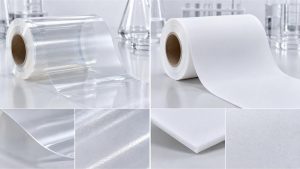
Polymer films provide lightweight, flexible and space-efficient protection. They are widely used for electrical insulation, masking, release, packaging and component separation.
PTFE Film
PTFE is a fluoropolymer known for:
- Excellent chemical resistance
- Low coefficient of friction
- Non-stick performance
- Low moisture absorption
- Electrical insulation
- Wide operating temperature range
Standard PTFE grades are commonly used continuously up to approximately 260°C, depending on thickness, mechanical load and application conditions.
Common PTFE products include:
- Skived pure PTFE film
- High-temperature PTFE adhesive tape
- PTFE-coated fiberglass cloth
- Custom PTFE washers and gaskets
PTFE is often selected for chemical processing, release surfaces, electrical insulation, sliding components and high-temperature sealing.
FEP Film
FEP is another fluoropolymer. It provides chemical resistance, electrical insulation, low friction, transparency and heat sealability.
FEP film can be used for:
- Electrical isolation
- Release layers
- Heat-sealable covers
- Protective laminates
- Chemical-resistant barriers
FEP can also be laminated with polyimide film to create a composite material with additional surface and bonding properties.
Polyimide Film
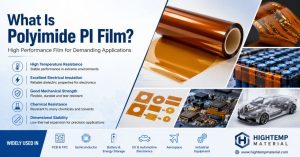
Polyimide, commonly abbreviated as PI, provides:
- High dielectric strength
- Thermal stability
- Mechanical strength
- Dimensional stability
- Flexibility at low thickness
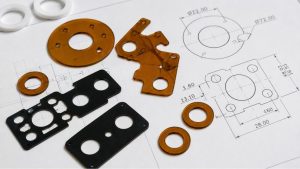
- Precision die-cutting capability
PI film is commonly used in:
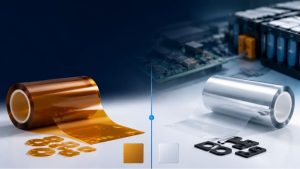
- PCB and FPC manufacturing
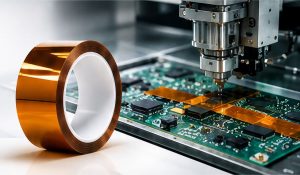
- SMT masking
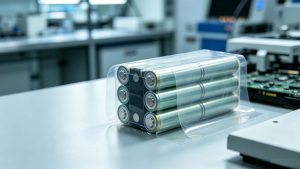
- Lithium battery insulation
- Motors and transformers
- Semiconductor equipment
- Aerospace electronics
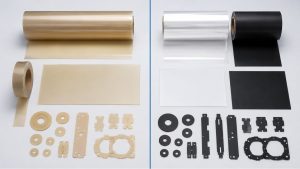
Available forms may include plain amber PI film, black matte PI film, anti-static ESD film, high-temperature PI tape and custom die-cut insulation pads.
PET Film
PET film provides a cost-effective balance of electrical insulation, dimensional stability and mechanical strength.
High-temperature PET products may include:
- Flame-retardant insulation film
- SMT reflow masking film
- PCB lamination release film
- Black matte insulation film
- Clear electrical isolation film
PET generally has a lower continuous-use temperature than PI, PTFE or PPS. Special grades may still be suitable for short high-temperature manufacturing cycles.
PPS Film
PPS film offers:
- High-temperature resistance
- Chemical stability
- Electrical insulation
- Low moisture absorption
- Dimensional stability
- Flame-retardant performance
It is used in automotive electronics, power modules, inverters, battery systems and high-voltage insulation.
PEN Film
PEN provides better thermal and dimensional performance than standard PET while maintaining good electrical insulation and mechanical strength.
Typical applications include:
- Solar PV modules
- Outdoor electrical insulation
- Lithium battery packaging
- Power electronics
- Inverters
- High-temperature labels
2. High-Temperature Elastomers
Elastomers are flexible materials used for sealing, cushioning, gap filling and vibration control.
Silicone Rubber
Silicone rubber remains flexible over a wide temperature range and provides good resistance to weathering, ozone and electrical stress.
Common forms include:
- Solid silicone rubber sheets
- Closed-cell silicone foam
- Thermally conductive silicone pads
- Silicone-coated fiberglass cloth
- Custom die-cut silicone gaskets
Silicone products are used in battery packs, electrical enclosures, PCB lamination equipment, power electronics and industrial seals.
FKM Fluorine Rubber
FKM is a high-performance elastomer offering strong resistance to heat, oils, fuels and many chemicals.
It is commonly used for:
- Gaskets
- O-rings
- Valve seals
- Pump components
- Chemical equipment
- Automotive systems
Depending on the compound, some FKM materials may be designed for operating environments from approximately 220°C to 300°C.
The exact limit depends on formulation, chemicals, pressure and exposure time.
3. Mica Insulation Materials
Mica is a mineral-based material with high-temperature resistance, electrical insulation and flame-resistant properties.
It can be supplied as:
- Rigid mica sheets
- Flexible mica sheets
- Mica plates
- Die-cut mica barriers
- Mica gaskets
- Terminal insulation parts
Mica is commonly used in:
- Electric heaters
- Battery modules
- Busbar insulation
- Industrial furnaces
- Electrical appliances
- High-voltage equipment
Mica is especially useful when electrical insulation and heat protection are both required.
4. Aerogel Thermal Insulation
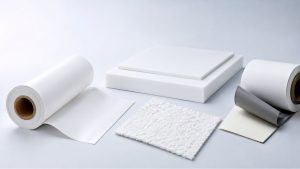
Aerogel composites are known for very low thermal conductivity.
They are often selected when a thin material must reduce heat transfer in a limited space.
Aerogel insulation pads may be used for:
- Lithium battery thermal barriers
- Energy storage systems
- Industrial pipelines
- High-temperature equipment
- Compact thermal protection
Aerogel products are often reinforced with fiberglass or other materials to improve handling and mechanical strength.
Aerogel is a thermal barrier. It should not be confused with a thermally conductive pad, which is designed to transfer heat toward a cooling component.
5. Fiberglass and High-Silica Materials
Fiberglass fabrics are lightweight, flexible and resistant to heat. Coatings can be added to improve chemical resistance, sealing or release performance.
Common products include:
- Fiberglass cloth
- Silicone-coated fiberglass cloth
- PTFE-coated fiberglass cloth
- High-silica fiberglass cloth
- Fiberglass ropes
High-silica fiberglass cloth is used in more demanding heat-protection applications such as:
- Welding blankets
- Fire curtains
- Furnace insulation
- Industrial heat shields
- Pipeline protection
Depending on its composition and construction, high-silica cloth may be suitable for operating environments around 900°C or short exposure to higher temperatures.
6. Ceramic Fiber Materials
Ceramic fiber materials provide high-temperature thermal insulation for industrial heating equipment.
Available forms include:
- Ceramic fiber board
- Ceramic fiber paper
- Ceramic fiber cotton
- Ceramic fiber rope
- Custom insulation components
Typical applications include:
- Furnaces
- Kilns
- Boilers
- Industrial ovens
- Heat-treatment equipment
- High-temperature door seals
Ceramic fiber products offer much higher temperature capability than most polymer materials, but they have different flexibility, handling and mechanical characteristics.
7. Basalt and Mineral Fiber Materials
Basalt fiber is produced from volcanic rock and provides useful heat resistance, mechanical strength and flame protection.
Basalt fiber fabric may be used for:
- Welding protection
- Fire blankets
- Battery fire protection
- Industrial heat shields
- Shipbuilding
- Aerospace thermal protection
Rock wool and aluminum silicate boards are also used for thermal insulation in industrial equipment, buildings, furnaces and pipelines.
High-Temperature Material Comparison
| Material | Main Strength | Common Applications |
|---|---|---|
| PTFE | Chemical resistance, low friction and non-stick surface | Seals, release films and chemical equipment |
| FEP | Heat sealability, transparency and chemical resistance | Laminates and protective insulation |
| PI | Thin electrical insulation and dimensional stability | PCB, electronics and battery components |
| PET | Cost-effective electrical insulation | Masking, release and component isolation |
| PPS | Heat resistance and chemical stability | Inverters, automotive electronics and batteries |
| PEN | Dimensional stability and outdoor durability | Solar PV and power electronics |
| Silicone | Flexibility, sealing and cushioning | Enclosures, battery packs and thermal management |
| FKM | Heat, oil and chemical resistance | Gaskets, pumps and valves |
| Mica | Electrical insulation and flame resistance | Heaters, batteries and high-voltage parts |
| Aerogel | Very low thermal conductivity | Battery and industrial thermal barriers |
| High-silica cloth | Flexible high-temperature protection | Welding, furnaces and fire curtains |
| Ceramic fiber | Extreme-temperature insulation | Kilns, boilers and industrial ovens |
| Basalt fiber | Heat resistance and mechanical strength | Fire blankets and industrial heat shields |
The table shows general material characteristics. Actual performance depends on grade, thickness, construction and operating conditions.
Important Properties to Understand
Maximum Operating Temperature
This is the highest recommended temperature under specific conditions. Confirm whether the value represents continuous, intermittent or short-term exposure.
Dielectric Strength
Dielectric strength describes a material’s ability to resist electrical breakdown.
It is important for:
- Battery insulation
- Motors
- Transformers
- Busbars
- PCB components
- Power electronics
Thermal Conductivity
Thermal conductivity describes how easily heat passes through a material.
Low thermal conductivity is desirable for insulation and thermal barriers. Higher thermal conductivity is desirable for thermal interface pads that move heat toward a heat sink.
Dimensional Stability
Dimensional stability describes how well the material maintains its size and shape during heat exposure.
It is especially important for thin films, precision die-cut parts and electronic components.
Chemical Resistance
Chemical compatibility must be evaluated when the material contacts oils, fuels, acids, alkalis, solvents, flux or cleaning agents.
Compression Set
Compression set indicates how much an elastomer fails to recover after being compressed.
It is important for foam pads, seals and gaskets.
Flame Resistance
Flame resistance describes how a material behaves when exposed to an ignition source.
A flame-retardant rating does not automatically confirm that the material is suitable for every finished product. Thickness, installation and component-level testing also matter.
High-Temperature Materials vs Fireproof Materials
These terms are related but not identical.
A high-temperature material can operate at elevated temperatures without necessarily being designed for direct flame exposure.
A fireproof or fire-resistant material is intended to resist ignition, flame spread or direct heat exposure for a specified period.
For example:
- PI film is a high-temperature electrical insulation material.
- PTFE is a high-temperature chemical-resistant polymer.
- Aerogel is a high-temperature thermal barrier.
- High-silica cloth is a flexible heat and flame protection material.
- Ceramic fiber board is an extreme-temperature insulation material.
Always match the material to the required function rather than relying only on a general description.
Common Forms of High-Temperature Materials
High-temperature materials are supplied in many forms:
- Rolls
- Films
- Tapes
- Sheets
- Boards
- Foams
- Fabrics
- Ropes
- Gaskets
- Washers
- Insulation pads
- Custom die-cut parts
The form is often just as important as the base material.
A material supplied as a custom die-cut component may be easier to install and more consistent than a standard sheet cut manually during assembly.
Where Are High-Temperature Materials Used?
Electronics and Semiconductors
PI, PET, PPS, PEN, PTFE and silicone materials protect PCBs, connectors, semiconductors, transformers and power modules.
Lithium Batteries and Energy Storage
PI, PET, PPS, mica, aerogel and silicone materials provide electrical insulation, thermal management, cushioning and thermal barriers.
Automotive and Power Electronics
High-temperature films, thermal pads and FKM seals are used in inverters, motors, battery modules, sensors and charging equipment.
Chemical Processing
PTFE and FKM are widely used for chemical-resistant seals, gaskets, liners and insulation parts.
Solar Photovoltaic Systems
UV-resistant PEN, PET, PPS, PI and silicone materials are used in PV modules, junction boxes, inverters and outdoor electrical equipment.
Industrial Furnaces and Heat Treatment
Ceramic fiber, high-silica cloth, basalt fabric, mica and aerogel help reduce heat loss and protect surrounding equipment.
SMT and PCB Manufacturing
PI tape, high-temperature PET masking film, PTFE release materials and silicone press cushions protect surfaces during soldering, coating and lamination.
How to Select a High-Temperature Material
Step 1: Define the Temperature
Identify:
- Continuous operating temperature
- Maximum peak temperature
- Exposure time
- Number of thermal cycles
- Heating and cooling rate
Step 2: Define the Primary Function
Determine whether the material must provide:
- Electrical insulation
- Thermal insulation
- Heat transfer
- Sealing
- Cushioning
- Chemical resistance
- Flame protection
- Release performance
Step 3: Check the Environment
Consider:
- Chemicals
- Moisture
- UV radiation
- Pressure
- Vibration
- Abrasion
- Electrical voltage
- Outdoor exposure
Step 4: Determine the Required Form
Decide whether you need a roll, film, tape, gasket, sheet, board, foam or custom die-cut component.
Step 5: Test the Material
A datasheet is a useful starting point, but it cannot reproduce every application.
Samples should be tested under the actual temperature, pressure, chemical, electrical and mechanical conditions before mass production.
Common Selection Mistakes
| Mistake | Why It Causes Problems | Better Approach |
|---|---|---|
| Selecting only by maximum temperature | The rating may represent only short exposure | Confirm continuous temperature and exposure time |
| Ignoring mechanical load | Some materials creep or deform under pressure | Review strength, compression and dimensional stability |
| Confusing insulation with heat transfer | The two functions require opposite thermal behavior | Define whether heat should be blocked or transferred |
| Ignoring adhesive performance | The backing may survive while the adhesive fails | Evaluate the complete tape construction |
| Assuming all grades are identical | Fillers, coatings and thickness affect performance | Review the exact grade and datasheet |
| Skipping application testing | Laboratory values may not reflect the finished component | Test samples in the real assembly |
Custom Converting Services
High-temperature materials can be converted into parts that match the finished product or manufacturing process.
Available options may include:
- Precision die cutting
- CNC cutting
- Slitting and rewinding
- Sheet cutting
- Kiss cutting
- Adhesive lamination
- Multilayer lamination
- Hole and slot cutting
- Protective liner application
- Prototype sample production
For an accurate recommendation, provide a drawing, material thickness, dimensions, tolerance, temperature, application and order quantity.
Frequently Asked Questions
What is considered a high-temperature material?
A high-temperature material is designed to retain its required thermal, electrical, mechanical or chemical properties at temperatures beyond the capability of conventional materials.
What is the best high-temperature material?
There is no single best material. PTFE is strong in chemical resistance and low friction, PI provides thin electrical insulation, silicone offers sealing and flexibility, and ceramic fiber provides extreme-temperature insulation.
Which plastic has the best heat resistance?
PTFE, PI, PPS, FEP and other engineering polymers provide different types of heat resistance. The best choice depends on temperature, mechanical load, chemicals and electrical requirements.
What is the difference between a high-temperature film and a thermal barrier?
A high-temperature film is a thin material designed to remain stable under heat. A thermal barrier is designed specifically to reduce heat transfer.
Can high-temperature materials provide electrical insulation?
Yes. PI, PTFE, PET, PPS, PEN, mica and certain silicone products are widely used for electrical insulation.
Are high-temperature and flame-retardant materials the same?
No. A material can tolerate elevated temperatures without meeting a specific flame-retardant classification. Always review the required test standard and material grade.
Can high-temperature materials be custom die cut?
Yes. Films, tapes, silicone, FKM, mica and aerogel composites can be converted into custom components according to drawings or samples.
What information should I send to a material supplier?
Provide the operating temperature, exposure time, application, dimensions, thickness, voltage, chemicals, mechanical conditions, adhesive requirements and expected quantity.
Conclusion
High-temperature materials are an essential part of modern electronics, energy systems, industrial equipment and advanced manufacturing.
They include high-performance polymer films, elastomers, mineral insulation, aerogel composites and heat-resistant fabrics. Each material offers a different balance of temperature resistance, electrical insulation, chemical stability, mechanical strength and thermal performance.
The correct material is not always the one with the highest temperature rating. It is the one that maintains the required properties under the complete operating conditions.
We supply high-temperature films, tapes, silicone materials, sealing products, mica, aerogel, fireproof fabrics and precision die-cut components for industrial applications.
Contact us with your operating temperature, drawings, material thickness and performance requirements. Our team can help recommend suitable materials and provide custom samples for evaluation.
Recommended Internal Links
Add internal links from this article to:
- High Temperature Materials: Key to Reliability in Advanced Manufacturing
- PTFE vs PI: Which Material Is Right for You?
- Skived Pure PTFE Film
- FEP High Temperature Film
- Plain PI Kapton Base Film
- High Temperature PI Kapton Tape
- Flame Retardant PPS Film
- UV Resistant PEN Insulation Film
- Closed Cell Silicone Foam Pad
- FKM Fluorine Rubber Gasket
- Mica Sheet & Die Cut Mica Gasket
- Aerogel Thermal Insulation Pad
- High Silica Fiberglass Cloth
- Ceramic Fiber Board, Paper and Cotton
- Basalt Fiber Fireproof Fabric