

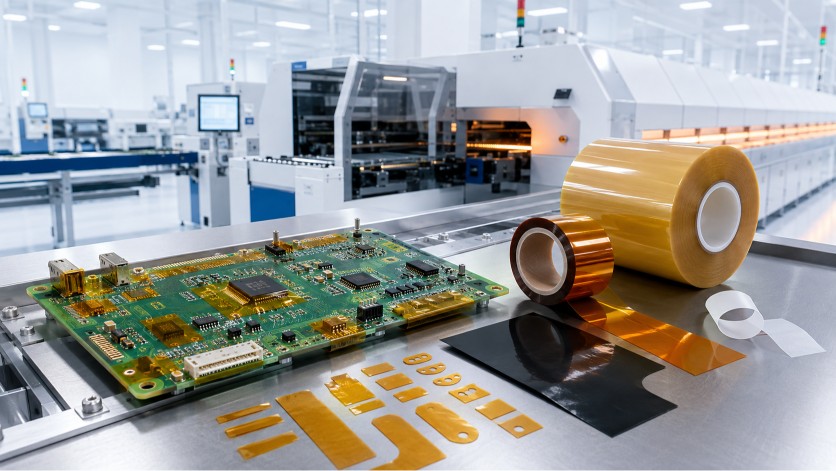
Surface mount technology has enabled electronics manufacturers to produce smaller, faster and more complex devices. However, SMT assembly exposes printed circuit boards, connectors and electronic components to heat, chemicals, electrostatic discharge and mechanical stress.
During reflow soldering, PCB assemblies pass through controlled heating zones that melt solder paste and form electrical connections. Sensitive areas must remain protected throughout this process without adhesive residue, film shrinkage or contamination.
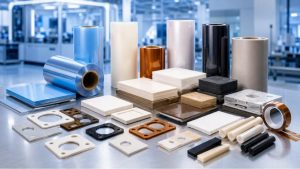
High-temperature masking films, tapes, insulation pads and release materials are therefore essential to reliable SMT production.
This guide examines seven material solutions for SMT high-temperature protection and explains how to select the right material for reflow soldering, wave soldering, PCB coating, electroplating and electronic component protection.
Why SMT Assembly Requires High-Temperature Materials
A typical SMT production process may include:
- Solder paste printing
- Component placement
- Reflow soldering
- Automated optical inspection
- Wave or selective soldering
- Cleaning
- Conformal coating
- Functional testing
- Final assembly
During these processes, the PCB and protective materials may be exposed to rapidly changing temperatures, flux, solder paste, cleaning agents and handling operations.
An unsuitable masking material can cause:
- Film shrinkage
- Adhesive transfer
- Lifted tape edges
- Solder leakage
- Contaminated contacts
- Damaged connectors
- Discolored surfaces
- Electrostatic damage
- Difficult tape removal
- Increased rework
The right material must survive the complete process while maintaining dimensional stability, adhesion and clean removability.
Key Requirements for SMT Protection Materials
Short-Term Temperature Resistance
Lead-free reflow soldering commonly involves higher peak temperatures than traditional tin-lead processes. Protective films and adhesives must withstand the actual thermal profile, including preheating, soaking, peak exposure and cooling.
The maximum temperature printed on a datasheet is not enough by itself. Engineers should also check how long the material can tolerate that temperature.
A material rated for short-term exposure to 260°C may not be suitable for continuous operation at the same temperature.
Dimensional Stability
Masking film must remain flat and stable during rapid heating. Excessive shrinkage can expose gold fingers, terminals or other areas intended to remain protected.
Adhesive Performance
The adhesive must provide sufficient holding force during processing but still remove cleanly afterward.
Important adhesive characteristics include:
- Initial tack
- Peel strength
- High-temperature holding power
- Resistance to edge lifting
- Clean removability
- Resistance to adhesive residue
- Compatibility with PCB finishes
Chemical Resistance
SMT protection materials may contact:
- Solder paste
- Flux
- Isopropyl alcohol
- Cleaning agents
- Conformal coatings
- Electroplating chemicals
- Process solvents
Chemical compatibility should be tested under the actual temperature and exposure conditions.
ESD Control
Sensitive electronic components can be damaged by electrostatic discharge during handling and assembly.
Anti-static films may be required in cleanrooms, semiconductor production, PCB/FPC manufacturing and component packaging.
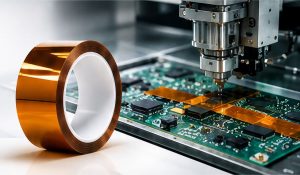
1. High-Temperature PI Tape
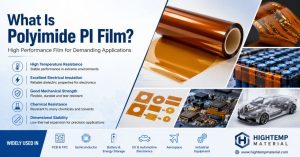
Polyimide tape is one of the most widely used protection materials in electronics manufacturing.
It normally consists of an amber polyimide film coated with high-temperature silicone adhesive. The PI backing provides thermal stability, dielectric strength and mechanical strength, while the adhesive keeps the tape securely positioned.
Advantages of PI Tape
High-temperature PI tape can provide:
- High-temperature resistance
- Excellent electrical insulation
- Good dimensional stability
- Strong mechanical performance
- Conformability to PCB surfaces
- Clean removal with a suitable adhesive
- Compatibility with precision slitting and die cutting
SMT Applications
PI tape is commonly used for:
- SMT reflow protection
- Wave solder masking
- Gold finger protection
- Connector masking
- FPC protection
- Component fixing
- PCB edge masking
- Transformer and coil insulation
- Powder-coating masking
- Battery component protection
PI tape is especially useful for complex PCB areas requiring flexible, narrow or precisely die-cut masking.
Selection Considerations
When selecting PI tape, review:
- Film thickness
- Total tape thickness
- Adhesive type
- Peel strength
- Maximum short-term temperature
- Removal temperature
- Required width
- Surface cleanliness
- Soldering cycle duration
PI tape should be tested on the actual PCB finish because adhesive behavior may differ on copper, gold plating, solder mask and plastic connectors.
2. SMT Reflow High-Temperature PET Masking Film
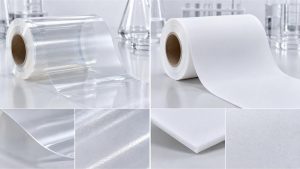
High-temperature PET masking film provides an alternative for applications requiring dimensional stability, larger-area protection and cost-effective processing.
SMT PET masking film may use a high-temperature silicone adhesive and release-treated surface. Certain grades are designed for short-term reflow exposure up to approximately 260°C.
This temperature capability must be understood as short-term process resistance rather than continuous operating performance.
Key Advantages
SMT PET masking film can provide:
- Stable masking during reflow
- Good dimensional control
- Chemical resistance
- Clean removal
- Low adhesive residue
- Smooth surface
- Precision slitting
- Large-area coverage
- Cost-effective production
Typical Applications
Applications include:
- SMT reflow soldering
- Wave soldering
- PCB coating masking
- Gold finger protection
- Electroplating
- Powder coating
- Electronic component protection
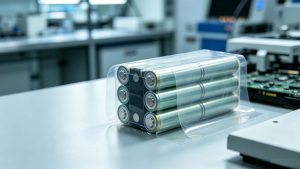
- Battery module protection
Available total thicknesses may include:
- 25 μm
- 36 μm
- 50 μm
- 75 μm
- 100 μm
Widths, lengths and roll cores can be customized according to the production line.
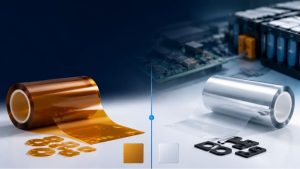
PET Film vs PI Tape
PET masking film may be preferred for larger, flatter areas and cost-sensitive production.
PI tape is generally preferred when higher thermal stability, thin-film strength or complex masking geometry is required.
The final choice should be based on the complete thermal profile and actual surface.
3. Anti-Static ESD PI Film
Thermal protection is only one part of SMT process control. Electrostatic discharge can damage semiconductors and sensitive electronic components even when no visible damage occurs.
Anti-static PI film combines high-temperature performance with controlled surface resistance.
Depending on the grade, surface resistance may be designed within approximately 10⁶–10⁹ Ω/sq and can be customized for specific applications.
Main Properties
Anti-static PI film can provide:
- ESD protection
- High-temperature resistance
- Electrical insulation
- Dimensional stability
- Chemical resistance
- Low particle generation
- Mechanical strength
- Cleanroom compatibility
Typical Applications
Anti-static PI film is suitable for:
- PCB and FPC production
- Semiconductor processing
- Electronic component protection
- Cleanroom manufacturing
- SMT assembly
- High-temperature ESD barriers
- Precision die-cut components
- Temporary process protection
Engineers should confirm whether the material must be conductive, dissipative or insulating. These categories have different surface-resistance ranges and should not be treated as interchangeable.
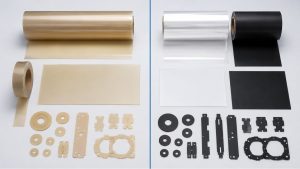
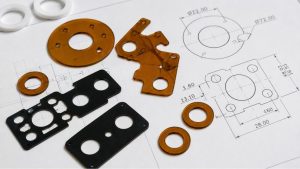
4. Plain PI Film and Custom Die-Cut PI Parts
Plain PI film is used when electrical insulation and thermal stability are required without a pressure-sensitive adhesive.
It can be converted into custom shapes for:
- Component isolation
- Terminal barriers
- Connector protection
- PCB insulation
- Test fixture insulation
- Motor and coil insulation
- Electronic assembly spacers
Benefits of Custom Die Cutting
Precision die cutting allows PI film to be supplied with:
- Small holes
- Narrow edges
- Complex profiles
- Positioning slots
- Adhesive backing
- Release liners
- Multilayer constructions
Custom parts reduce manual cutting and improve repeatability during electronic assembly.
For accurate production, drawings should specify thickness, dimensions, tolerance, hole positions and adhesive requirements.
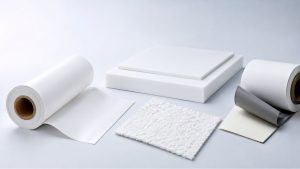
5. PTFE Film and PTFE-Coated Fiberglass Cloth
PTFE provides chemical resistance, electrical insulation, low friction and non-stick performance.
Unlike PI and PET masking films, PTFE is especially useful when the primary requirement is release performance or resistance to process chemicals.
Typical Forms
PTFE materials for electronics manufacturing may include:
- Skived PTFE film
- High-temperature PTFE adhesive tape
- PTFE-coated fiberglass cloth
- Custom PTFE washers
- Custom PTFE gaskets
- PTFE release sheets
SMT and PCB Applications
Potential applications include:
- Non-stick process surfaces
- Soldering fixture insulation
- Chemical-resistant barriers
- Heat-press release sheets
- Conveyor and guide surfaces
- Custom insulating washers
- PCB lamination release components
PTFE has low surface energy, which creates excellent non-stick properties but also makes the material difficult to bond. Adhesive-backed PTFE products may require surface treatment and a specialized adhesive system.
PTFE-coated fiberglass cloth provides better dimensional stability than unsupported PTFE film and is useful in heat-processing and release applications.
6. FEP Film and FEP-Laminated PI Film
FEP is a fluoropolymer offering chemical resistance, electrical insulation, low friction, transparency and heat sealability.
It is softer and more easily heat bonded than PTFE.
FEP Film Applications
FEP film may be used for:
- Release layers
- Chemical-resistant protection
- Electrical insulation
- Heat-sealable covers
- Protective lamination
- High-temperature processing surfaces
FEP-Laminated PI Film
FEP-laminated PI film combines the mechanical and thermal properties of PI with a heat-sealable fluoropolymer surface.
Potential benefits include:
- Thermal stability
- Dielectric insulation
- Chemical resistance
- Heat-sealable surface
- Improved release properties
- Multilayer insulation capability
This composite material may be suitable for electronic insulation and lamination applications requiring properties that cannot be provided by a single film.
The correct lamination temperature and pressure must be established through testing.
7. Silicone Materials for Thermal and Mechanical Protection
Silicone materials are used where SMT equipment or electronic assemblies require cushioning, sealing, pressure distribution or thermal management.
Relevant products include:
- Solid silicone rubber sheets
- Closed-cell silicone foam pads
- Thermally conductive silicone sheets
- Silicone-coated fiberglass cloth
- Custom die-cut silicone components
Thermally Conductive Silicone Pads
Thermally conductive silicone pads fill air gaps between heat-generating components and cooling structures.
They may be installed around:
- Power modules
- Heat sinks
- LED assemblies
- Power supplies
- Control electronics
- Battery management systems
Silicone Foam
Closed-cell silicone foam provides:
- Cushioning
- Vibration absorption
- Gap filling
- Pressure distribution
- Dust and moisture sealing
- Component protection
Silicone-Coated Fiberglass Cloth
Silicone-coated fiberglass cloth combines the strength of fiberglass fabric with a flexible, heat-resistant silicone surface.
It may be used for:
- Equipment insulation
- Removable thermal barriers
- Protective covers
- Flexible sealing
- Heat-processing equipment
Thermally conductive silicone and thermal insulation materials perform opposite functions. The first transfers heat; the second reduces heat transfer.
SMT Protection Material Comparison
| Material | Main Function | Typical Applications |
|---|---|---|
| PI tape | High-temperature masking and electrical insulation | Reflow, wave soldering and connector masking |
| High-temperature PET masking film | Stable, cost-effective area masking | Reflow, coating, electroplating and surface protection |
| Anti-static PI film | ESD control and heat resistance | Cleanrooms, semiconductors and sensitive electronics |
| Plain PI film | Thin electrical insulation | Die-cut barriers, PCB insulation and component separation |
| PTFE film | Chemical resistance and low friction | Fixtures, washers and non-stick protection |
| PTFE-coated fiberglass cloth | Release performance and dimensional stability | Heat processing and PCB lamination |
| FEP film | Chemical resistance and heat sealability | Release layers and protective lamination |
| Silicone pad | Heat transfer, cushioning or sealing | Power electronics and assembled components |
Actual performance depends on material grade, thickness, adhesive, temperature profile and process conditions.
Material Selection by SMT Process
Reflow Soldering
Recommended options may include:
- PI high-temperature tape
- SMT high-temperature PET masking film
- Custom die-cut PI masking parts
- Anti-static PI film for ESD-sensitive environments
The material must withstand the complete reflow profile and remove cleanly after cooling.
Wave Soldering
Wave solder masking requires strong adhesion and resistance to soldering temperatures, flux and process chemicals.
PI tape and high-temperature PET masking film are commonly considered.
The tape edge must remain securely bonded to prevent solder penetration.
Conformal Coating
Masking materials protect connectors, test points, contacts and grounding areas from coating.
PET or PI masking products should be selected according to coating chemistry, curing temperature and removal requirements.
Electroplating
Electroplating masking requires chemical resistance, strong edge sealing and clean removal.
The adhesive and backing must resist the plating solution and process temperature.
Powder Coating
PI tape and suitable high-temperature PET masking film can protect electronic housings, contacts and grounding areas during powder-coating processes.
PCB Lamination
PTFE-coated fiberglass cloth, PET release film, FEP film and silicone press cushions may be used to support release, pressure distribution and process protection during PCB/FPC lamination.
Common SMT Masking Problems and Solutions
| Problem | Possible Cause | Recommended Action |
|---|---|---|
| Adhesive residue | Excessive heat, unsuitable adhesive or long dwell time | Select a suitable silicone adhesive and test the complete thermal cycle |
| Tape edge lifting | Low adhesion, contaminated surface or tight corner | Clean the surface and use a more conformable material |
| Film shrinkage | Material lacks thermal stability | Use PI or qualified high-temperature PET film |
| Solder leakage | Incomplete edge sealing | Improve tape placement or use a precision die-cut mask |
| Difficult removal | Excessive adhesion or incorrect removal temperature | Adjust adhesive grade and removal process |
| PCB contamination | Adhesive degradation or chemical incompatibility | Test the film against flux, solder paste and cleaning agents |
| ESD damage | Standard insulating film used in an ESD-sensitive area | Use a suitable anti-static or dissipative material |
| Component movement | Insufficient holding power | Select the correct tape thickness and high-temperature holding strength |
How to Select the Right SMT Masking Material
1. Review the Thermal Profile
Provide:
- Maximum temperature
- Time above the critical temperature
- Number of heating cycles
- Heating and cooling rate
- Removal temperature
2. Identify the Protected Surface
Confirm whether the tape will contact:
- Solder mask
- Copper
- Gold fingers
- Tin plating
- Plastic connectors
- Ceramic components
- Metal housings
3. Check Chemical Exposure
List the solder paste, flux, cleaning agent, coating or plating chemicals used in the process.
4. Define Adhesive Requirements
Determine the required holding strength, clean-removal performance and permitted residue level.
5. Confirm ESD Requirements
For sensitive components, specify the required surface resistance and whether the material must be anti-static, static-dissipative or electrically insulating.
6. Determine Dimensions and Format
Materials can be supplied as:
- Jumbo rolls
- Slit rolls
- Sheets
- Discs
- Frames
- Tabs
- Custom die-cut parts
- Adhesive-backed insulation pads
Benefits of Precision-Converting SMT Materials
Custom converting helps improve production efficiency and masking consistency.
Available processes may include:
- Precision die cutting
- Slitting and rewinding
- Sheet cutting
- Kiss cutting
- Adhesive lamination
- Multilayer lamination
- Hole and slot cutting
- Release liner application
- Prototype sample production
Pre-cut components can reduce operator variation, simplify placement and improve coverage around complex PCB features.
Frequently Asked Questions
Which material is best for SMT reflow masking?
PI tape and qualified high-temperature PET masking film are commonly used. PI is preferred for demanding temperatures and complex shapes, while PET may offer stable and cost-effective large-area protection.
Can PET film withstand 260°C reflow soldering?
Certain specialized PET masking films are designed for short-term reflow exposure up to approximately 260°C. This does not mean the film is suitable for continuous operation at that temperature.
What is the difference between PI tape and PET masking film?
PI tape generally provides stronger high-temperature performance and thin-film mechanical strength. PET masking film can provide good dimensional stability and cost-effective area coverage.
How can adhesive residue be prevented?
Select an adhesive designed for the actual temperature and surface, control the heating duration and test removal at the recommended temperature.
What material is suitable for ESD-sensitive SMT processes?
Anti-static or static-dissipative PI film may be used. The required surface-resistance range should be confirmed before selection.
Can SMT masking materials be custom die cut?
Yes. PI, PET, PTFE, FEP and silicone materials can be converted into custom shapes according to PCB drawings or samples.
Is PTFE tape suitable for PCB masking?
PTFE tape can be suitable when chemical resistance or non-stick performance is required. PI tape is more commonly used for precision PCB masking during reflow and wave soldering.
What information is needed for material selection?
Provide the maximum temperature, heating time, PCB surface, chemical exposure, dimensions, adhesive requirements and ESD requirements.
Conclusion
Reliable SMT assembly depends on protection materials that can withstand heat, chemicals, electrical stress and demanding production conditions.
PI tape provides high-temperature masking and electrical insulation. Specialized PET masking film offers stable and cost-effective protection during reflow, coating and electroplating. Anti-static PI film supports ESD control, while PTFE and FEP provide chemical resistance and release properties. Silicone materials support thermal management, cushioning and sealing.
The best material should be selected according to the complete thermal profile, surface type, adhesive requirements, chemical exposure and finished component geometry.
We supply high-temperature PI tapes, SMT PET masking films, anti-static PI films, fluoropolymer materials, silicone components and precision die-cut insulation parts for PCB, FPC, semiconductor and electronic assembly applications.
Contact us with your process temperature, PCB drawing, masking area, material thickness and adhesive requirements. Our team can help recommend a suitable material and provide custom samples for process testing.
Recommended Internal Links
Add internal links from this article to the following product pages:
- High Temperature PI Kapton Tape
- SMT Reflow High Temp PET Masking Film
- Anti-static ESD PI Film
- Plain PI Kapton Base Film
- Custom Die Cut PI Insulation Pad
- PCB/FPC Lamination PET Release Film
- FEP Composite Laminated PI Film
- FEP High Temperature Film
- High Temp PTFE Adhesive Tape
- Fiberglass Reinforced PTFE Coated Cloth
- Closed Cell Silicone Foam Pad
- Thermal Conductive Silicone Sheet