


Table of Contents
1. What Is PPS Film?
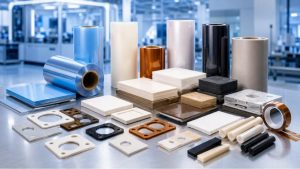
PPS film is a high-performance thermoplastic film made from polyphenylene sulfide.
It belongs to the super-engineering plastic family and is valued for its combination of:
- High-temperature resistance.
- Electrical insulation.
- Dimensional stability.
- Chemical resistance.
- Moisture and hydrolysis resistance.
- Inherent flame resistance.
- Low dielectric loss in suitable grades.
- Stability under demanding environmental conditions.
Commercial PPS film is available in a more specialized and limited supply chain than PET film. Toray describes its Torelina™ PPS film as a biaxially oriented PPS film developed for applications requiring heat resistance, flame retardancy, chemical resistance, and electrical characteristics. Toray also states that it can be used for longer periods in high-temperature ranges than PET film. Toray Films – Torelina™ PPS Film
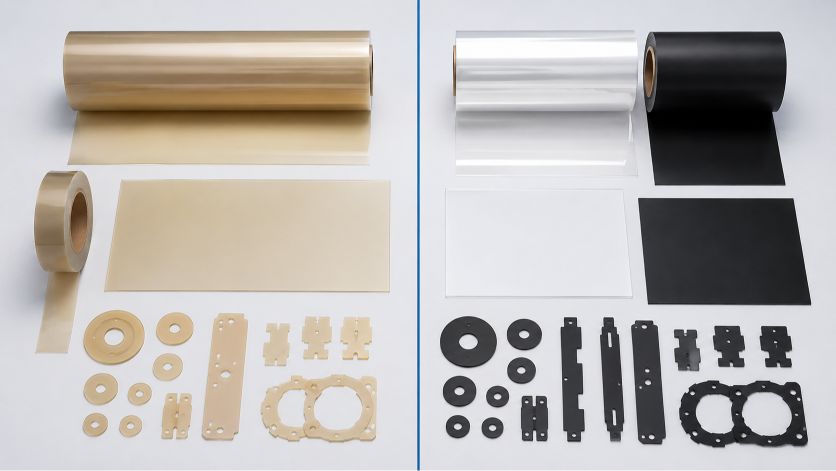
PPS film may be supplied as:
- Plain PPS insulation film.
- Flame-resistant PPS film.
- Electrical-grade PPS film.
- PPS adhesive tape.
- PPS/PET/PPS laminated insulation.
- Slit PPS film rolls.
- Custom die-cut PPS insulation parts.
Typical applications include:
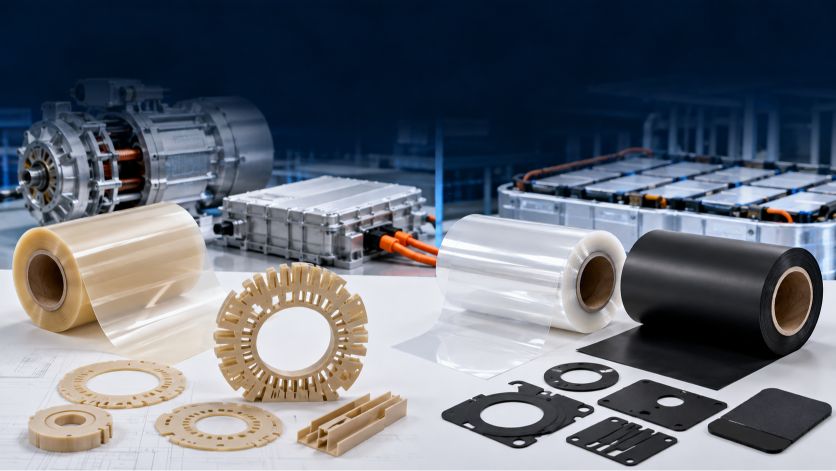
- Electric motor insulation.
- Transformer insulation.
- EV powertrain components.
- Battery insulation.
- Flexible flat cables.
- Flexible printed circuits.
- Power electronics.
- Wire and cable insulation.
- Adhesive-backed high-temperature insulation parts.
PPS film should not be confused with molded PPS resin components. Although they share the same polymer family, film orientation, thickness, processing, and material-grade design influence the final properties.
2. What Is PET Film?
PET film is a polyester film manufactured from polyethylene terephthalate.
It is one of the most widely used polymer films for electrical insulation because it provides a practical balance of:
- Electrical insulation.
- Mechanical strength.
- Dimensional consistency.
- Processability.
- Broad thickness availability.
- Surface treatment options.
- Material availability.
- Cost efficiency.
PET insulation films are available in many constructions, including:
- Clear PET film.
- Milky-white PET film.
- Black PET film.
- Matte PET film.
- Flame-retardant PET film.
- Anti-static PET film.
- Adhesive-backed PET film.
- Silicone-coated PET release film.
- Custom die-cut PET insulation parts.
PET film is commonly used in:
- Motors and transformers.
- Battery modules.
- Electrical barriers.
- Electronic assemblies.
- Insulation labels.
- Die-cut spacers.
- Flexible circuits.
- Industrial laminates.
- Protective films.
Mylar Specialty Films lists PET film applications that include slot liners and electrical insulation, flexible electronics, and photovoltaic products. However, the exact grade should always be confirmed because packaging PET and electrical-grade PET are not automatically interchangeable. Mylar Specialty Films
3. PPS vs PET Film: Quick Comparison
The following table presents a general material comparison.
Actual performance depends on the exact grade, thickness, test method, surface treatment, adhesive construction, and operating environment.
PPS film is not automatically necessary for every electrical insulation application.
If a qualified PET film meets the required temperature, dielectric, mechanical, and compliance conditions, PET may provide a more economical solution.
| Property | PPS Film | PET Film |
|---|---|---|
| Full material name | Polyphenylene sulfide | Polyethylene terephthalate |
| Material category | Super-engineering thermoplastic | Engineering polyester |
| Typical appearance | Natural, translucent, beige, brown, or grade-dependent | Clear, white, black, matte, or grade-dependent |
| Temperature resistance | Generally higher | Suitable for moderate-temperature applications |
| Long-term thermal stability | Better under demanding high-temperature conditions | Grade-dependent and generally lower than PPS |
| Electrical insulation | Excellent for demanding electrical environments | Reliable within qualified operating conditions |
| Moisture resistance | Excellent | Good, but prolonged heat and moisture require evaluation |
| Hydrolysis resistance | Generally stronger | More grade- and condition-dependent |
| Chemical resistance | Excellent against many industrial chemicals | Good for many general applications |
| Inherent flame resistance | An important advantage of PPS | Requires grade-specific verification |
| Dimensional stability at elevated temperature | Generally better | Good within the intended temperature range |
| Flexibility | Suitable for thin insulation and laminates | Good flexibility and handling |
| Availability | Specialized and more limited | Broadly available |
| Cost | Generally higher | Generally lower |
| Custom converting | Slitting, die cutting, laminating, adhesive converting | Slitting, die cutting, laminating, adhesive converting |
| Typical selection reason | Heat, chemicals, hydrolysis, flame performance | Cost, availability, standard electrical insulation |
4. Temperature Resistance and Thermal Aging
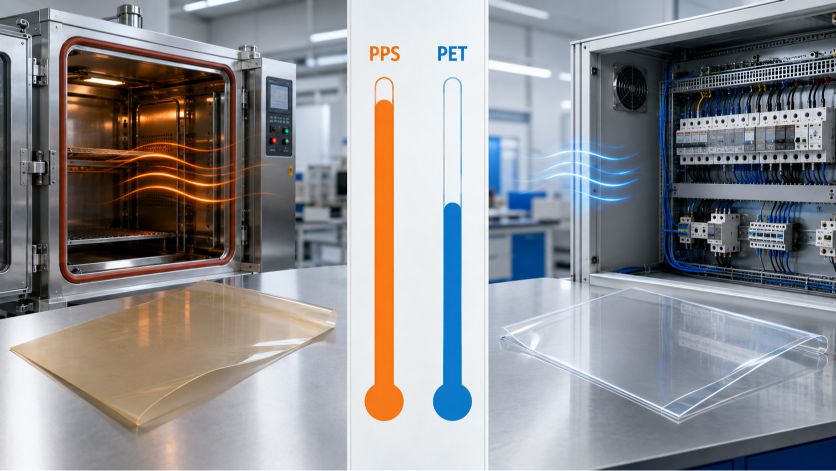
Temperature resistance is one of the most important differences between PPS and PET film.
However, buyers should not compare materials using only one “maximum temperature” value.
A technical comparison should distinguish between:
- Continuous operating temperature.
- Short-term peak temperature.
- Manufacturing-process temperature.
- Exposure duration.
- Thermal cycling.
- Heat aging.
- Film shrinkage.
- Mechanical load during heating.
- Adhesive temperature resistance.
PPS Film at Elevated Temperatures
PPS film is generally better suited to long-term use in high-temperature environments than PET film.
Toray describes PPS as a crystalline polymer with a melting point around 280°C and notes that PPS film provides heat resistance, electrical characteristics, dimensional stability, and flame resistance. These polymer-level figures should not be interpreted as the allowable continuous operating temperature of every PPS film grade. Toray – PPS Film for 5G Circuit Boards
The allowable service temperature of a finished insulation component depends on:
- Film grade.
- Film thickness.
- Electrical requirements.
- Mechanical stress.
- Exposure time.
- Adhesive or lamination layers.
- Required performance after aging.
PPS film may be considered when PET film experiences excessive:
- Shrinkage.
- Warping.
- Loss of mechanical strength.
- Electrical property changes.
- Adhesive failure.
- Premature thermal aging.
PET Film at Elevated Temperatures
PET film provides reliable performance in many electrical insulation applications but generally has lower high-temperature capability than PPS film.
Its suitability depends heavily on the grade.
Standard, heat-stabilized, electrical-grade, and flame-retardant PET films can have different:
- Heat shrinkage.
- Thermal endurance.
- Mechanical retention.
- Electrical characteristics.
- Surface properties.
PET film may still be the better choice when operating and manufacturing temperatures remain comfortably within the qualified limits of the selected grade.
Peak Temperature Is Not Continuous Temperature
A film that survives a short manufacturing cycle at an elevated temperature is not necessarily suitable for continuous operation at that temperature.
Before selecting PPS or PET, confirm:
- Normal operating temperature.
- Maximum abnormal temperature.
- Peak process temperature.
- Exposure time.
- Number of thermal cycles.
- Acceptable dimensional change.
- Required electrical performance after aging.
The same evaluation must be applied to any adhesive, coating, release liner, or laminated layer.
5. Electrical Insulation Performance
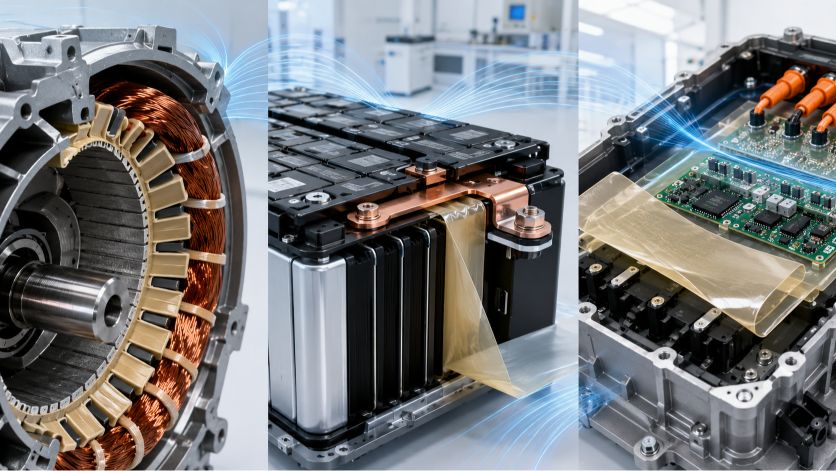
Both PPS and PET films can provide electrical insulation.
The correct choice depends on the required dielectric performance and the conditions under which that performance must be maintained.
Important properties include:
- Dielectric strength.
- Breakdown voltage.
- Dielectric constant.
- Dissipation factor.
- Volume resistivity.
- Surface resistivity.
- Tracking resistance.
- Performance under humidity.
- Performance after thermal aging.
- Film thickness.
PPS Film Electrical Characteristics
PPS film is valued for maintaining electrical performance in environments involving high temperature, moisture, or industrial chemicals.
Toray identifies electrical characteristics and low dielectric loss as important features of PPS film and lists applications including flexible circuits, printed circuit boards, motors, cables, and lithium-ion battery insulation. Toray Films – PPS Film
PPS may therefore be considered for:
- Motor winding insulation.
- High-temperature electrical barriers.
- Power-electronics components.
- Flexible printed circuits.
- High-frequency electronic applications.
- Insulation near heat-generating components.
However, dielectric values must be taken from the data sheet for the exact film grade and thickness.
PET Film Electrical Characteristics
Electrical-grade PET film is widely used in motors, transformers, batteries, and electronic assemblies.
It can provide a strong balance of:
- Breakdown resistance.
- Mechanical strength.
- Thickness consistency.
- Converting efficiency.
For moderate-temperature applications, PET may satisfy electrical requirements without the additional cost of PPS.
Thickness Must Be Considered
Dielectric strength and breakdown voltage are related but are not the same measurement.
A thin film may show a high dielectric-strength value expressed per unit of thickness, while a thicker film may withstand a higher total voltage.
When requesting material, specify:
- Nominal thickness.
- Minimum breakdown voltage.
- Test method.
- Test environment.
- Conditioning requirements.
- Whether testing applies before or after thermal aging.
- Whether adhesive is included.
Comparing PPS and PET without matching thickness and test conditions can produce misleading conclusions.
6. Dimensional Stability and Mechanical Properties
Electrical insulation films must remain stable during slitting, die cutting, installation, and operation.
Relevant mechanical considerations include:
- Tensile strength.
- Elongation.
- Tear behavior.
- Puncture resistance.
- Creep resistance.
- Heat shrinkage.
- Thickness uniformity.
- Folding performance.
- Edge quality after cutting.
PPS Film Dimensional Stability
PPS film is generally advantageous when the part must retain its dimensions during elevated-temperature exposure.
This can be important for:
- Precision motor insulation.
- Narrow electrical-clearance designs.
- Flexible circuits.
- Power modules.
- Components requiring accurate hole alignment.
- Multi-layer laminated insulation.
PPS also offers good creep resistance, which can be valuable when the insulation remains under mechanical pressure at elevated temperatures.
PET Film Dimensional Stability
PET film provides good dimensional consistency within its intended temperature range.
It is particularly suitable for:
- Flat insulation barriers.
- Slot liners.
- Insulating washers.
- Adhesive-backed labels.
- Battery-cell pads.
- High-volume die-cut components.
PET film is broadly available in standard thicknesses, which can simplify material sourcing and production planning.
Film Orientation Matters
Many technical films are oriented during production.
Orientation can affect:
- Machine-direction shrinkage.
- Transverse-direction shrinkage.
- Tensile strength.
- Tear behavior.
- Cutting performance.
For precision die-cut parts, request shrinkage and dimensional-stability information in both film directions.
7. Moisture, Hydrolysis, and Chemical Resistance
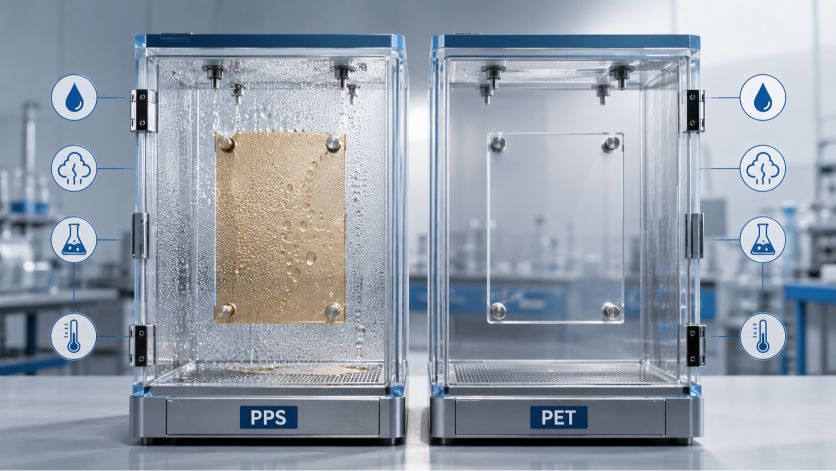
Electrical insulation components may be exposed to:
- Humidity.
- Hot water.
- Coolants.
- Oils.
- Cleaning chemicals.
- Acids and alkalis.
- Solvents.
- Battery-related chemicals.
- Condensation.
PPS Film
PPS generally provides strong resistance to moisture, hydrolysis, oils, and many industrial chemicals.
This is an important advantage in:
- Automotive motors.
- EV powertrain systems.
- Industrial pumps.
- High-humidity equipment.
- Fuel-cell components.
- Battery systems.
- Chemical-processing equipment.
Toray highlights PPS film’s hydrolysis resistance and long-term heat-and-humidity durability, while its technical information also emphasizes chemical resistance and dimensional stability under demanding environmental conditions. Toray PPS Technical Information
PET Film
PET film provides useful moisture and chemical resistance for many standard applications.
However, prolonged exposure to combined heat and moisture can require closer evaluation.
The result depends on:
- PET grade.
- Temperature.
- Humidity.
- Exposure duration.
- Mechanical stress.
- Chemical concentration.
- Film processing history.
When hot, humid service conditions are critical, request hydrolysis-aging data rather than relying only on room-temperature properties.
Test the Complete Construction
Adhesives and coatings may be more sensitive than the base film.
A PPS carrier film does not guarantee that an adhesive-backed PPS part will survive the same chemical or temperature exposure as the plain film.
Test:
- Base film.
- Adhesive.
- Primer.
- Release coating.
- Laminated layers.
- Final die-cut component.
8. Flame-Retardant Performance
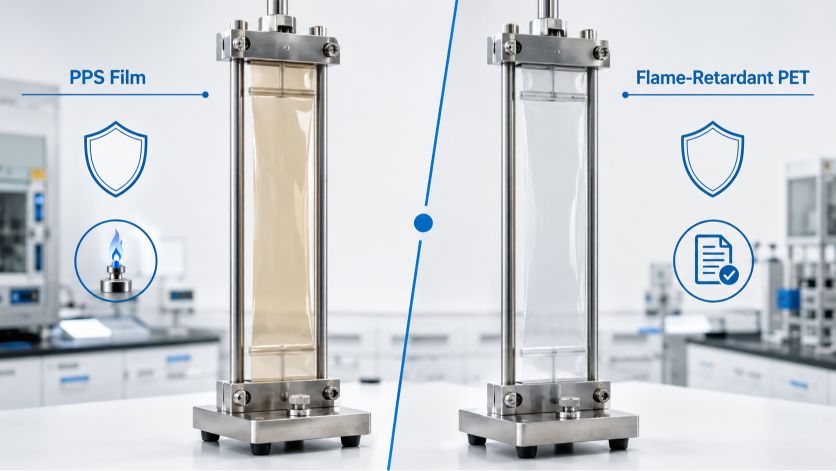
PPS is inherently resistant to burning, which can be an important advantage for electrical and electronic equipment.
Some PPS film grades may carry thin-material flame classifications at specified thicknesses. For example, Toray lists UL 94 VTM-0 for certain Torelina™ PPS film constructions of 25 μm and above. This statement should not be applied to every PPS film, thickness, color, adhesive-backed construction, or fabricated part without documentation.
PET film does not automatically provide the same inherent flame performance.
Options may include:
- Standard PET film.
- Flame-retardant PET film.
- Coated PET film.
- PET-based composite insulation.
- Recognized electrical insulation laminates.
Any flame rating must be confirmed for the exact grade and tested thickness.
UL explains that VTM ratings apply to thin materials and are not equivalent to V ratings because the test methods differ. UL Solutions – Combustion Tests for Plastics
When flame performance matters, verify:
- Exact material grade.
- Film thickness.
- Color.
- Flame-test method.
- UL file or other supporting documentation.
- Whether the rating applies to the plain film.
- Whether adhesive and lamination change the construction.
- Whether the final part requires separate qualification.
A UL 94 classification describes material behavior under defined small-scale test conditions. It should not be interpreted as complete proof of fire safety for the finished equipment.
9. Thickness, Flexibility, and Part Design
Both PPS and PET films are available in thin constructions suitable for compact electrical assemblies.
Film selection should account for:
- Required electrical clearance.
- Minimum breakdown voltage.
- Space limitations.
- Bend radius.
- Folding requirements.
- Part rigidity.
- Installation method.
- Edge handling.
- Die-cut geometry.
When Thin PPS Film Is Valuable
A thin PPS film may be useful where engineers require:
- High-temperature capability in limited space.
- Thin motor or transformer insulation.
- Flexible high-performance circuits.
- Stable insulation near heat-generating components.
Flame-resistant thin-film construction.
When PET Film Is Practical
PET is often practical for:
- Standard slot liners.
- Flat insulation barriers.
- Battery-cell pads.
- Labels and protective parts.
- General electrical spacers.
- High-volume die-cut components.
Using PPS solely to reduce thickness is not sufficient justification. The electrical and mechanical performance of the thinner construction must be verified.
10. Die Cutting, Slitting, and Custom Converting
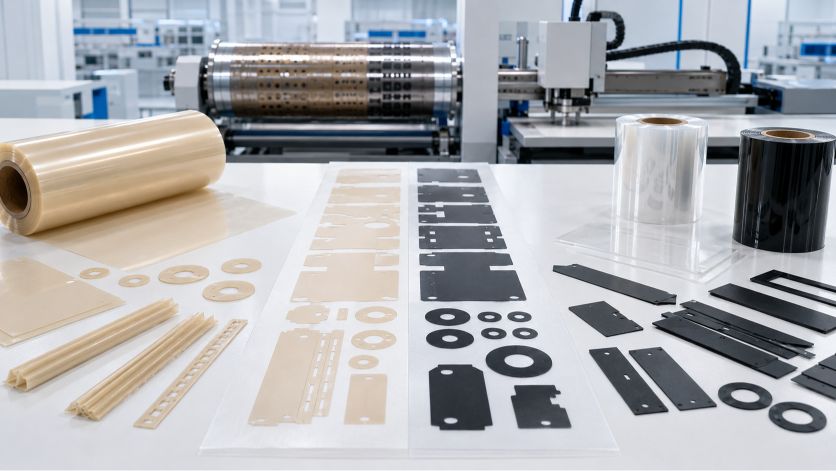
Both materials can be converted into rolls, sheets, tapes, laminates, and precision die-cut parts.
Common processes include:
- Roll slitting.
- Sheet cutting.
- Flatbed die cutting.
- Rotary die cutting.
- Kiss cutting.
- Digital cutting.
- Laser cutting where technically suitable.
- Adhesive coating.
- Laminating.
- Multi-layer assembly.
PPS Film Converting Considerations
PPS film can be converted into:
- Motor insulation parts.
- Battery insulation components.
- Electrical washers.
- Flexible circuit insulation.
- High-temperature labels.
- Adhesive-backed barriers.
- Custom thermal and electrical protection parts.
Important factors include:
- Film thickness.
- Part geometry.
- Minimum hole size.
- Edge quality.
- Tooling design.
- Adhesive selection.
- Release-liner stability.
- Dimensional tolerance.
- Material availability.
Because PPS film is a specialized material, efficient nesting is important for controlling scrap and cost.
PET Film Converting Considerations
PET film is well suited to high-volume converting and can be supplied as:
- Loose parts.
- Parts on sheets.
- Kiss-cut parts on release liners.
- Continuous roll-format components.
- Laminated insulation sheets.
- Slit rolls.
Its wider availability and standard thickness range can make it easier to develop prototypes and repeat production orders.
| Requirement | Possible Manufacturing Approach |
|---|---|
| Low-volume prototype | Digital or CNC cutting |
| Simple trial parts | Flatbed cutting |
| Medium-volume repeat orders | Flatbed die cutting |
| High-volume roll production | Rotary die cutting |
| Adhesive-backed sheet parts | Kiss cutting on liner |
| Multi-layer insulation | Laminating followed by cutting |
11. Cost, Availability, and Minimum Order Quantity
PET film is generally more economical and widely available than PPS film.
PPS film commonly carries a higher cost because it is:
- A specialized high-performance material.
- Produced through a more limited supply chain.
- Selected for demanding technical applications.
- Less widely available in every thickness and width.
- Frequently purchased for lower-volume specialized projects.
PET Cost Advantages
PET may offer:
- Lower base-film cost.
- More standard thicknesses.
- Broader supplier availability.
- Lower sourcing risk.
- Easier sample procurement.
- Better economics for high-volume die cutting.
PPS Cost Considerations
PPS pricing can be affected by:
- Film grade.
- Thickness.
- Roll width.
- Supplier minimum order quantity.
- Required documentation.
- Slitting loss.
- Die-cut scrap rate.
- Import and delivery costs.
- Material lead time.
Compare Total Cost
The lowest film price does not always produce the lowest total application cost.
A less suitable material may create:
- Heat shrinkage.
- Dimensional misalignment.
- Insulation failure.
- Shorter service life.
- Assembly defects.
- Additional inspections.
- Increased warranty risk.
12. Typical Electrical Insulation Applications
Electric Motors
PPS may be considered for:
- High-temperature motor insulation.
- EV traction motors.
- Motor components exposed to oils or coolants.
- Designs requiring stronger hydrolysis resistance.
- High-temperature slot, phase, or barrier insulation.
PET may be suitable for:
- General motor insulation.
- Standard slot liners.
- Moderate-temperature motor applications.
Cost-sensitive production with qualified thermal requirements.
Transformers and Coils
PPS may be selected for demanding thermal and environmental conditions.
PET remains widely used in standard transformer insulation, coil wrapping, spacers, and laminates when the selected grade meets the insulation-system requirements.
Batteries and Energy Storage
PPS may be useful for:
- Insulation near heat-generating components.
- High-temperature battery-module areas.
- Components exposed to humidity or chemicals.
- Flame-performance-sensitive designs.
PET may be suitable for:
- Cell insulation pads.
- Module barriers.
- Adhesive-backed protective films.
- General electrical separation layers.
- High-volume die-cut components.
No single film should be considered a complete solution for thermal-runaway protection. Battery-safety materials must be selected and tested as part of the full system.
Flexible Circuits and Electronics
PPS film may offer advantages in:
- High-frequency flexible circuits.
- Low-loss electronic constructions.
- Heat-resistant flexible flat cables.
- High-temperature printed circuits.
PET may be suitable for:
- Membrane circuits.
- General flexible electronics.
- Insulating layers.
- Printed labels.
Lower-temperature flexible assemblies.
Power Electronics and EV Systems
PPS can be considered for:
- Power modules.
- Electric compressors.
- High-voltage equipment.
- Busbar insulation.
- Components exposed to thermal cycling.
PET may still be used in areas where temperature and environmental requirements are less severe.
At the same time, selecting PPS for a moderate-temperature application may add cost without providing a meaningful benefit.
The best choice is the least expensive qualified construction—not simply the cheapest film or the film with the highest specifications.
13. When Should You Choose PPS Film?
Consider PPS film when the application requires several of the following:
- Higher long-term operating temperature.
- Strong thermal-aging performance.
- Reduced dimensional change during heating.
- Resistance to hot and humid conditions.
- Hydrolysis resistance.
- Resistance to oils, solvents, or industrial chemicals.
- Inherent flame resistance.
- Low dielectric loss in a suitable grade.
- Insulation for EV motors or power electronics.
- Thin insulation in a demanding environment.
- Longer service life under elevated temperatures.
PPS is most valuable when its performance advantages solve a documented technical problem.
It should not be selected only because it is considered a premium material.
14. When Should You Choose PET Film?
Consider PET film when:
- The application operates within the qualified PET temperature range.
- Standard electrical insulation is required.
- Broad material availability is important.
- The project uses high production volumes.
- Material cost is a major consideration.
- Standard thicknesses meet the design.
- The environment is not unusually hot, humid, or chemically aggressive.
- Flame-retardant performance can be met by a documented PET grade or laminate.
- Faster sampling and sourcing are required.
PET can be the better engineering choice when it satisfies all technical requirements at a lower total cost.
15. Frequently Asked Questions
Is PPS film more heat-resistant than PET film?
Generally, yes. PPS film is commonly selected for longer-term use in higher-temperature environments.The actual operating limit depends on the film grade, thickness, electrical requirement, exposure time, and complete product construction.
Is PPS film electrically insulating?
Yes. PPS film offers electrical insulation and is used in motors, flexible circuits, batteries, cables, and industrial electrical components.Performance must be verified using the data sheet for the exact grade and thickness.
Is PET film suitable for motor insulation?
Yes. Electrical-grade PET film is widely used for insulation barriers, die-cut electrical parts, battery components, and electronic assemblies.Its suitability depends on the actual electrical, thermal, mechanical, and compliance requirements.
Is PPS film naturally flame resistant?
PPS has inherent flame-resistant characteristics. However, any claimed flame classification must be confirmed for the exact film grade and thickness.An adhesive-backed or laminated construction may require separate evaluation.
Can flame-retardant PET replace PPS?
Possibly, if the PET construction meets all temperature, electrical, mechanical, environmental, and flame-performance requirements.A flame classification alone does not make PET equivalent to PPS in heat aging or chemical resistance.
Is PPS film more expensive than PET film?
Yes. Both can be slit, sheeted, laminated, die cut, and kiss cut.The appropriate process depends on film thickness, part geometry, tolerance, adhesive construction, production quantity, and presentation format.
Which film is better for EV motor insulation?
PPS may be preferred for high-temperature, high-humidity, oil-exposed, or chemically demanding environments.PET may be suitable for components operating within the qualified limits of the selected electrical-grade PET film.
Can PPS and PET be combined?
Yes. PPS and PET can be used in laminated insulation constructions.Toray, for example, offers a PPS/PET/PPS three-layer material designed to combine electrical, thermal, mechanical, and flexibility characteristics for insulation systems. Toray TLT™ PPS/PET/PPS Film
Which documents should I request from a supplier?
Request documentation for the exact material being supplied:
· Technical data sheet.
· Film-grade identification.
· Thickness tolerance.
· Electrical properties.
· Thermal data.
· Applicable flame classification.
· RoHS and REACH information.
· Traceability documents.
· Sample evaluation report, if required.
Send us your application requirements or technical drawing to evaluate suitable material and converting options.
Our engineers will help you select the right film for your application.
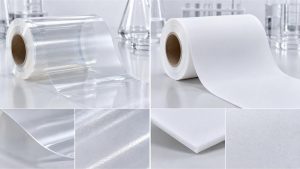
FEP vs PTFE Film: Key Differences in Processing and Performance
FEP and PTFE films belong to the fluoropolymer family and share valuable characteristics such as chemical resistance, electrical insulation, low surface energy and good performance in demanding environments. However, they are not interchangeable. Their different molecular structures lead to major differences in melt processing, transparency, heat sealing, temperature capability, stiffness and fabrication.
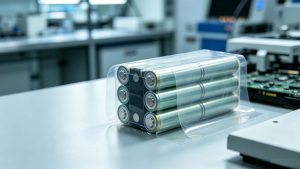
Case Study: UL94 VTM-0 PET Film for Battery Insulation Applications
How a flame-retardant PET insulation film helped a U.S. customer meet laboratory material requirements for a battery-powered product
When developing a new battery-powered product for the U.S. market, material selection is not only about thickness, flexibility, or cost. For products containing batteries, flammability, electrical insulation, and regulatory compliance can become critical factors during laboratory evaluation.
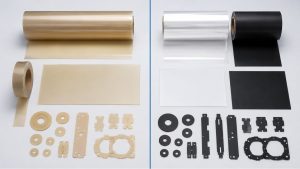
PPS vs PET Film: Which Electrical Insulation Film Should You Choose?
PPS film is generally selected for demanding environments involving higher temperatures, thermal aging, chemicals, humidity, or flame-performance requirements. PET film offers dependable electrical insulation, broad availability, convenient processing, and lower material cost for applications operating within its qualified limits.
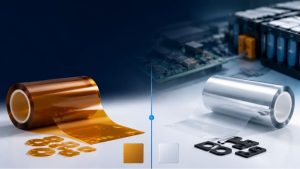
PI vs PET Film: Temperature Resistance, Insulation and Cost Comparison
PI film is generally selected when an application requires greater thermal stability or resistance to demanding processing conditions. PET film is often preferred when reliable electrical insulation, dimensional stability, and lower material cost are the main priorities.