



An Industrial Buyer’s Guide to Selecting the Right Supply Format for Electrical Insulation Films and Custom Converted Materials
When purchasing electrical insulation films or other high-performance flexible materials, selecting the right polymer is only part of the decision.
The format in which the material is supplied—roll, sheet or custom die-cut part—can have a significant impact on production efficiency, material waste, labor requirements, tooling investment and total manufacturing cost.
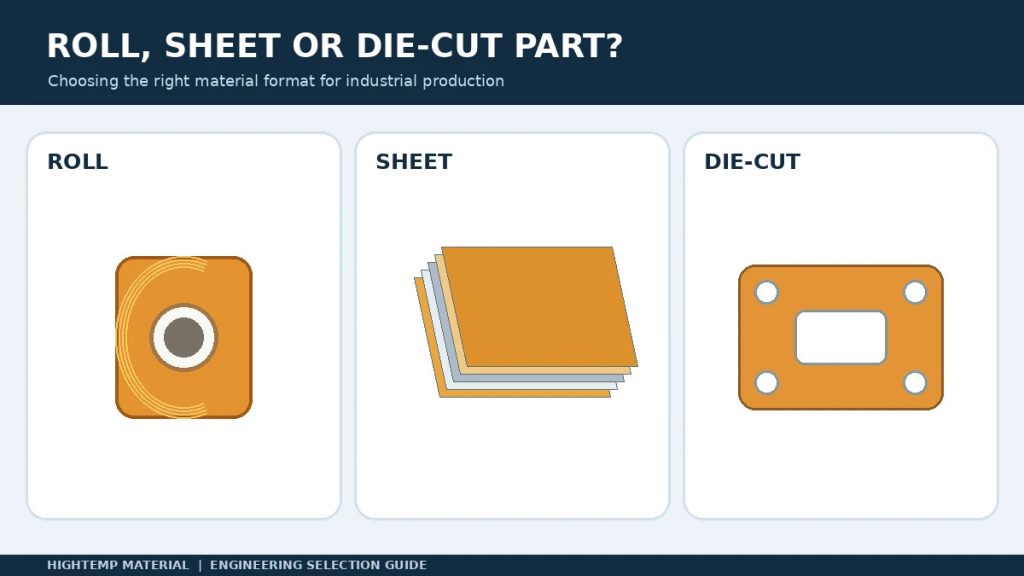
A roll may be ideal for continuous production, while sheets can be easier to handle for prototyping and batch processing. Custom die-cut parts can reduce downstream cutting and assembly operations, but may require tooling and more detailed engineering specifications.
The best material format is not necessarily the one with the lowest purchase price. It is the format that delivers the required performance at the lowest practical total cost for your production process.
This guide compares rolls, sheets and die-cut parts for PET, polyimide (PI), PTFE, PPS, PEN and related insulation materials, helping engineers and industrial buyers choose a suitable supply format.
1. Why Material Supply Format Matters
Industrial insulation materials may pass through several manufacturing steps before becoming finished components.
These steps can include:
- Slitting
- Sheet cutting
- Laminating
- Adhesive coating
- Die cutting
- Inspection
- Handling
- Assembly
- Packaging
The chosen material format determines which operations are performed by the supplier and which remain with the customer.
For example, purchasing a master roll may provide flexibility for a manufacturer with in-house converting equipment. A company without such equipment may benefit from receiving pre-cut sheets or finished insulation parts.
Purchase Price vs Total Cost
Material purchase price is only one element of the overall cost.
A more complete evaluation includes:
Total usable-part cost = Purchased material + Conversion + Tooling allocation + Labor + Scrap + Inspection + Handling + Logistics
This is a conceptual cost model, not a standardized accounting formula. Individual projects may require additional factors, including inventory, financing and quality-related costs.
A lower-priced master roll can become more expensive if substantial material is wasted or significant labor is needed to prepare each part.
Conversely, pre-converted parts may cost more per piece but reduce internal manufacturing work.
2. Understanding Roll, Sheet and Die-Cut Material Formats
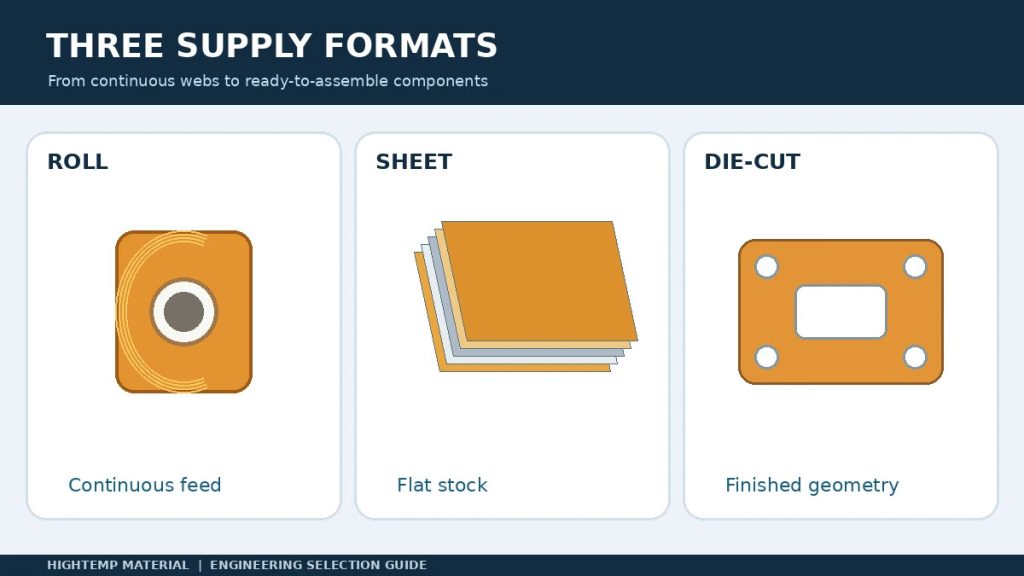
Roll Format
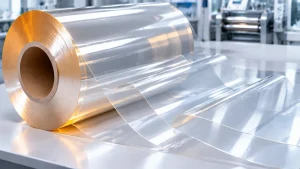
Roll materials are supplied as continuous lengths wound onto a core.
They may be available as master rolls or slit rolls with customized widths.
Typical specifications include:
- Film material and grade
- Nominal thickness
- Roll width
- Roll length
- Core inner diameter
- Maximum roll outer diameter
- Winding direction
- Edge quality
- Splices and defect requirements
Roll format is often suitable for continuous processes such as coating, laminating, automated feeding and high-volume converting.
Sheet Format
Sheet materials are supplied as flat pieces cut to specified dimensions.
They may be rectangular or square, depending on the application.
Sheets can be useful for:
- Prototype development
- Manual assembly
- Small and medium production batches
- Flat insulation barriers
- Laboratory testing
- Secondary cutting operations
Sheet format can reduce the need for roll unwinding equipment, but may require more manual handling than continuous roll processing.
Custom Die-Cut Parts
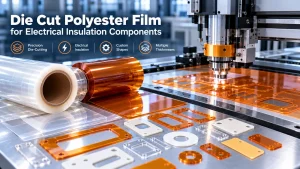
Die-cut parts are supplied in finished or near-finished geometries.
They may include:
- Holes
- Slots
- Windows
- Rounded corners
- Tabs
- Custom profiles
- Adhesive-backed areas
- Release liners
Die-cut parts are often selected when the customer wants to minimize internal cutting operations or requires repeatable component geometry.
Examples include battery insulation liners, electrical isolation washers, PCB protective components and busbar insulation covers.
For drawing-based components, explore our Precision Converting Services.
3. Roll vs Sheet vs Die-Cut Parts: Key Differences
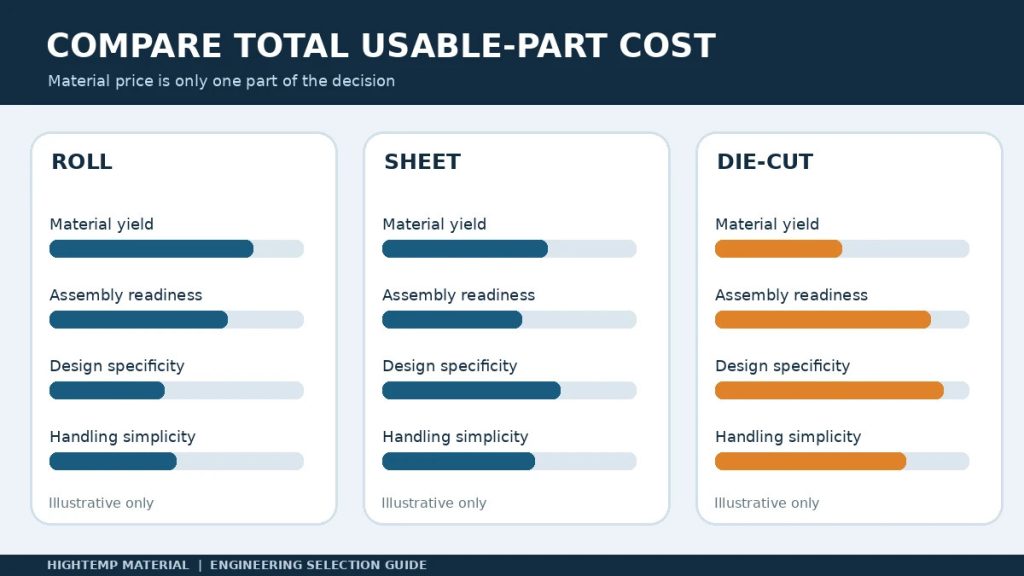
The following comparison summarizes the main purchasing and production considerations.
| Factor | Roll | Sheet | Die-Cut Part |
|---|---|---|---|
| Typical format | Continuous web | Flat rectangular pieces | Custom finished geometry |
| Continuous production | Often well suited | Usually requires sheet feeding | Depends on part presentation |
| Manual handling | Requires unwinding or cutting | Generally straightforward | Often ready for assembly |
| Internal cutting needed | Usually | Sometimes | Often minimal |
| Initial tooling | Depends on downstream process | Often limited for simple cuts | May require dedicated tooling |
| Complex holes and slots | Requires additional converting | Requires additional converting | Can be supplied pre-cut |
| Material utilization | Depends on web width and nesting | Depends on sheet layout | Depends on part nesting and process |
| Dimensional requirements | Width, thickness and winding | Sheet dimensions and flatness | Full drawing and feature tolerances |
| Lead time | Depends on stock and slitting | Depends on stock and cutting | Depends on tooling and qualification |
| Best fit | Continuous processing | Prototypes and batch assembly | Repeatable shaped components |
Which Format Has the Lowest Material Cost?
A roll may have a lower quoted unit price than a finished die-cut part, but this does not automatically mean it has the lowest usable-part cost.
The comparison should include the amount of material required to produce one acceptable finished component.
Which Format Has the Lowest Labor Cost?
Custom die-cut parts may reduce labor when they eliminate manual cutting or trimming.
However, roll-fed automated equipment can also achieve excellent labor efficiency when production volumes justify the equipment investment.
Which Format Offers the Most Flexibility?
Rolls often provide flexibility for manufacturers that perform their own converting.
Sheets can be convenient for design changes and small batches.
Die-cut parts provide design-specific geometry but may require tooling revisions when the part changes.
4. How Each Material Format Fits the Production Process
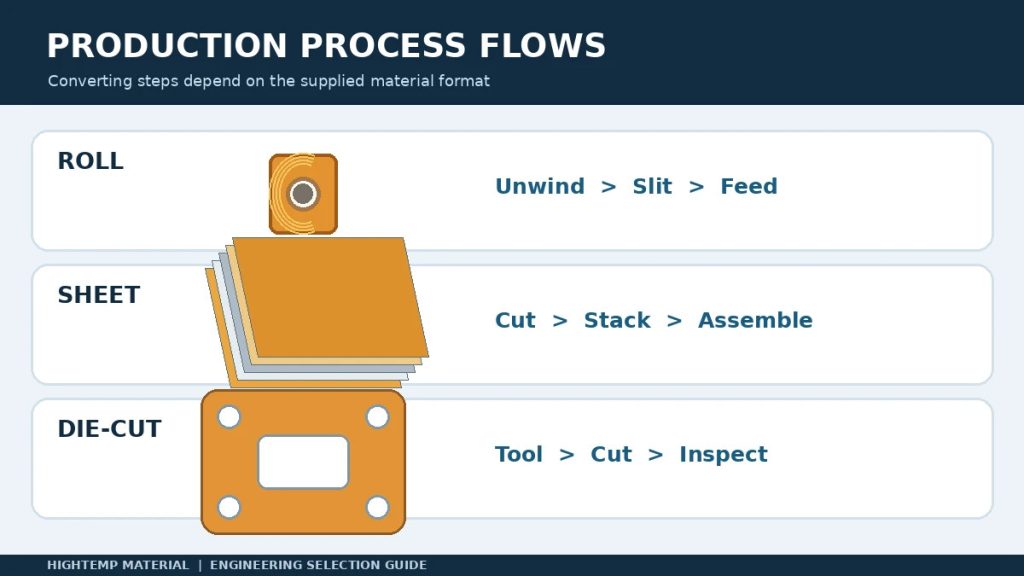
The production process should be evaluated before selecting a material format.
Roll-to-Roll Manufacturing
Continuous roll-fed operations may include:
- Adhesive coating
- Lamination
- Film slitting
- Automated tape application
- Continuous protective film processing
- Roll-fed die cutting
For these operations, a stable roll construction can improve feeding and process consistency.
Important factors include winding tension, edge quality, core dimensions and material flatness.
HighTemp Material provides Precision Film Slitting Services for suitable insulation films and flexible materials.
Sheet-Fed Processing
Sheet-fed manufacturing may be appropriate for:
- Manual assembly
- Flat lamination
- Prototype cutting
- Batch production
- Large flat insulation components
Sheets should be evaluated for dimensional accuracy, flatness, packaging and protection from scratches or contamination.
Finished-Part Assembly
Pre-cut parts may be delivered individually, on sheets or on release liners.
This can reduce the customer’s need to perform additional cutting.
For adhesive-backed parts, kiss-cut presentation on a liner may be useful for manual or automated placement.
The most suitable presentation depends on the assembly process and the finished component design.
5. Material Utilization, Scrap and Total Cost
Material utilization is an important factor when comparing supply formats.
Understanding Material Yield
Material yield can be estimated as:
Material utilization (%) = Total area of acceptable finished parts ÷ Total material area consumed × 100
This calculation must account for the actual production layout, including edge trim, gaps between parts, internal cutouts and rejected material.
Example: Comparing Two Production Approaches
Suppose a production order requires 10,000 rectangular insulation parts.
Two options are considered:
Option A: Purchase sheets and cut parts in-house
- Sheet purchase cost
- Internal cutting labor
- Equipment operating cost
- Sheet-layout scrap
- Quality inspection
- Material handling
Option B: Purchase finished die-cut parts
- Supplier’s finished-part price
- Any tooling or setup cost
- Incoming inspection
- Assembly labor
- Packaging and handling
The more economical option depends on actual supplier quotations, part geometry, labor rates, yield and production volume.
There is no universal percentage by which die cutting reduces costs.
Tooling Amortization
For a dedicated die, tooling cost can be distributed across the planned production quantity.
Tooling cost per part = Tooling investment ÷ Total acceptable parts produced using that tooling
This simplified calculation does not include maintenance, replacement or financing costs.
At higher production volumes, tooling cost per part may become relatively small.
For short prototype runs, a tooling-free or lower-tooling-cost process may be preferable.
Inventory and Storage
Rolls may reduce the number of individual items handled but require suitable storage and unwinding equipment.
Sheets require protection against bending, scratching and contamination.
Finished die-cut parts may require special packaging, liners or separation to avoid damage.
The correct format should support the customer’s inventory and material-handling systems.
6. Application Examples: Which Format Works Best?
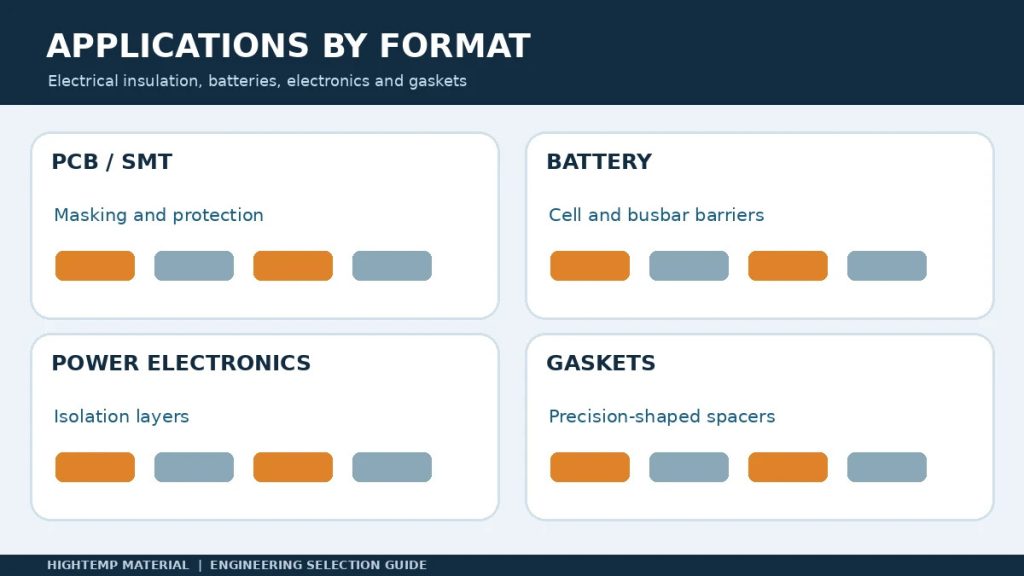
PCB and SMT Manufacturing
PCB and SMT manufacturers may use insulation and masking materials in different formats.
Rolls are often suitable for continuous masking tape or film processing.
Sheets may be useful for flat protection layers or manual operations.
Die-cut components may be preferred when precise windows, holes or repeatable protective shapes are required.
Battery Modules and Energy Storage Systems
Battery manufacturing may require:
- Cell insulation films
- Module liners
- Busbar insulation covers
- Electrical isolation spacers
- Protective film components
Roll materials may be suitable for automated film feeding or internal converting.
Sheets may support larger flat barriers.
Custom die-cut parts may reduce assembly preparation when complex shapes or mounting holes are required.
The material grade and finished insulation system must still be qualified for the actual electrical, thermal and mechanical requirements.
Power Electronics and Inverters
Power electronic assemblies may require electrical insulation barriers around conductive components.
For simple flat barriers, sheets may be practical.
For repeated components containing holes, tabs or cutouts, die-cut parts may simplify assembly.
Roll format may be suitable where the manufacturer has automated converting equipment.
Industrial Gaskets and Spacers
Custom gaskets and spacers often require controlled geometry.
Die-cut parts can be appropriate for repeatable washers, rings and insulating profiles.
However, sheet stock may be preferred when the customer already has suitable cutting equipment or needs flexibility for multiple designs.
Semiconductor and High-Temperature Equipment
Material cleanliness, dimensional stability, thermal performance and traceability may be critical.
The format must be selected together with packaging and handling requirements.
A convenient supply format does not replace material qualification or contamination control.
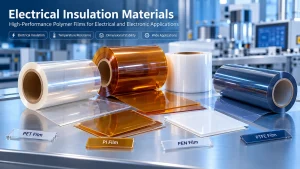
7. Material Selection: PET, PI, PTFE, PPS and PEN
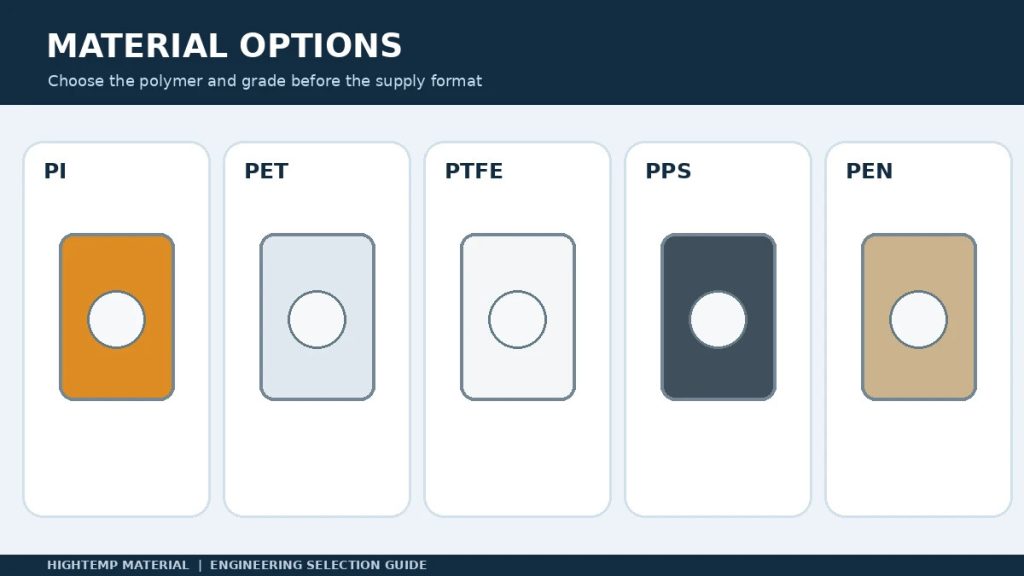
The available supply formats depend on the material grade, thickness, width and processing characteristics.
| Material | Roll Considerations | Sheet Considerations | Die-Cut Considerations |
|---|---|---|---|
| PET | Common for flexible films and converting | Useful for flat barriers | Suitable for many insulation shapes |
| Polyimide (PI) | Useful for thin high-temperature films | Suitable for flat insulation | Often considered for precision insulation parts |
| PTFE | Film construction and handling matter | Useful for specialty applications | Creep and cutting behavior require evaluation |
| PPS | Grade and available dimensions matter | Useful for selected barriers | Thickness and stiffness affect cutting |
| PEN | Film stability and winding conditions matter | Useful for flat electrical components | Grade-specific converting evaluation required |
PET Film
PET may offer a practical balance of electrical insulation properties, cost and converting performance.
For high-volume projects, slit rolls may be appropriate.
For battery liners or custom insulation shapes, sheets or die-cut parts may be more convenient.
Polyimide Film
Polyimide film is often considered for elevated-temperature electrical insulation applications.
It may be supplied in rolls, sheets or custom-cut parts, depending on the grade and processing requirements.
For material selection guidance, see our PI vs PET Film Comparison.
PTFE Film
PTFE is valued for its chemical resistance and low-friction properties.
Its mechanical behavior and processing characteristics can differ significantly from PET and PI.
The appropriate format should be confirmed according to the specific PTFE film construction.
PPS and PEN Films
PPS and PEN may be selected for particular thermal, electrical or dimensional requirements.
Availability of specific thicknesses and widths should be confirmed before designing the converting process.
Material selection reminder: The same polymer may behave differently across grades and thicknesses. Roll, sheet and die-cut availability should never be assumed without checking the actual material specification.
8. Design Considerations for Custom Sheets and Die-Cut Parts
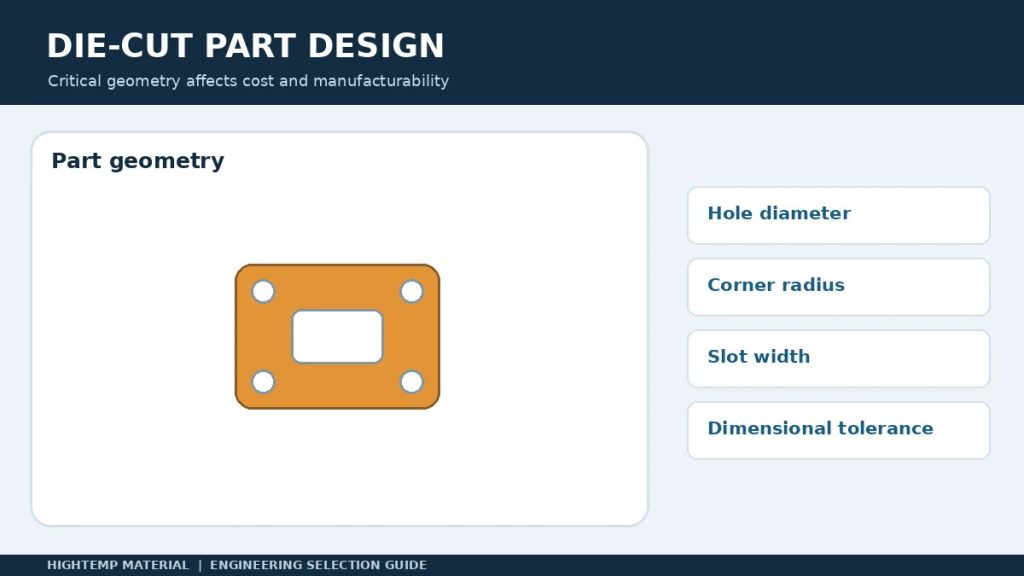
When purchasing custom-cut materials, the drawing and specification directly affect manufacturing feasibility.
Overall Dimensions
Specify:
- Length and width
- Material thickness
- Dimensional tolerance
- Orientation, if important
- Flatness requirements, if applicable
Holes, Slots and Corner Radii
For die-cut parts, provide a dimensioned drawing showing:
- Hole diameters
- Hole positions
- Slot dimensions
- Internal windows
- Corner radii
- Edge distances
Small features and narrow material bridges may require additional tooling evaluation.
Adhesive-Backed Components
If adhesive is required, specify:
- Adhesive type
- Adhesive thickness
- Full or selective coverage
- Adhesive edge margins
- Release liner
- Finished-part presentation
Do not assume that adhesive thickness is included in the stated base film thickness.
Tolerance Requirements
Achievable tolerance depends on the material, thickness, geometry and cutting process.
Avoid applying unnecessarily tight tolerances to every feature.
Instead, identify dimensions that are critical to fit, electrical clearance or assembly.
For a detailed design review, see our Custom Die Cutting Services.
9. Common Purchasing Mistakes
Mistake 1: Comparing Only Price per Square Meter
A lower material price may be offset by higher scrap, labor and converting costs.
Better approach: Compare total cost per acceptable finished component.
Mistake 2: Buying Rolls Without Checking Equipment Compatibility
Incorrect roll width, core size or winding characteristics can disrupt production.
Better approach: Confirm the full roll specification before ordering.
Mistake 3: Ordering Sheets Without Considering Flatness and Packaging
Thin films may curl or become damaged during handling.
Better approach: Define sheet presentation, protection and flatness requirements.
Mistake 4: Requesting Die-Cut Parts Without a Complete Drawing
Missing tolerances, hole positions or material details can delay quotations.
Better approach: Provide a dimensioned PDF and editable CAD file where available.
Mistake 5: Ignoring Production Volume
A format suitable for ten prototype parts may not be economical for hundreds of thousands of production parts.
Better approach: Provide both sample demand and annual production forecasts.
Mistake 6: Assuming All Materials Can Be Converted Identically
PET, PI, PTFE, PPS and PEN have different processing characteristics.
Better approach: Confirm grade-specific feasibility before approving tooling.
10. How to Choose the Best Material Format: A Practical Decision Process
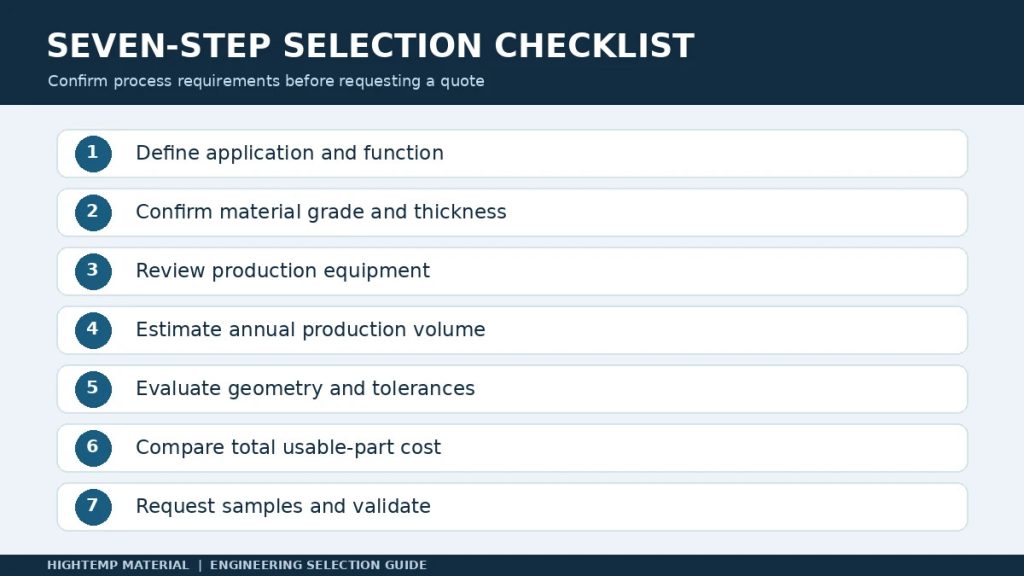
Use the following sequence when comparing supply options.
Step 1: Define the Final Application
Identify the insulation function, operating conditions and finished component geometry.
Step 2: Confirm Material and Thickness
Specify the polymer, grade, thickness and any required test documentation.
Step 3: Review Your Manufacturing Equipment
Determine whether your production line can accept rolls, sheets or finished parts.
Step 4: Estimate Production Volume
Provide prototype quantity, monthly demand and expected annual usage.
Step 5: Evaluate Part Geometry
Simple rectangular pieces may be suitable for sheet cutting.
Complex shapes with holes and windows may benefit from die cutting.
Continuous strips may be more appropriate in roll format.
Step 6: Compare Total Production Cost
Include material cost, yield, tooling, labor, inspection, packaging and logistics.
Step 7: Validate Samples
Test representative samples in the actual manufacturing process before approving volume production.
Quick Selection Guide
Choose roll format when:
- Your process is continuous or roll-fed.
- You have suitable converting equipment.
- You need customized widths or long lengths.
- Production volume supports roll handling.
Choose sheet format when:
- You need flat rectangular materials.
- Your process is sheet-fed or manual.
- You are developing prototypes.
- You want flexibility for secondary cutting.
Choose die-cut parts when:
- You require repeatable custom geometry.
- Holes, slots or cutouts are needed.
- You want to reduce internal cutting.
- You need parts prepared for assembly.
- The expected volume supports the selected converting method.
These are selection indicators, not absolute rules. The final decision should be based on the actual project.
11. RFQ Checklist: What to Send Your Supplier
A complete RFQ helps the supplier recommend the correct material format and provide an accurate quotation.
| Requirement | Information to Provide |
|---|---|
| Application | Intended equipment and insulation function |
| Material | PET, PI, PTFE, PPS, PEN or other |
| Grade | Required brand or technical specification |
| Thickness | Nominal thickness and tolerance |
| Format | Roll, sheet, die-cut or open to recommendation |
| Roll dimensions | Width, length, core and outer diameter |
| Sheet dimensions | Length, width and flatness requirements |
| Die-cut geometry | Drawing, holes, slots and radii |
| Adhesive | Type, thickness, coverage and liner |
| Tolerances | Critical and general dimensional requirements |
| Quantity | Sample, batch and annual demand |
| Packaging | Roll, stack, liner or individual presentation |
| Documentation | TDS, test reports and declarations |
| Delivery | Destination and required schedule |
Can You Request Multiple Formats in One RFQ?
Yes.
If the most economical format is unclear, ask the supplier to quote alternatives.
For example:
- Option A: Master roll
- Option B: Slit rolls
- Option C: Custom sheets
- Option D: Finished die-cut components
Provide the same material grade, thickness, estimated consumption and quality requirements so the options can be compared fairly.
12. Roll, Sheet and Custom Die-Cut Material Solutions from HighTemp Material
HighTemp Material supplies high-temperature insulation materials and supports project-based precision converting for industrial customers.
Relevant material categories include:
- PET electrical insulation film
- Polyimide (PI) film
- PTFE film
- PPS film
- PEN film
- Selected adhesive-backed insulation materials
Relevant converting services include:
Available dimensions, tolerances, material grades and processing options are subject to project review.
Not Sure Whether to Order Rolls, Sheets or Die-Cut Parts?
Send us your material requirements, production volume and finished-part drawing.
We can discuss the suitability of different supply formats and converting approaches for your application.
Contact HighTemp Material to Request a Quote
Frequently Asked Questions
Is it cheaper to buy insulation film in rolls or sheets?
It depends on the material price, order quantity, cutting requirements, scrap and handling costs. Rolls may be economical for continuous processing, while sheets may reduce preparation work for smaller batches.
Are die-cut insulation parts more expensive than rolls?
Finished die-cut parts may have a higher quoted unit price because converting operations are included. However, they may reduce the customer’s labor, equipment use and material waste. Compare total usable-part cost.
What is the best format for battery insulation materials?
The best format depends on the battery design and manufacturing process. Rolls may suit automated feeding, sheets may suit flat barriers, and die-cut parts may suit liners or covers with custom geometry.
Can polyimide film be supplied as custom die-cut parts?
Yes, suitable polyimide films can be converted into custom insulation components, subject to grade, thickness, geometry and processing feasibility.
What information is required for custom slit rolls?
Provide the material grade, thickness, finished width, roll length, core diameter, maximum roll diameter, winding requirements and quantity.
Do die-cut parts always require expensive tooling?
No. Tooling cost depends on the cutting method, geometry and volume. Some prototype or short-run methods may require less dedicated tooling, while high-volume production may benefit from purpose-built dies.
Can adhesive-backed insulation films be supplied on a release liner?
Yes, suitable adhesive-backed constructions may be supplied as kiss-cut parts on a release liner. The liner, adhesive and cutting process must be evaluated together.
Can I request rolls, sheets and die-cut parts in the same quotation?
Yes. Providing multiple format options can help compare material utilization, conversion cost, lead time and assembly efficiency.
Conclusion
Choosing between rolls, sheets and custom die-cut parts is an important manufacturing and purchasing decision.
Rolls often suit continuous processing and in-house converting. Sheets can simplify prototyping, flat-part handling and batch operations. Custom die-cut parts can reduce downstream processing and provide ready-to-assemble geometry.
However, the best format depends on the material, part design, production volume, equipment, labor and total cost.
For PET, PI, PTFE, PPS and PEN insulation materials, buyers should evaluate the complete manufacturing workflow rather than comparing purchase prices alone.
HighTemp Material supports material selection and converting discussions for customized rolls, sheets and precision-cut electrical insulation components.
Request a Material Format and Converting Quote
Engineering note: Cost, utilization, lead time and processing suitability vary by material grade, thickness, geometry, quantity and manufacturing method. All project-specific requirements should be confirmed through supplier review and sample validation.