


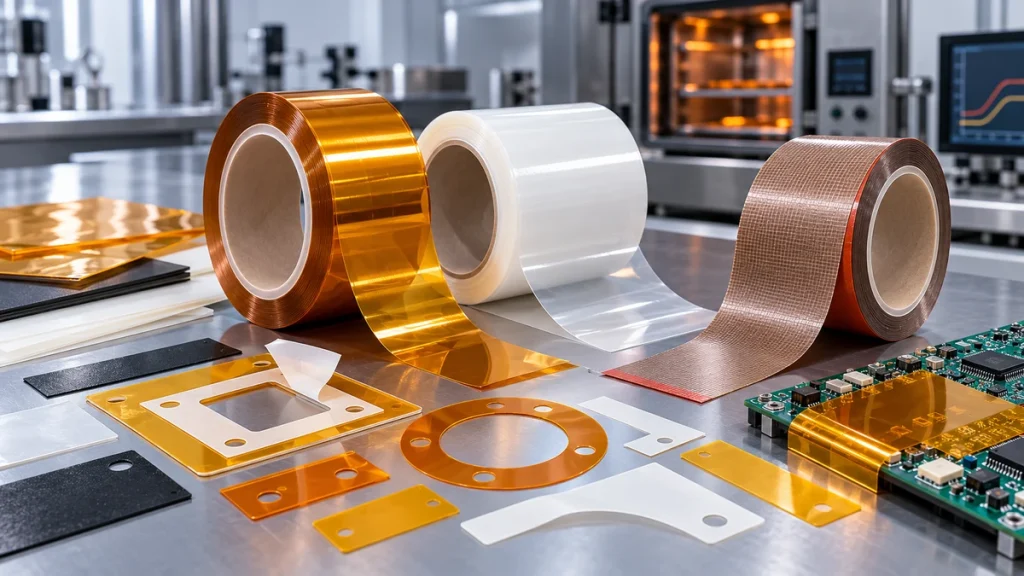
An Engineering Guide to Silicone, Acrylic and Rubber-Based Adhesives for Industrial Tapes, Electrical Insulation and Precision-Converting Applications
Selecting a high-temperature pressure-sensitive adhesive (PSA) is not simply a matter of choosing the product with the highest published temperature rating.
A pressure-sensitive adhesive must maintain the required bond under real operating conditions, which may include elevated temperatures, thermal cycling, vibration, chemical exposure, surface contamination and mechanical loading.
For temporary masking applications, clean removal may be more important than maximum adhesion. For permanent electrical insulation components, long-term bonding reliability and resistance to creep may be the primary concerns.
The right high-temperature pressure-sensitive adhesive depends on adhesive chemistry, bonding surface, temperature exposure, mechanical stress, required service life and the construction of the finished tape or component.
This guide compares silicone, acrylic and rubber-based PSAs and explains how engineers and industrial buyers can evaluate adhesive performance for SMT masking, electrical insulation, battery assemblies, heat-sealing equipment and custom adhesive-backed materials.
1. What Is a High-Temperature Pressure-Sensitive Adhesive?
A pressure-sensitive adhesive is a viscoelastic material that forms a bond when sufficient pressure brings it into contact with a compatible surface.
Unlike many structural adhesives, a conventional PSA generally does not require a separate chemical curing reaction during installation.
However, some PSA products may undergo curing or crosslinking during manufacturing, and their properties can continue to change as the bond develops.
High-temperature PSAs are formulated or selected to maintain useful adhesive performance during specified thermal exposure.
They are commonly supplied as part of:
- Single-sided industrial adhesive tapes
- Double-sided adhesive tapes
- Adhesive-backed electrical insulation films
- High-temperature masking tapes
- Adhesive-coated fiberglass fabrics
- Custom die-cut insulation components
- Protective films and industrial laminates
What Makes an Adhesive Suitable for High Temperatures?
High-temperature suitability involves more than preventing the adhesive from melting or decomposing.
Engineers may need the adhesive to:
- Maintain sufficient peel adhesion
- Resist sliding or creep under load
- Avoid excessive softening
- Limit adhesive transfer
- Remain compatible with the substrate
- Withstand repeated heating and cooling
- Preserve electrical or contamination requirements
- Meet the required service life
The adhesive, backing film, surface coating and any other layers must be evaluated as a complete construction.
For an example of an industrial adhesive-backed film, see our High Temperature PI Kapton Tape.
2. Silicone vs Acrylic vs Rubber-Based Pressure-Sensitive Adhesives
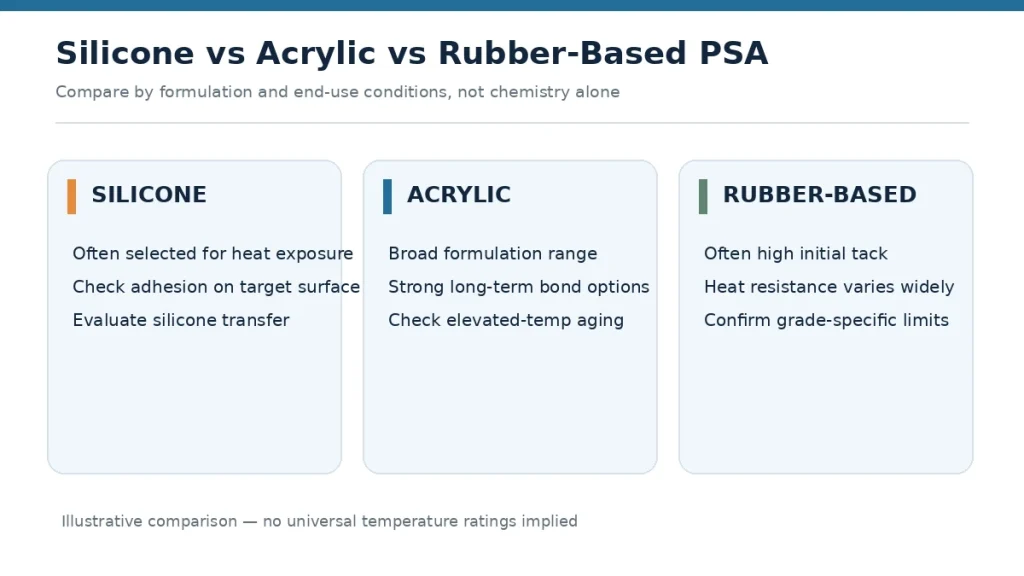
Three important adhesive families used in industrial tape applications are silicone, acrylic and rubber-based PSAs.
Each family includes multiple formulations, so the following comparison should be treated as a starting point rather than a universal performance ranking.
| Property | Silicone PSA | Acrylic PSA | Rubber-Based PSA |
|---|---|---|---|
| High-temperature suitability | Often selected for demanding heat exposure | Ranges from general-purpose to specialty high-temperature grades | Highly formulation-dependent; many conventional grades have more limited heat endurance |
| Initial tack | Formulation-dependent | Formulation-dependent | Often strong in high-tack grades |
| Long-term adhesion | Grade and substrate dependent | Many grades designed for durable bonding | Depends on formulation and aging |
| Clean removal | Available in selected formulations | Available in selected removable grades | Must be specifically validated |
| UV and weathering resistance | Often favorable | Often favorable in suitable grades | Can be more sensitive in some formulations |
| Chemical resistance | Depends on the chemical and formulation | Depends on the chemical and formulation | Depends on the chemical and formulation |
| Bonding to silicone surfaces | Specialized silicone systems may be useful | Often requires special formulation or treatment | Requires compatibility evaluation |
| Typical applications | High-temperature masking, PI tapes, specialty insulation | Industrial bonding, insulation laminates, assembly tapes | Packaging, temporary bonding and selected industrial applications |
Silicone Pressure-Sensitive Adhesive
Silicone PSAs are frequently considered for high-temperature masking tapes and specialty industrial applications.
They may offer useful performance during elevated-temperature exposure and can be formulated for bonding to certain difficult surfaces.
Typical applications include:
- Polyimide masking tape
- PTFE-coated fiberglass adhesive tape
- Selected electrical insulation tapes
- Temporary process protection
- Specialty high-temperature laminates
However, silicone adhesive does not automatically guarantee residue-free removal.
Adhesive transfer, contamination and removal force depend on the formulation, substrate, dwell time and thermal history.
Acrylic Pressure-Sensitive Adhesive
Acrylic PSAs are available in a broad range of formulations.
They are widely used in industrial bonding and adhesive-backed film applications because they can offer a useful balance of adhesion, aging performance and processing characteristics.
Specialty acrylic grades may be appropriate for elevated-temperature service, but their suitability must be confirmed using grade-specific data.
Potential applications include:
- Permanent adhesive-backed insulation components
- Industrial assembly tapes
- PET film laminates
- Electronic component bonding
- Selected high-temperature protective constructions
Rubber-Based Pressure-Sensitive Adhesive
Rubber-based PSAs are often associated with high initial tack and rapid bonding.
However, many conventional rubber-based systems are less suitable for prolonged elevated-temperature exposure than specially formulated silicone or acrylic alternatives.
Specialty grades may perform differently.
They should be evaluated according to the exact adhesive formulation and required operating conditions.
Which Adhesive Chemistry Is Best?
There is no universal winner.
For temporary masking at elevated temperatures, a suitable silicone PSA may be a strong starting candidate.
For durable bonding of an electrical insulation film, a specialty acrylic or silicone system may be considered.
For applications where rapid initial bonding is important, a rubber-based system may be relevant if it meets the thermal requirements.
Engineering recommendation: Compare qualified adhesive grades under the same test conditions rather than relying only on the adhesive family name.
3. Temperature Exposure: Continuous Service vs Short-Term Peaks
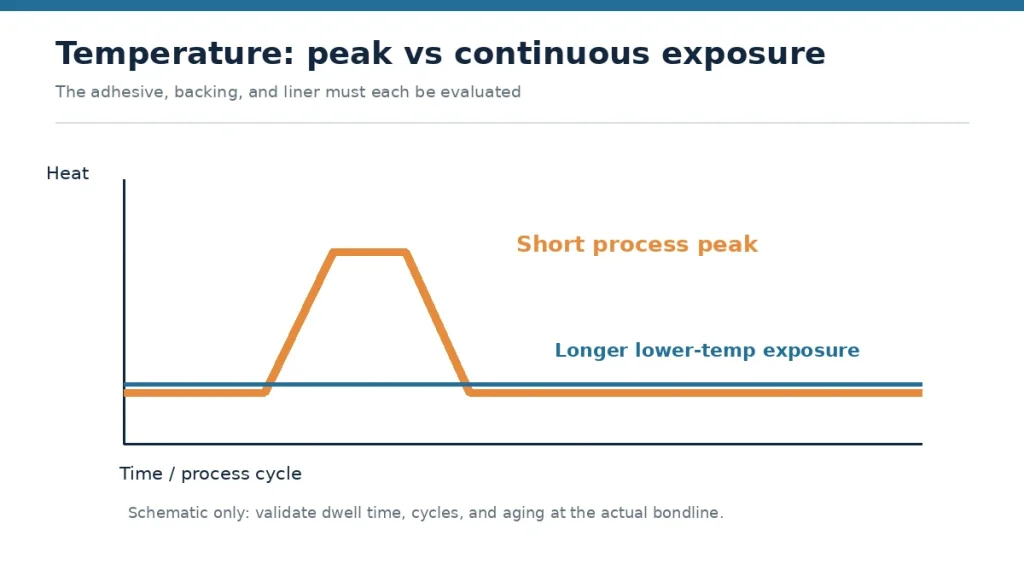
Temperature is one of the most important factors in PSA selection.
However, published temperature ratings may refer to very different conditions.
Continuous Operating Temperature
Continuous service involves extended exposure at an elevated temperature.
The adhesive may experience gradual changes in:
- Peel adhesion
- Cohesive strength
- Creep resistance
- Elasticity
- Surface compatibility
- Aging behavior
A short-term temperature rating should not be used as evidence of long-term reliability.
Short-Term Peak Temperature
Temporary masking tapes may experience brief temperature peaks during manufacturing.
For example, an SMT masking tape may pass through a soldering process and then be removed.
The relevant questions include:
- What is the actual tape or bondline temperature?
- How long does the peak last?
- How many thermal cycles occur?
- Is the tape removed immediately afterward?
- Is residue or contamination acceptable?
A tape that survives a brief high-temperature process may not be suitable for continuous service at the same temperature.
Thermal Cycling
Repeated heating and cooling can cause different materials in the assembly to expand and contract at different rates.
This can introduce stress into the adhesive bond.
Thermal cycling may contribute to:
- Edge lifting
- Wrinkling
- Adhesive fatigue
- Delamination
- Loss of dimensional stability
The adhesive should be evaluated with the actual backing and bonding substrate.
Temperature Ratings Apply to the Complete Tape
Consider a tape consisting of:
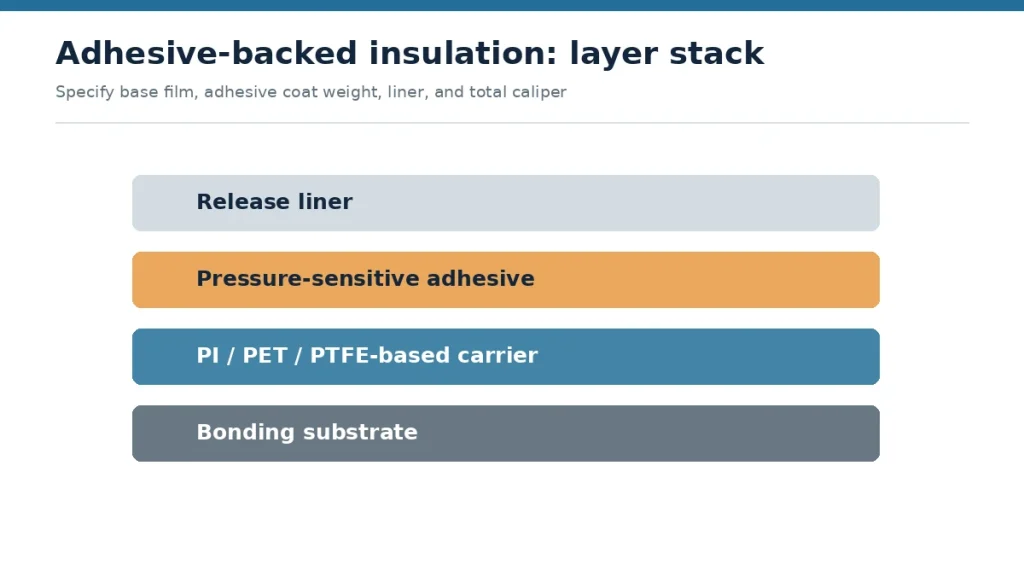
- A polyimide film backing
- A pressure-sensitive adhesive
- An optional release liner
The polyimide film may tolerate a temperature that the adhesive cannot sustain for the required duration.
Similarly, a release liner may be intended only for storage and processing, not for exposure during service.
For high-temperature tape selection, the limiting layer and complete construction must be identified.
4. Bonding Surface and Surface Preparation
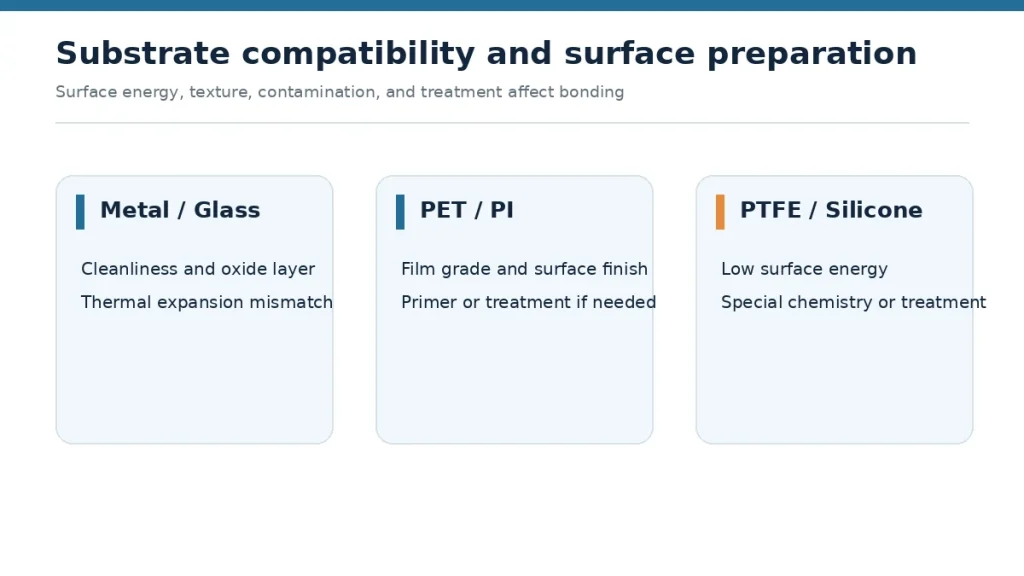
An adhesive can perform well on one substrate and poorly on another.
Surface compatibility is therefore just as important as temperature resistance.
High-Surface-Energy Materials
Many clean metals and glass surfaces are comparatively receptive to a broad range of PSAs.
However, bonding performance can still be affected by:
- Oxide layers
- Surface treatments
- Oils
- Moisture
- Dust
- Roughness
- Thermal expansion differences
PET and Polyimide Films
PET and PI films are common carriers for adhesive-backed insulation materials.
Bonding performance depends on the specific film grade, surface finish and any applied treatment.
Some constructions may require primers, corona treatment, plasma treatment or a specially selected adhesive.
PTFE and Silicone Surfaces
PTFE and silicone are generally considered difficult bonding surfaces because of their low surface energy.
Standard acrylic or rubber-based PSAs may not achieve adequate adhesion without suitable surface treatment or specialty formulations.
Even silicone PSAs must be evaluated for the exact silicone surface and operating conditions.
Surface Preparation Checklist
Before testing an adhesive:
- Identify the exact bonding substrate.
- Confirm whether coatings or surface treatments are present.
- Remove contamination using an approved cleaning procedure.
- Control application temperature and humidity.
- Apply the specified pressure.
- Allow the required bond development time.
- Test after representative thermal exposure.
Important: Do not assume that a successful room-temperature bond will remain reliable at elevated temperature.
5. Peel Adhesion, Initial Tack and Shear Resistance
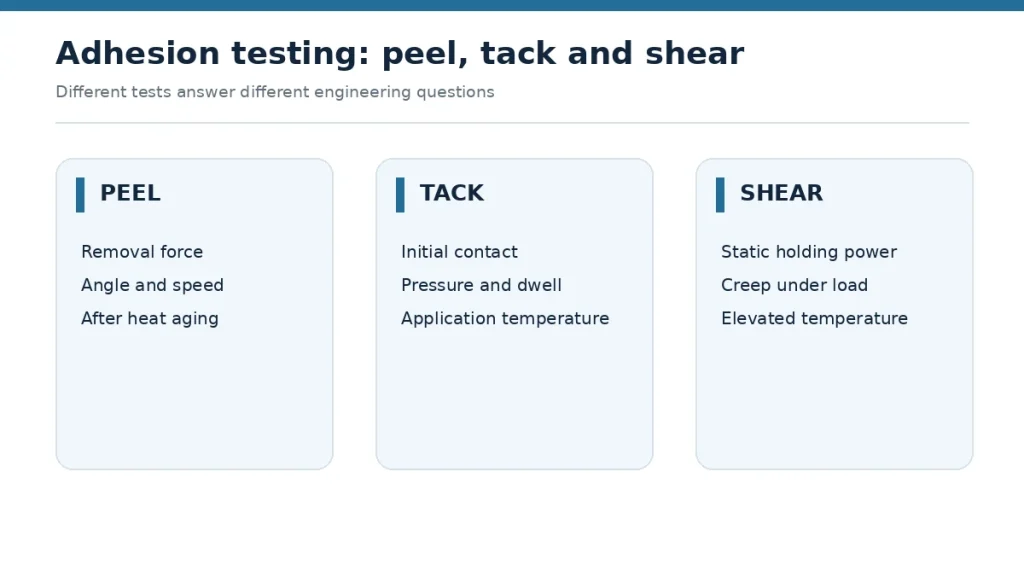
Three important PSA performance concepts are peel adhesion, tack and shear resistance.
They describe different behaviors and should not be treated as interchangeable.
Peel Adhesion
Peel adhesion describes the force required to remove an adhesive material under a defined peeling condition.
Test results depend on:
- Peel angle
- Peel speed
- Test substrate
- Sample width
- Application pressure
- Dwell time
- Temperature
A higher peel value is not always better.
For temporary masking, excessive peel adhesion may increase the risk of substrate damage or difficult removal.
For permanent insulation components, insufficient adhesion may lead to lifting or detachment.
Initial Tack
Tack describes how readily the adhesive develops adhesion during initial contact.
High tack can be useful in fast assembly operations.
However, high initial tack does not automatically indicate good long-term heat resistance or shear performance.
Shear Resistance
Shear resistance describes the adhesive’s ability to resist forces acting parallel to the bonded surface.
At elevated temperatures, an adhesive may gradually deform under load.
This behavior is particularly important for components installed vertically or subjected to sustained mechanical stress.
Relevant Test Methods
Commonly referenced methods include:
- ASTM D3330 — Peel adhesion of pressure-sensitive tape
- ASTM D3654 — Shear adhesion of pressure-sensitive tapes
- ASTM D2979 — Pressure-sensitive tack using an inverted probe machine
The selected method, conditions and reporting units must be stated when comparing test data.
Test After Thermal Aging
Initial adhesion measurements may not reveal long-term failure risks.
For demanding applications, consider evaluating:
- Initial adhesion
- Adhesion after heat aging
- Shear holding performance at service temperature
- Thermal cycling
- Removal force after exposure
- Adhesive residue
- Substrate damage
A meaningful qualification program should reflect the actual application.
6. Clean Removal, Adhesive Residue and Contamination
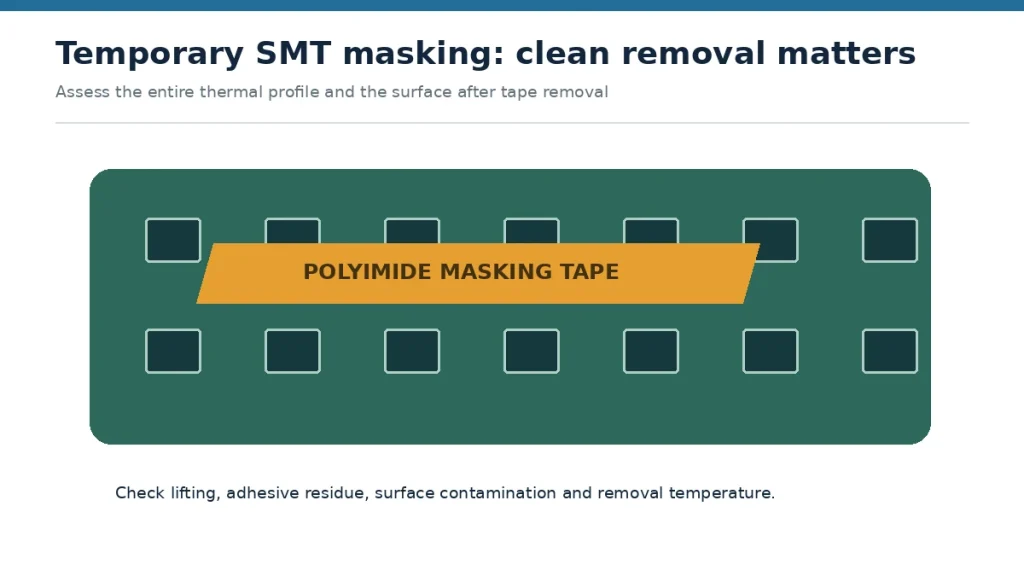
For temporary high-temperature masking, removal behavior can determine whether a tape is acceptable.
A tape may remain attached during processing but still fail the application if it leaves unacceptable adhesive residue.
Common Causes of Adhesive Residue
Potential causes include:
- Excessive temperature
- Extended dwell time
- Incompatible adhesive formulation
- Surface contamination
- Thermal degradation
- Incorrect removal conditions
- Interaction with surface coatings
Silicone Transfer vs Visible Residue
Visible adhesive residue and molecular-level surface contamination are not the same.
A surface may appear clean while still requiring contamination testing for sensitive downstream processes.
This can matter in electronics manufacturing, coating, bonding and semiconductor-related applications.
Where contamination control is critical, specify appropriate analytical or process-compatibility requirements.
How to Evaluate Clean Removal
Test the actual tape on the actual substrate.
Record:
- Heating profile
- Dwell time
- Number of cycles
- Cooling conditions
- Removal temperature
- Peel angle and speed
- Visible residue
- Surface condition after removal
For critical electronics applications, additional cleanliness testing may be necessary.
7. Selecting PSA by Industrial Application
Different applications require different adhesive priorities.
| Application | Candidate Starting Point | Main Qualification Requirement |
|---|---|---|
| SMT masking | Suitable silicone PSA tape | Heat-cycle survival and clean removal |
| Wave soldering protection | Grade-specific high-temperature masking tape | Thermal exposure, edge sealing and residue |
| Permanent electrical insulation | Qualified acrylic or silicone PSA laminate | Long-term adhesion, dielectric and thermal aging |
| Heat-sealing equipment | Silicone-adhesive PTFE fiberglass tape | Release performance, adhesion and heat endurance |
| Battery insulation parts | Application-qualified adhesive-backed film | Electrical, mechanical, thermal and aging validation |
| Industrial protective covers | Application-specific PSA | Surface compatibility, environmental exposure |
| Custom die-cut adhesive parts | Qualified adhesive and liner construction | Registration, cutting quality and assembly |
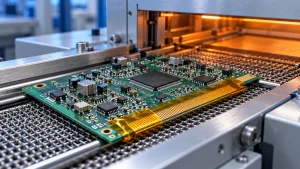
SMT and PCB Masking Applications
Polyimide tape with a suitable silicone adhesive is commonly evaluated for high-temperature electronics manufacturing.
Important performance requirements include:
- Adhesion during processing
- Resistance to edge lifting
- Suitable thermal endurance
- Clean removal
- Limited contamination
- Compatibility with the PCB surface
For a more detailed guide, read How to Choose High-Temperature Polyimide Tape for SMT Masking and Electrical Insulation.
Heat-Sealing and Packaging Equipment
PTFE-coated fiberglass tape with silicone adhesive is commonly used on heat-sealing surfaces.
In this construction, the PTFE-coated fiberglass provides the exposed release surface, while the adhesive attaches the tape to the equipment.
The two layers serve different functions.
See our High Temp PTFE Adhesive Tape for a relevant product example.
Battery and Power Electronics Insulation
Adhesive-backed PET, PI or other insulation films may be used to position or secure electrical insulation components.
However, the adhesive itself should not automatically be treated as a qualified electrical insulation layer.
The complete laminate must be evaluated for:
- Dielectric withstand
- Electrical insulation requirements
- Thermal aging
- Mechanical stress
- Bonding reliability
- Environmental exposure
- Applicable flammability requirements
Industrial Assembly and Protective Components
For permanent adhesive-backed components, the main priority may be long-term bond durability rather than easy removal.
The selected PSA should be tested on the actual equipment material under representative loading and environmental conditions.
8. Backing Film, Adhesive Thickness and Release Liner Selection
A high-temperature adhesive tape is a multi-layer construction.
Its performance depends on the interaction between the backing, adhesive and any processing layers.
Backing Film Selection
Common backing materials include:
- Polyimide film
- PET film
- PTFE-coated fiberglass fabric
- Selected PPS or PEN films
- Specialty insulation laminates
The backing must satisfy the required thermal, mechanical, electrical and dimensional performance.
Adhesive Thickness
Adhesive coat thickness can influence:
- Surface wetting
- Bonding to rough surfaces
- Conformability
- Total laminate thickness
- Edge ooze
- Cutting behavior
- Adhesive consumption
A thicker adhesive layer is not always better.
The appropriate coating weight or thickness should be established through application testing.
Release Liner
Release liners protect the adhesive before installation and can support die cutting or automated placement.
Important specifications include:
- Liner material
- Liner thickness
- Release force
- Dimensional stability
- Temperature exposure during converting
- Split-liner or tab requirements
The liner may be removed before the product enters service.
Do not assume it has the same temperature capability as the finished adhesive construction.
Single-Sided vs Double-Sided Adhesive
Single-sided adhesive films may be used for masking or protective attachment.
Double-sided constructions may be used for bonding two surfaces.
For some applications, different adhesive systems or adhesion levels may be required on each side.
Such constructions should be evaluated as complete laminates.
9. Common PSA Selection Mistakes and Failure Modes
Mistake 1: Selecting Only by Maximum Temperature Rating
A maximum temperature figure may refer to a short exposure rather than continuous service.
Better approach: Request the complete thermal exposure conditions and test results.
Mistake 2: Assuming Silicone PSA Always Removes Cleanly
Silicone PSAs can leave residue or transfer under unsuitable conditions.
Better approach: Validate removal on the actual substrate after the complete heating process.
Mistake 3: Ignoring the Bonding Surface
Adhesion to stainless steel does not prove adhesion to PTFE, silicone, PET or coated aluminum.
Better approach: Test on the actual surface and finish.
Mistake 4: Using Initial Tack as a Measure of Long-Term Reliability
A tape that bonds quickly may still creep or fail during thermal aging.
Better approach: Include peel, shear and aging tests.
Mistake 5: Confusing Film Thickness With Total Tape Thickness
The finished construction may include the backing, adhesive and liner.
Better approach: Specify each layer separately and clarify the measurement basis.
Mistake 6: Ignoring Adhesive Edge Lifting
Edge lifting may be caused by contamination, poor wetting, thermal shrinkage or mechanical stress.
Better approach: Review substrate preparation, application pressure, geometry and thermal cycling.
Mistake 7: Assuming a Material-Level Rating Qualifies the Assembly
Electrical, flammability or thermal data for one layer may not apply to the complete adhesive-backed product.
Better approach: Confirm which construction was actually tested and approved.
10. Custom Adhesive Coating and Precision Converting
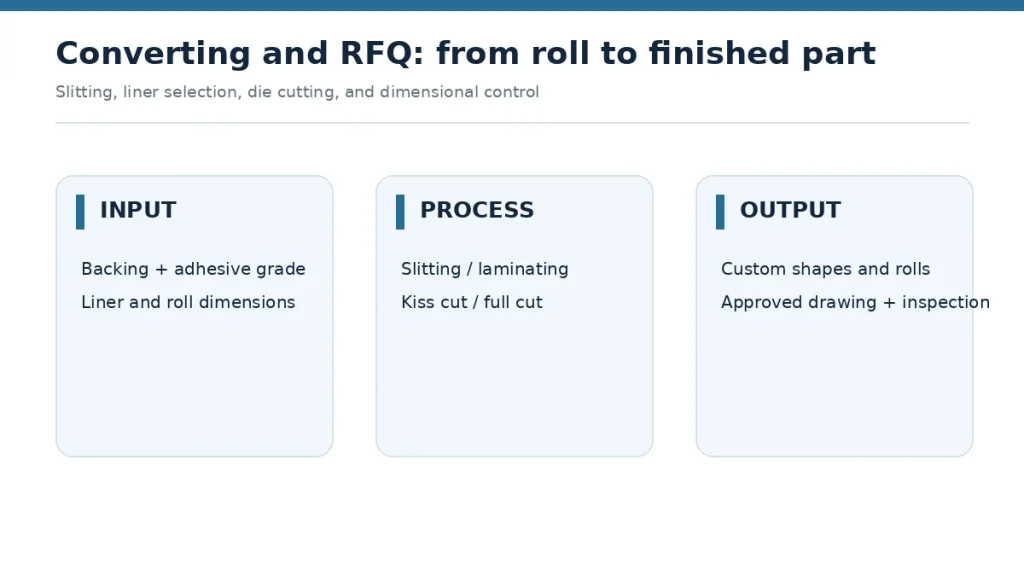
Industrial customers often require more than a standard adhesive tape roll.
Depending on the project, adhesive-backed materials may be supplied as:
- Custom-width rolls
- Cut sheets
- Adhesive-coated insulation films
- Kiss-cut parts on release liners
- Full-cut insulation components
- Custom gaskets and spacers
- Multi-layer laminated parts
Custom Adhesive Coating
Adhesive selection should consider the film substrate, bonding surface, temperature exposure and required adhesion performance.
HighTemp Material provides project-based Custom Adhesive Coating Services for suitable films, foams and industrial materials.
The available adhesive system, coating thickness, liner and finished construction are subject to technical evaluation.
Precision Slitting
Wide adhesive-coated master rolls may be converted into narrower widths.
Slitting quality depends on adhesive behavior, film thickness, winding tension and edge stability.
Explore our Precision Slitting Services for customized roll formats.
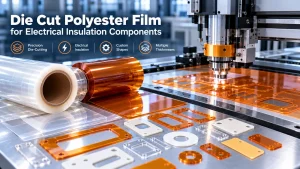
Die-Cut Adhesive-Backed Components
Adhesive-backed insulation materials may require holes, slots, custom profiles and controlled adhesive coverage.
The design should specify:
- Part dimensions
- Material thickness
- Adhesive pattern
- Release liner
- Critical tolerances
- Finished presentation
- Sample and production quantities
For multi-process projects, see our Precision Converting Services.
Why Early Manufacturing Review Matters
A technically suitable adhesive may still create production difficulties if it causes:
- Excessive die-cutting buildup
- Liner damage
- Adhesive edge ooze
- Poor roll winding
- Waste-removal problems
- Unstable dimensional registration
Early review of the complete material stack can help identify these risks before tooling approval.
11. High-Temperature PSA Selection Checklist
Before approving an adhesive-backed material, confirm the following requirements.
| Requirement | Information to Provide |
|---|---|
| Application | SMT masking, electrical insulation, industrial bonding or other |
| Adhesive chemistry | Silicone, acrylic, rubber-based or open to recommendation |
| Backing material | PI, PET, PTFE fiberglass or other |
| Bonding surface | Exact material, finish and coating |
| Continuous temperature | Actual long-term bondline temperature |
| Peak temperature | Maximum temperature and exposure duration |
| Thermal cycling | Number of cycles and temperature range |
| Adhesion requirements | Peel, tack, shear or other functional tests |
| Removability | Permanent, repositionable or clean-removal |
| Contamination limits | Residue, silicone transfer or cleanliness requirements |
| Thickness | Backing, adhesive and total construction |
| Liner | Type, thickness and release characteristics |
| Finished dimensions | Width, roll length or part drawing |
| Quantity | Prototype and annual demand |
| Documentation | TDS, test reports, declarations and customer specifications |
Recommended Qualification Process
Define the application → Identify the bonding surface → Confirm the temperature profile → Select candidate adhesive grades → Evaluate peel, tack and shear → Conduct thermal aging and removal tests → Validate the complete construction.
This approach is more reliable than choosing an adhesive solely from a temperature rating or product description.
12. Request High-Temperature Adhesive and Converting Support
HighTemp Material supplies high-temperature insulation materials, industrial adhesive tapes and precision-converting solutions.
Our relevant product and service areas include:
- Polyimide adhesive tapes
- PTFE-coated fiberglass adhesive tapes
- Adhesive-backed insulation films
- Custom adhesive coating
- Precision slitting
- Lamination and die-cut components
- Drawing-based converting evaluation
For a quotation or technical discussion, please provide:
- Application and bonding substrate
- Continuous and peak temperature requirements
- Preferred backing film and adhesive type
- Required thickness and dimensions
- Peel, shear or clean-removal requirements
- Estimated quantity
- Required documentation or test methods
We can review suitable material and converting options based on the project requirements.
Contact HighTemp Material to discuss your high-temperature adhesive-backed material requirements.
Frequently Asked Questions
What is the best pressure-sensitive adhesive for high-temperature applications?
There is no universal best adhesive. Silicone PSAs are frequently considered for demanding heat exposure, while specialty acrylic PSAs may be suitable for long-term bonding. The correct grade depends on temperature, substrate, loading and required service life.
Is silicone adhesive always better than acrylic adhesive at high temperatures?
No. Performance depends on the specific formulation and test conditions. A specialty acrylic PSA may outperform a particular silicone PSA in some applications. Compare grade-specific data under representative conditions.
Can high-temperature adhesive tape be removed without residue?
Some tapes are designed for clean removal, but performance depends on the substrate, thermal history, dwell time and removal conditions. Clean removal should be validated in the actual process.
What is the difference between peel adhesion and shear resistance?
Peel adhesion measures resistance to removal under a defined peeling condition. Shear resistance describes the ability to resist forces acting parallel to the bond. Both may be important in high-temperature applications.
Can acrylic PSA be used on polyimide film?
Yes, suitable acrylic PSA formulations can be used in selected polyimide film constructions. Adhesion, thermal performance and electrical requirements must be evaluated for the specific film and adhesive combination.
Why is PTFE difficult to bond with pressure-sensitive adhesive?
PTFE has low surface energy, which makes wetting and adhesion challenging for many conventional adhesives. Specialized adhesive systems or surface treatment may be required.
Does a 260°C polyimide tape rating mean the adhesive can withstand 260°C continuously?
Not necessarily. The rating must be checked against the exact tape grade, adhesive formulation, exposure duration and test conditions. The backing and adhesive may have different limitations.
Can high-temperature adhesive films be custom slit or die-cut?
Yes. Suitable adhesive-backed films can be converted into custom rolls, sheets and die-cut components. Feasibility depends on the material stack, adhesive properties, liner, geometry and required tolerances.
Conclusion
Selecting a high-temperature pressure-sensitive adhesive requires a balanced evaluation of adhesive chemistry, substrate compatibility, temperature exposure, mechanical loading and long-term reliability.
Silicone, acrylic and rubber-based PSAs each have different strengths, but their actual performance depends on the specific formulation and application.
For temporary masking, clean removal and contamination control may be the deciding factors.
For permanent electrical insulation and industrial bonding, long-term adhesion, shear resistance and thermal aging performance may be more important.
Engineers should evaluate the complete adhesive-backed construction rather than relying on a single temperature rating.
HighTemp Material supports high-temperature tape sourcing, adhesive coating and precision-converting discussions for industrial customers.
Request a High-Temperature Adhesive Material Quote
Technical References and Further Reading
- ASTM D3330 — Peel Adhesion of Pressure-Sensitive Tape
- ASTM D3654 — Shear Adhesion of Pressure-Sensitive Tapes
- ASTM D2979 — Pressure-Sensitive Tack of Adhesives
- HighTemp Material — High-Temperature Polyimide Tape Selection Guide
Engineering disclaimer: This guide provides preliminary selection considerations. No universal temperature rating, adhesion value, clean-removal performance or certification is implied for all products within an adhesive family. Final selection requires grade-specific documentation and testing under the intended operating conditions.