

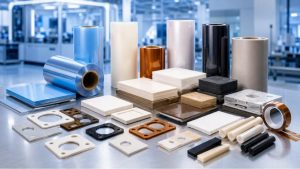
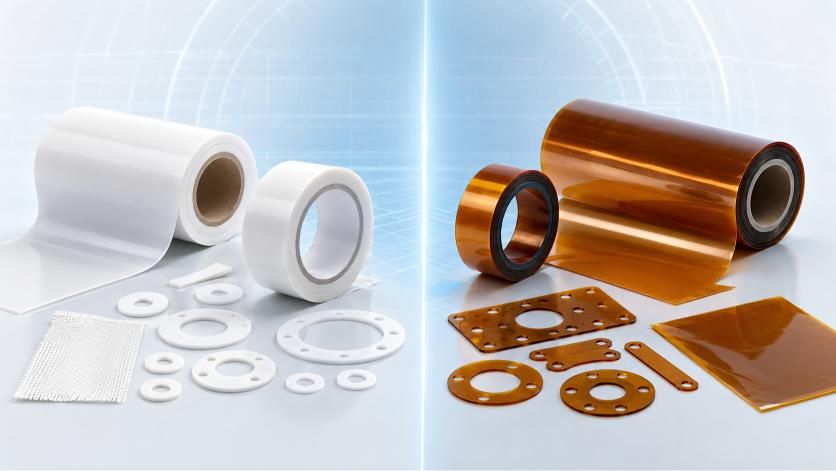
PTFE and PI are two of the most widely used high-performance polymer materials in electrical insulation, electronics manufacturing, chemical processing, lithium batteries, aerospace and other demanding industrial applications.
Both materials can withstand elevated temperatures and provide excellent electrical insulation. However, they differ significantly in chemical resistance, mechanical strength, dimensional stability, surface properties and processing performance.
Choosing between PTFE and PI is therefore not simply a question of which material is “better.” The correct choice depends on the actual operating environment and the function the material must perform.
This PTFE vs PI comparison explains seven important differences between the two materials and provides a practical selection guide for engineers, designers and industrial buyers.
What is PTFE?
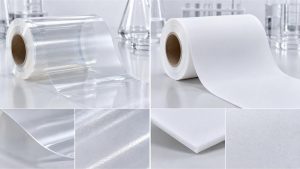
PTFE stands for polytetrafluoroethylene. It is a fluoropolymer known for its excellent chemical resistance, low coefficient of friction, non-stick surface and wide operating temperature range.
PTFE is commonly used in applications involving aggressive chemicals, high temperatures, sliding contact, electrical insulation or low surface adhesion.
Common PTFE products include:
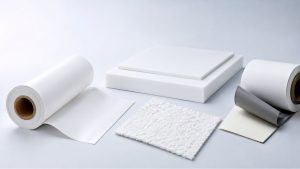
- Skived pure PTFE film
- High-temperature PTFE adhesive tape
- Fiberglass-reinforced PTFE coated cloth
- ePTFE microporous breathable film
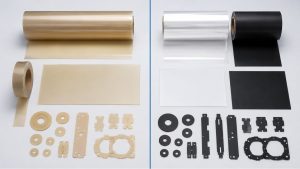
- Custom die-cut PTFE washers
- Custom PTFE gaskets and insulation parts
Depending on the grade and construction, PTFE materials are commonly used across a broad temperature range. Standard PTFE is often suitable for continuous operation up to approximately 260°C, although the final working limit depends on thickness, load, pressure, adhesive system and application conditions.
Main Advantages of PTFE
PTFE provides several important advantages:
- Exceptional chemical resistance
- Very low friction
- Excellent non-stick properties
- Good electrical insulation
- Low moisture absorption
- Wide service temperature range
- Strong resistance to weathering and ultraviolet exposure
- Good performance in corrosive environments
These characteristics make PTFE particularly suitable for chemical equipment, seals, release surfaces, sliding components and high-temperature processing systems.
What is PI?
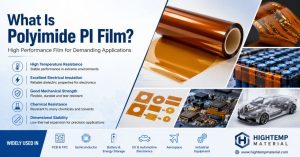
PI stands for polyimide. It is a high-performance polymer known for its excellent thermal stability, dielectric strength, mechanical strength and dimensional stability.
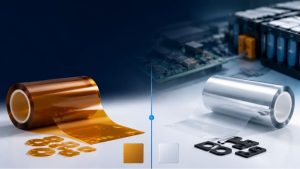
Polyimide film is often recognized by its transparent amber appearance, although black, matte, antistatic and laminated grades are also available.
Common PI products include:
- Plain PI base film
- Black matte PI masking film
- Anti-static ESD PI film
- FEP laminated PI film
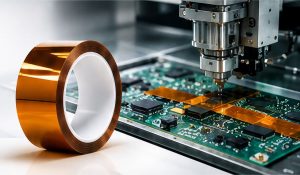
- High-temperature PI Kapton tape
- Custom die-cut PI insulation pads
PI film can remain thin, flexible and mechanically strong under demanding thermal and electrical conditions. These properties make it especially valuable in compact electronic assemblies where limited installation space requires a thin insulation layer.
Depending on the grade, PI materials can provide long-term temperature resistance around 260°C, with some constructions tolerating higher temperatures for short periods. Actual performance must be confirmed for the selected grade and application.
Main Advantages of PI
PI offers:
- High dielectric strength
- Excellent thermal stability
- Strong mechanical performance
- Good dimensional stability
- High tensile strength
- Excellent flexibility at low thickness
- Good radiation resistance
- Compatibility with precision die cutting
- Reliable performance in electronic applications
PI film is commonly used in PCB manufacturing, motors, transformers, lithium batteries, semiconductor equipment and aerospace electronics.
PTFE vs PI: Quick Comparison
| Property | PTFE | PI |
|---|---|---|
| Material family | Fluoropolymer | High-performance aromatic polymer |
| Typical appearance | White, translucent or colored | Amber, transparent, black or coated |
| Continuous heat resistance | Commonly up to approximately 260°C | Commonly up to approximately 260°C |
| Short-term heat resistance | Depends on grade and mechanical load | Some grades can tolerate approximately 300°C short term |
| Chemical resistance | Exceptional | Good, but more chemical-dependent |
| Electrical insulation | Excellent | Excellent, especially in thin-film applications |
| Mechanical strength | Relatively soft and flexible | Higher tensile and tear strength |
| Dimensional stability | Lower under load | Generally better |
| Coefficient of friction | Extremely low | Higher than PTFE |
| Surface adhesion | Naturally difficult to bond | Easier to coat, laminate and bond |
| Moisture absorption | Extremely low | Higher than PTFE |
| Common forms | Film, tape, sheet, coated cloth, gasket and washer | Film, tape, laminated film and die-cut insulation pad |
| Typical applications | Chemical sealing, release surfaces and low-friction insulation | Electronics, PCB masking and compact electrical insulation |
The values and behavior shown above are general comparisons. Actual performance varies according to material grade, thickness, fillers, coatings, adhesives and operating conditions.
1. Temperature Resistance
Temperature resistance is often the first factor considered when comparing PTFE vs PI.
Both materials can perform at high temperatures, and both are commonly used in applications approaching 260°C. However, they behave differently when exposed to heat and mechanical stress.
PTFE Temperature Performance
PTFE maintains its chemical stability and electrical insulation across a wide temperature range. It is frequently used in high-temperature sealing, chemical processing and industrial release applications.
However, PTFE is relatively soft and may deform under continuous mechanical pressure at elevated temperatures. Designers must consider creep, compression and mechanical load when selecting PTFE for structural or sealing components.
PI Temperature Performance
PI film maintains high mechanical strength and dimensional stability at elevated temperatures. It is therefore widely used in thin electrical insulation, flexible circuits, high-temperature masking and precision electronic components.
For applications requiring a thin film that must remain stable during soldering, lamination or high-temperature processing, PI is often the more suitable choice.
Which One Should You Choose?
Choose PTFE when chemical stability, release performance or low friction is the main requirement.
Choose PI when the material must remain thin, mechanically strong and dimensionally stable during high-temperature processing.
2. Electrical Insulation Performance
Both PTFE and PI are excellent electrical insulation materials, but they are typically used in different types of insulation systems.
PTFE provides high electrical resistance, low dielectric loss and stable performance in humid or chemically aggressive environments. It is suitable for cables, connectors, high-frequency components, washers and electrical isolation parts.
PI film offers excellent dielectric strength even at very low thicknesses. This makes it particularly useful where installation space is limited.
Typical PI electrical insulation applications include:
- Flexible printed circuits
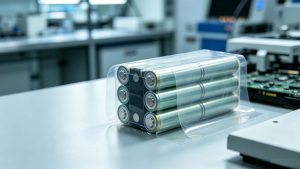
- Battery cell insulation
- Motor and transformer insulation
- Busbar insulation
- Coil wrapping
- Semiconductor manufacturing
- Electronic component isolation
- Precision die-cut insulation pads
For compact electronics requiring thin and mechanically strong insulation, PI is often preferred. For chemically resistant insulation or low-loss applications, PTFE may offer greater advantages.
3. Chemical Resistance
Chemical resistance is one of the clearest differences between PTFE and PI.
PTFE is highly resistant to most industrial chemicals, solvents, acids and alkalis. Its stable fluoropolymer structure makes it a preferred material for corrosive processing environments.
PTFE products are commonly used in:
- Chemical equipment
- Pipe and flange sealing
- Laboratory equipment
- Valve and pump components
- Chemical-resistant electrical insulation
- Semiconductor processing
- Industrial tank and vessel systems
PI also provides useful chemical resistance, but its performance depends more strongly on the chemical, concentration, temperature and exposure time. Certain strong alkalis, acids and solvents may affect some polyimide grades.
If the component will be continuously exposed to aggressive chemicals, PTFE is generally the safer starting point. Application-specific compatibility testing is still recommended.
4. Mechanical Strength and Dimensional Stability
PI generally provides higher tensile strength, better tear resistance and greater dimensional stability than unfilled PTFE.
This is important when the material must:
- Hold a precise shape
- Maintain small holes or narrow edges
- Resist tearing during installation
- Remain stable during die cutting
- Withstand repeated handling
- Fit into a compact electronic assembly
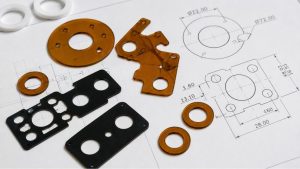
Custom die-cut PI insulation pads can be manufactured with precise holes, slots, frames and complex profiles. Depending on the material and component design, tight die-cutting tolerances can be achieved.
PTFE is softer and more likely to deform under pressure. This characteristic can be beneficial for sealing because the material can conform to irregular surfaces.
However, PTFE creep must be considered when a gasket or washer is exposed to long-term compression.
Selection Recommendation
Choose PI for thin, precise and dimensionally stable electrical components.
Choose PTFE for conformable sealing components, chemical-resistant washers and applications requiring low surface friction.
5. Friction and Non-Stick Performance
PTFE has one of the lowest coefficients of friction among engineering polymers. Its non-stick surface prevents many materials, adhesives and process residues from bonding easily.
This makes PTFE suitable for:
- Release liners and release surfaces
- Heat-sealing equipment
- Packaging machinery
- Conveyor systems
- Sliding components
- Lamination equipment
- Adhesive processing
- Mold-release applications
Fiberglass-reinforced PTFE coated cloth combines the release and chemical properties of PTFE with the dimensional strength of fiberglass fabric. It can be used for conveyor belts, release sheets and heat-processing equipment.
PI does not provide the same level of natural non-stick or low-friction performance. PI should therefore not be selected as a direct replacement when release performance is the primary requirement.
6. Bonding and Adhesive Compatibility
PTFE has extremely low surface energy. While this creates excellent non-stick properties, it also makes the material difficult to bond.
When PTFE must be laminated or attached with adhesive, surface treatment or a specially formulated adhesive system may be required.
High-temperature PTFE adhesive tape normally combines a PTFE film or PTFE-coated fabric backing with a pressure-sensitive adhesive selected according to the operating environment.
PI has better compatibility with coatings and adhesives. PI film is commonly coated with silicone adhesive to produce high-temperature masking tape.
High-temperature PI tape is frequently used in:
- PCB soldering and masking
- Powder coating
- Electronic component protection
- Battery assembly
- Coil insulation
- High-temperature manufacturing
- Semiconductor processing
If easy bonding or adhesive coating is important, PI is normally more convenient. If non-stick performance is required, PTFE is the better choice.
7. Processing and Custom Die Cutting
Both PTFE and PI can be converted into custom components, but they require different processing considerations.
PTFE Converting Options
PTFE materials can be processed into:
- Washers
- Gaskets
- Sealing rings
- Insulation spacers
- Sliding pads
- Release sheets
- Adhesive-backed components
- Custom strips and profiles
Because PTFE is soft and may deform during processing, tooling, cutting speed and material support must be carefully controlled.
PI Converting Options
PI film can be processed into:
- Electrical insulation pads
- Battery insulation components
- Terminal barriers
- PCB masking shapes
- Motor insulation parts
- Electronic protective films
- Adhesive-backed die-cut parts
- Components with small holes and narrow edges
PI film is especially suitable for precision converting because it offers high strength at low thickness.
Available converting services may include:
- Precision die cutting
- CNC cutting
- Slitting and rewinding
- Sheet cutting
- Kiss cutting
- Adhesive lamination
- Multi-layer lamination
- Protective liner application
- Prototype sampling
The final process should be selected according to material thickness, dimensions, tolerances, order quantity and assembly method.
PTFE vs PI by Application
PCB and FPC Manufacturing
PI is usually the preferred material for PCB and FPC masking because it offers high-temperature resistance, dimensional stability and good adhesive compatibility.
High-temperature PI Kapton tape can protect contacts, terminals and sensitive areas during soldering, reflow, lamination and other electronic processes.
PTFE may be selected for release sheets, non-stick processing surfaces and chemically resistant insulation around manufacturing equipment.
Recommended material: PI for masking and thin electrical insulation; PTFE for release and low-friction surfaces.
Lithium Battery Insulation
PI film and custom die-cut PI pads are suitable for battery cell insulation, terminal protection, busbar isolation and compact electronic components.
PTFE may be used where chemical resistance, low moisture absorption or special dielectric properties are required.
Recommended material: PI for thin, strong battery insulation; PTFE for special chemical-resistant or low-friction components.
High-Temperature Sealing
PTFE is commonly used for chemical-resistant gaskets, washers and seals. Its soft structure allows it to conform to sealing surfaces.
PI film is generally not the first choice for compressible sealing applications.
Recommended material: PTFE.
Chemical Processing
PTFE is usually preferred for components exposed to aggressive chemicals, solvents or corrosive environments.
Recommended material: PTFE.
Semiconductor Equipment
Both materials may be used in semiconductor manufacturing.
PTFE is suitable for chemically resistant components, tubing, seals and low-friction surfaces. PI is suitable for thin electrical insulation, precision masking and high-temperature electronic components.
Recommended material: Depends on whether chemical resistance or thin precision insulation is the primary requirement.
Motors and Transformers
PI is widely used for coil wrapping, slot insulation and electrical isolation because of its dielectric strength and flexibility.
Recommended material: PI.
Release and Non-Stick Applications
PTFE is the clear choice for release sheets, heat-sealing surfaces, conveyor belts and other low-friction applications.
Recommended material: PTFE.
When Should You Choose PTFE?
PTFE is generally the better option when your application requires:
- Exceptional chemical resistance
- Very low friction
- A non-stick or release surface
- Low moisture absorption
- Resistance to outdoor weathering
- Chemical-resistant sealing
- Conformable gaskets or washers
- Stable dielectric properties in harsh environments
Suitable products may include skived PTFE film, high-temperature PTFE adhesive tape, fiberglass-reinforced PTFE cloth and custom die-cut PTFE gaskets.
When Should You Choose PI?
PI is generally the better option when your application requires:
- High dielectric strength at low thickness
- Excellent dimensional stability
- Strong mechanical performance
- Precision die-cutting capability
- High-temperature masking
- Thin electrical insulation
- Flexible circuit compatibility
- Reliable performance in compact electronic assemblies
Suitable products may include plain PI film, black matte PI masking film, anti-static ESD PI film, FEP laminated PI film, PI Kapton tape and custom die-cut PI insulation pads.
Can PTFE and PI Be Combined?
In some applications, PTFE and PI do not have to be competing options. A multi-material solution may use both materials to perform different functions.
For example:
- PI film may provide thin electrical insulation.
- PTFE may provide a low-friction or chemical-resistant surface.
- FEP-laminated PI film may combine the strength of PI with additional fluoropolymer surface characteristics.
- PTFE components may be installed around chemical contact areas, while PI components protect nearby electronic circuits.
The suitability of a composite structure depends on temperature, bonding method, thermal expansion and processing conditions.
Practical Material Selection Checklist
Before selecting PTFE or PI, provide the following application details to your material supplier:
- Continuous and maximum operating temperature
- Required material thickness
- Working voltage and dielectric requirements
- Chemicals or solvents in contact with the material
- Mechanical load and compression
- Required coefficient of friction
- Component dimensions and tolerance
- Adhesive or lamination requirements
- Indoor or outdoor operating conditions
- Expected order quantity
- Applicable flame-retardant or industry standards
- Drawing, sample or installation diagram
Providing complete information allows the supplier to recommend a more accurate material grade and converting process.
Frequently Asked Questions
Is PTFE the same as polyimide?
No. PTFE is a fluoropolymer known for chemical resistance, low friction and non-stick performance. Polyimide is a high-performance polymer known for thermal stability, mechanical strength and thin-film electrical insulation.
Is Kapton PTFE or PI?
Kapton is a well-known brand of polyimide film. It is not PTFE. In general product descriptions, “PI tape” or “polyimide tape” is more appropriate unless the material is confirmed to use the specific branded film.
Which material has better heat resistance?
Both PTFE and PI can operate at high temperatures. Standard grades are commonly used around 260°C, but PI generally provides better mechanical and dimensional stability at elevated temperatures. PTFE provides stronger chemical and non-stick performance.
Which material offers better electrical insulation?
Both materials provide excellent electrical insulation. PI is often preferred for thin, compact electronic components, while PTFE is valuable in high-frequency, humid and chemically aggressive environments.
Which material is better for chemical resistance?
PTFE generally provides better resistance to aggressive chemicals, acids, alkalis and solvents.
Which material is better for PCB masking?
PI tape is generally preferred for PCB soldering, reflow and high-temperature masking because it combines thermal stability with a suitable adhesive system.
Can PTFE and PI materials be die cut?
Yes. Both materials can be die cut into custom parts. PI is particularly suitable for thin, precise insulation components, while PTFE is widely converted into gaskets, washers, seals and low-friction parts.
How do I select the correct thickness?
The correct thickness depends on dielectric requirements, mechanical load, available space, sealing pressure and processing conditions. Testing samples in the actual assembly is recommended before mass production.
Conclusion: PTFE or PI?
The PTFE vs PI decision depends on the primary function of the component.
Choose PTFE when you need outstanding chemical resistance, low friction, non-stick performance, low moisture absorption or reliable sealing.
Choose PI when you need thin electrical insulation, dimensional stability, mechanical strength, high-temperature masking or precision die-cut components.
If your application includes several requirements, the best solution may involve a modified grade, adhesive-backed construction, laminated material or combination of PTFE and PI components.
We supply PTFE films, PTFE adhesive tapes, PTFE coated fabrics, custom PTFE gaskets, PI films, high-temperature PI tapes and precision die-cut PI insulation parts.
Contact us with your drawing, dimensions, operating temperature, chemical environment and electrical requirements. Our team can help you compare suitable materials and prepare samples for testing.