
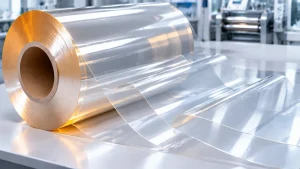

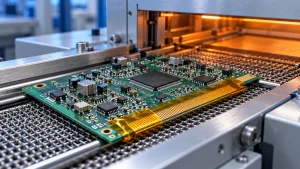



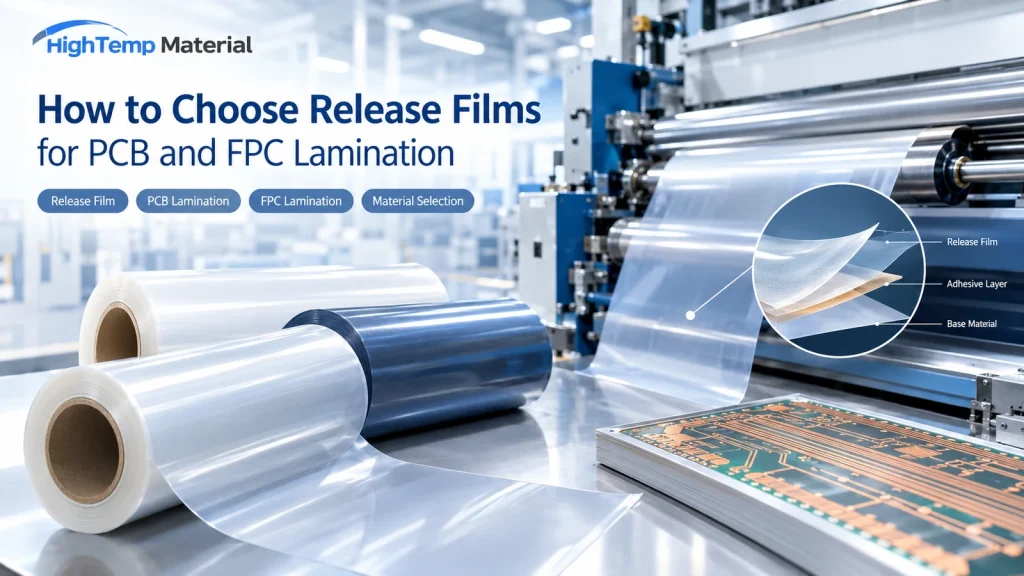
Release films are important process materials in printed circuit board (PCB) and flexible printed circuit (FPC) manufacturing. Although they are often treated as auxiliary consumables, their surface characteristics, thermal behavior, thickness consistency, and compatibility with the lamination system can influence process stability, surface quality, contamination control, and production yield.
Selecting a release film by polymer name alone is rarely sufficient. A film that performs well in one press cycle may not behave the same way with a different resin system, copper pattern, press configuration, pressure profile, or cooling procedure.
This guide explains how to select release films for PCB and FPC lamination, compare common material options, identify failure risks, establish a practical qualification plan, and prepare a technically complete request for quotation (RFQ).
1. What Is a Release Film in PCB and FPC Lamination?
A release film is a temporary process layer used to help separate a laminated assembly from adjacent surfaces or process components. Depending on the manufacturing process, it may also serve as a protective barrier, help control surface transfer, or reduce unwanted bonding between the workpiece and neighboring tooling materials.
Release films may be used in rigid PCB multilayer pressing, flexible circuit lamination, coverlay processing, and other electronic-material manufacturing operations. The required film construction depends on the actual stack-up and the role assigned to the film.
How does a release film work?
During lamination, the material stack may experience elevated temperature, applied pressure, resin flow, and subsequent cooling. The release film remains at an interface where unwanted adhesion or transfer must be controlled.
Its performance depends on several interacting properties:
- Release behavior: The force and consistency required to separate the film after processing.
- Thermal stability: The ability to maintain acceptable physical properties throughout the actual temperature-time cycle.
- Surface characteristics: Smoothness, texture, coating uniformity, and the potential to transfer surface features.
- Dimensional stability: Resistance to unacceptable shrinkage, distortion, wrinkling, or movement.
- Chemical compatibility: Resistance to interaction with resin, additives, cleaning agents, and other process chemicals.
- Cleanliness: The ability to avoid unacceptable particles, residue, coating transfer, or other contamination.
A release film is not necessarily a permanent component of the finished PCB or FPC. Its function, placement, and removal sequence should be defined in the process specification.
Why does release-film selection matter?
An unsuitable film may contribute to difficult separation, surface marks, contamination, local deformation, or inconsistent results between press cycles. These defects may also originate from resin formulation, tooling condition, press setup, handling, or cooling. Film selection should therefore be part of a controlled process evaluation rather than the default explanation for every lamination defect.
2. Understand the Release-Film Layer Stack
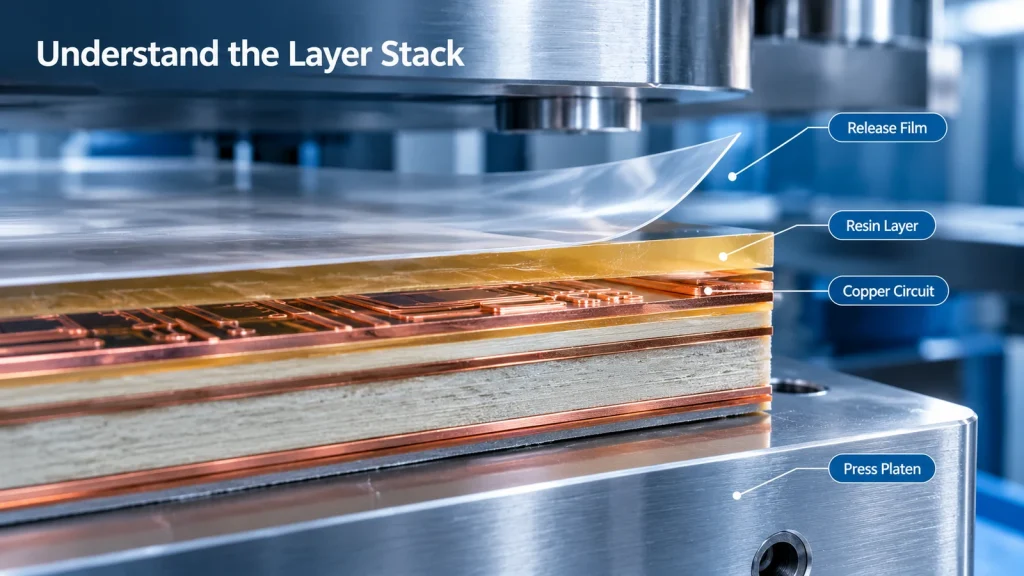
Before comparing materials, identify exactly where the release film sits in the assembly.
A simplified rigid PCB lamination stack may contain press tooling, a release film, copper-clad laminates or prepreg, additional release or separation layers, and a press platen. The actual sequence varies by process.
An FPC process may involve flexible copper-clad laminate, coverlay adhesive, protective layers, release materials, and flat or roll-based pressing equipment.
Define the interface first
Ask these questions before requesting samples:
- Which two surfaces contact the release film?
- Does the film contact uncured or partially cured resin, adhesive, copper, coverlay, or tooling?
- Must the film release from one surface or both?
- Is surface replication or a controlled surface finish important?
- Does the process require a barrier against resin transfer?
- Is the film used once, or is reuse being considered?
- Is the process static, vacuum-assisted, platen-based, or roll-to-roll?
These details help distinguish a true release-film requirement from a general protective-film, separator, or electrical-insulation requirement.
A polymer suitable for electrical insulation is not automatically qualified as a release film. The release function must be evaluated in the actual interface and process.
3. Core Factors for Selecting Release Films
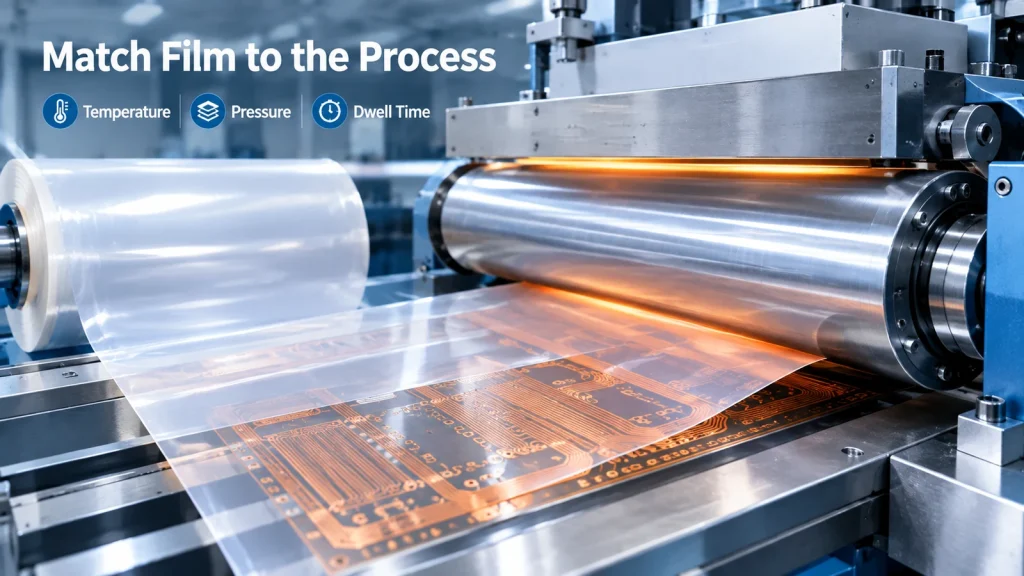
3.1 Temperature and exposure time
The nominal maximum temperature of a polymer does not establish its suitability for a particular lamination cycle.
Qualification should consider the complete thermal profile, including:
- Peak film temperature, not just the press controller setting.
- Time at elevated temperature.
- Heating and cooling rates.
- Number of thermal cycles.
- Applied pressure and mechanical constraint.
- Contact with resin, adhesive, solvents, or cleaning chemicals.
- Any requirement for dimensional stability after cooling.
A film may tolerate a short thermal exposure but behave differently during a longer cycle or repeated processing. Coatings and surface treatments may also have different limits from the base polymer.
Request grade-specific thermal information and confirm that the supplier’s stated test conditions are relevant to the intended process.
3.2 Release force and separation behavior
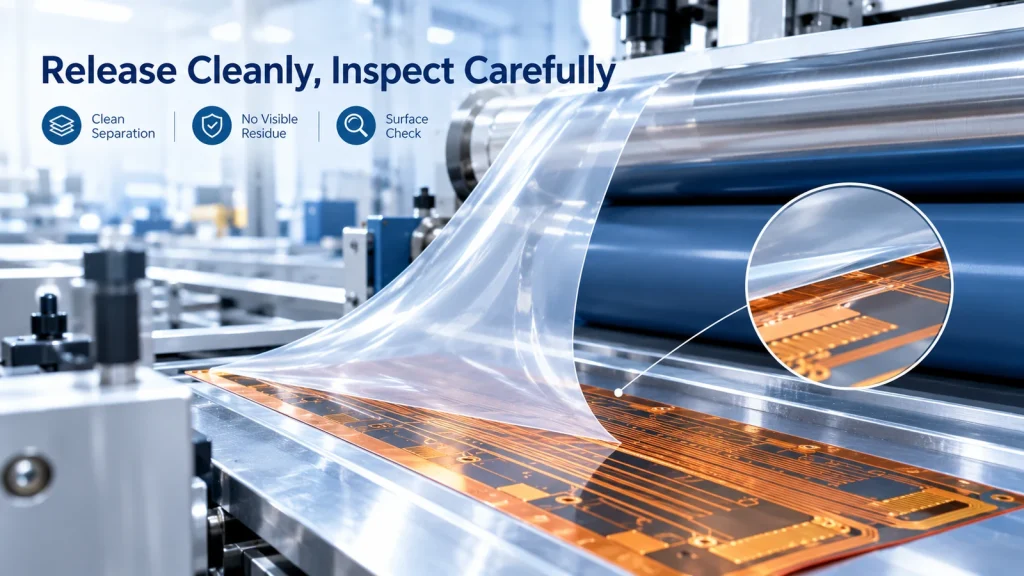
Release performance should be assessed using the actual contacting materials and a defined separation procedure.
A useful evaluation records:
- Whether separation is complete.
- Whether release force is consistent across the sample.
- Whether force changes after thermal exposure.
- Whether residue or surface transfer occurs.
- Whether the film tears, stretches, or deforms during removal.
- Whether release behavior varies across the width or between lots.
Low release force is not always the only objective. The film must also remain stable during handling and processing. The acceptable balance depends on the process design.
When quantitative release-force limits are required, define the test geometry, peel angle, test speed, temperature, conditioning, and reporting units. Do not compare measurements taken under different methods as if they were directly equivalent.
3.3 Thickness and thickness uniformity
Thickness influences handling, stack height, flexibility, conformity, and dimensional behavior. Depending on the process, variations may affect local contact conditions or the consistency of the resulting surface.
Specify:
- Nominal thickness.
- Permitted thickness tolerance.
- Measurement method and conditioning.
- Widthwise and lengthwise uniformity requirements.
- Whether thickness refers to the base film or the complete coated construction.
- Required roll width, roll length, and core dimensions.
For coated films, distinguish the substrate thickness from the coating thickness and total construction thickness. A supplier’s nominal thickness alone may not describe the functional interface.
3.4 Surface finish and transfer risk
Surface finish can matter when the laminated product requires a controlled appearance, texture, or interface condition.
Relevant variables include surface roughness, gloss, coating uniformity, scratches, embedded particles, and the potential for surface transfer during heating or separation.
Where surface quality is critical, establish a reference standard and inspection method. Visual comparison under controlled lighting may be appropriate for initial screening, while more demanding applications may require instrumental surface measurements.
Do not assume that a smoother film always produces a better result. The required surface depends on the laminate design and the role of the film.
3.5 Chemical compatibility
The film may contact resin systems, adhesive formulations, release coatings, cleaning chemicals, or other process materials.
Evaluate whether exposure could cause:
- Swelling or softening.
- Surface-treatment degradation.
- Coating transfer.
- Residue formation.
- Unwanted interaction with the resin or adhesive.
- Changes in release behavior after exposure.
Compatibility should be verified using the actual material system and process conditions whenever the consequences of incompatibility are significant.
3.6 Dimensional stability and handling
A film that shrinks, curls, wrinkles, or wanders during processing can create handling problems and uneven coverage.
Consider:
- Thermal shrinkage in both machine and transverse directions.
- Curl and flatness.
- Web tension and roll handling.
- Edge quality and winding consistency.
- Surface damage during storage or installation.
- Ability to conform to the required stack geometry.
These characteristics are particularly important for large-format sheets, thin flexible films, and automated roll-to-roll operations.
3.7 Cleanliness and contamination control
A film can meet dimensional requirements but still be unsuitable if it introduces particles, residue, or unwanted surface transfer.
Define acceptable cleanliness requirements according to the application. These may include visual inspection, particle assessment, residue checks, or chemical analysis where justified by the risk.
Packaging and handling matter as well. Specify protective packaging, storage conditions, roll-edge protection, traceability, and any restrictions on silicone-containing materials or other contaminants.
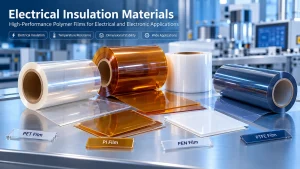
4. Release Film Material Comparison
The following table is a preliminary engineering comparison, not a ranking of universally suitable materials. The performance of a specific release film depends on its grade, coating or treatment, construction, thickness, and the actual lamination process.
| Material or construction | Potential advantages | Key limitations or risks | When to investigate it |
|---|---|---|---|
| PET film | Often offers good dimensional handling, clarity, and converting flexibility | Thermal shrinkage, softening, or surface changes may limit suitability under a particular cycle | Processes where a PET grade has been qualified for the actual temperature and exposure |
| PTFE film | Low surface energy, low friction, and strong chemical resistance are useful characteristics of PTFE | Flexibility, deformation, handling, surface condition, and process-specific release behavior still require evaluation | Applications where low adhesion and chemical resistance are important |
| FEP film | Fluoropolymer chemistry can provide useful release and chemical-resistance characteristics | Thermal and mechanical limits must be checked for the specific grade and process | Processes requiring a fluoropolymer film with a different construction or processing profile from PTFE |
| PI film | Can be considered where thermal capability and mechanical integrity are important | Base-film performance does not establish release behavior; surface treatment or coating may be necessary | High-temperature processes where a qualified PI construction meets the interface requirements |
| Coated or treated film | A surface coating may be designed to provide a particular release interface | Coating durability, transfer, compatibility, and coating uniformity become additional qualification factors | Applications requiring a specified release surface or controlled interface |
| Other engineered release constructions | May address specialized surface, handling, or process requirements | Availability, composition, test evidence, and process compatibility must be established | Cases where standard film constructions do not meet the requirements |
How should engineers interpret this comparison?
Do not choose a film solely because the base polymer is commonly associated with heat resistance or low friction. A coated PET film and an uncoated PET film may behave very differently. Likewise, an uncoated fluoropolymer film and a treated or laminated construction should not be treated as interchangeable.
Ask the supplier to identify the exact construction, intended use, available technical documentation, and any limitations relevant to the process.
HighTemp Material provides product information for skived pure PTFE film and a technical data sheet reference page, which lists a PCB/FPC lamination PET release-film entry. Confirm the exact product grade, release surface, construction, and applicable technical data before specifying either material for a production process.
5. Typical Industrial Applications
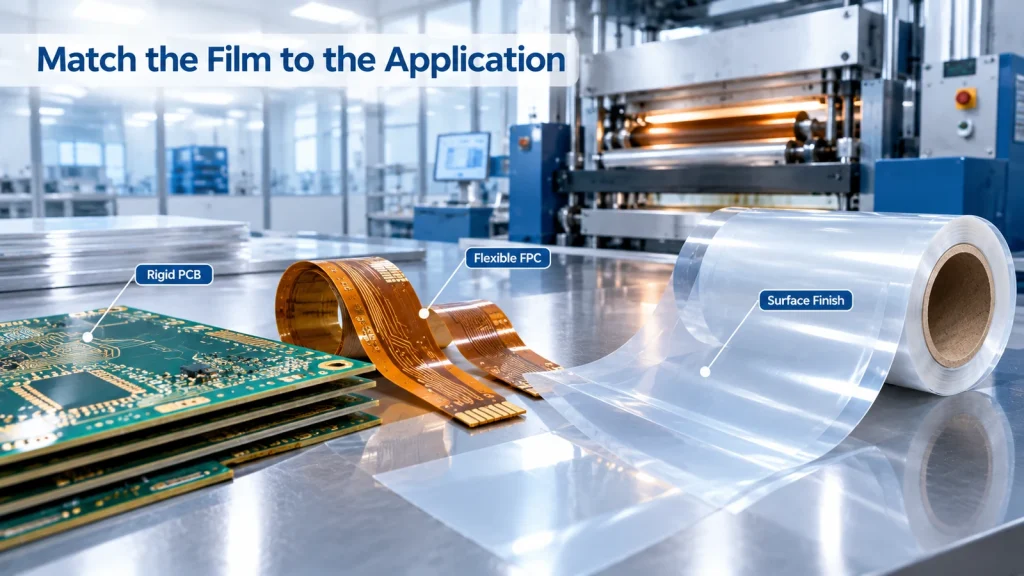
5.1 Multilayer rigid PCB lamination
Rigid multilayer PCB manufacturing requires control of resin flow, bonding, surface condition, and separation from process tooling.
The release film should be evaluated against the actual prepreg and laminate system, copper pattern, press cycle, and intended surface quality.
Important checks include release consistency, film integrity after pressing, resin transfer, dimensional stability, and variation between the center and edges of the panel.
5.2 Flexible printed circuit lamination
FPC manufacturing introduces additional considerations because flexible circuits and adhesive-containing layers may be sensitive to deformation, local pressure differences, and surface damage.
Selection should account for the actual coverlay or adhesive system, stack thickness, panel geometry, and removal procedure.
Inspect both the film and the circuit after separation. Pay particular attention to local sticking, surface marks, adhesive transfer, wrinkles, and damage to fine features.
5.3 Coverlay and adhesive lamination
When a release film contacts an adhesive or resin-containing layer, the interface chemistry becomes especially important.
The film must release as intended without causing unacceptable transfer, surface damage, or process contamination. Test the actual adhesive formulation rather than relying solely on the polymer name.
5.4 Precision electronic materials processing
Release films may also be used in other processes involving temporary separation, surface protection, or material handling.
These applications may require different combinations of thermal stability, surface texture, cleanliness, flexibility, and release behavior. A film qualified for one process should not automatically be approved for another.
6. Common Selection Errors
Error 1: Selecting by maximum temperature alone
Why it fails: Published thermal limits may not reflect the actual exposure time, applied pressure, coating stability, or chemical environment.
Prevention: Specify the complete process profile and qualify the finished film construction under representative conditions.
Error 2: Treating all films made from the same polymer as equivalent
Why it fails: Manufacturing method, additives, surface treatment, coating, and thickness can change performance.
Prevention: Identify the exact grade and construction, and require supplier confirmation for critical characteristics.
Error 3: Ignoring release-force consistency
Why it fails: A film may separate successfully in one test but become difficult to remove after longer exposure or repeated processing.
Prevention: Establish a repeatable separation test and assess multiple samples across the roll or batch.
Error 4: Ignoring the effect of film thickness
Why it fails: Changes in thickness can affect handling, conformity, stack height, and process consistency.
Prevention: Define nominal thickness, tolerance, measurement method, and acceptable variation before sampling.
Error 5: Using a generic surface-quality requirement
Why it fails: Terms such as “smooth,” “clean,” and “high quality” are subjective without a reference or measurement method.
Prevention: Define visual acceptance criteria, reference samples, measurement locations, and inspection conditions.
Error 6: Changing the film and process at the same time
Why it fails: If release behavior or surface quality changes, the cause becomes difficult to identify.
Prevention: Use controlled trials and change one major variable at a time where practical.
Error 7: Approving samples without lot-to-lot controls
Why it fails: A single successful sample does not demonstrate production consistency.
Prevention: Establish incoming inspection, batch traceability, certificate or test-document requirements where applicable, and change-notification expectations.
7. Failure Risks and Preventive Actions
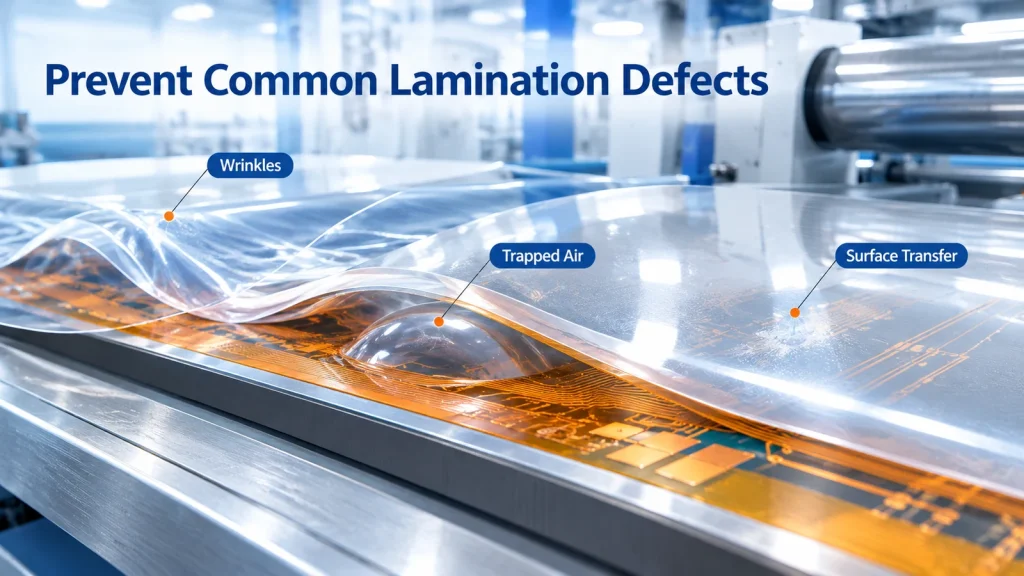
| Observed problem | Possible causes | Recommended investigation |
|---|---|---|
| Film sticks after pressing | Incompatible surface, coating change, unsuitable thermal exposure, resin interaction, or process variation | Compare release behavior before and after exposure; review resin compatibility and the actual thermal cycle |
| Film tears during removal | Insufficient mechanical integrity, damage, poor handling, edge defects, or excessive local adhesion | Inspect the film and edges; review thickness, handling, and separation procedure |
| Wrinkles or uneven coverage | Web tension, installation, thermal distortion, curl, or stack geometry | Inspect alignment and tension; compare dimensional behavior before and after processing |
| Surface marks or gloss variation | Surface texture transfer, contamination, pressure variation, or tooling condition | Compare the film surface and laminate; inspect tooling and establish controlled surface acceptance criteria |
| Resin or adhesive transfer | Inadequate release compatibility, coating interaction, or process-specific chemical effects | Examine residue and interface chemistry; evaluate alternative constructions with the actual material system |
| Results vary between batches | Differences in thickness, coating, surface condition, packaging, or process settings | Compare incoming inspection data, lot records, and process history |
| Local bubbles or incomplete contact | Trapped air, stack preparation, resin flow, vacuum conditions, or pressure distribution | Review stack preparation and press settings before attributing the defect to the film |
These symptoms are diagnostic starting points, not proof of a single root cause. A disciplined investigation should separate material-related effects from equipment, tooling, resin, handling, and process-control issues.
8. Testing and Qualification Before Production
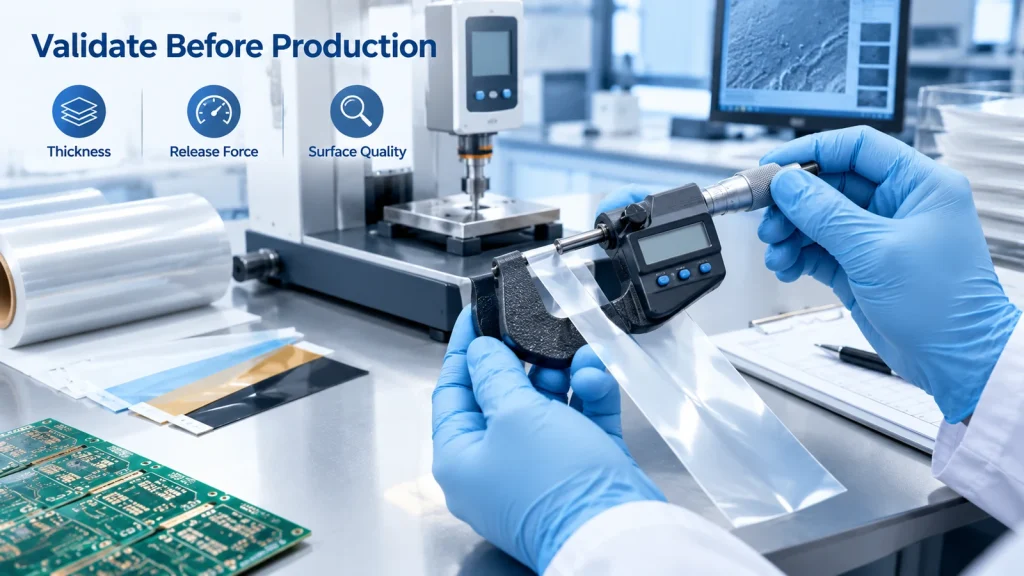
A qualification plan should demonstrate that the proposed film performs acceptably in the intended application. The test methods and acceptance limits should be agreed before the trial.
8.1 Review supplier documentation
Request the applicable technical data sheet and identify the exact grade, construction, thickness, surface treatment, and intended application.
Where relevant, request available information on thermal behavior, dimensional stability, surface characteristics, chemical compatibility, and release performance.
Do not treat general marketing statements as grade-specific test evidence. Any required certification or compliance claim must be supported by documentation applicable to the exact material and intended use.
8.2 Incoming material inspection
Depending on risk, incoming checks may include:
- Material identity and lot traceability.
- Thickness and dimensional conformity.
- Surface defects, scratches, particles, and contamination.
- Roll width, length, winding quality, and edge condition.
- Packaging integrity and storage history.
Use a documented sampling plan appropriate to the material’s criticality and the supplier’s established process capability.
8.3 Thermal exposure testing
Expose samples to a representative temperature-time profile, including the relevant pressure and contact conditions where feasible.
After exposure, inspect for shrinkage, curling, distortion, cracking, discoloration, coating changes, or other unacceptable changes.
A simple oven exposure can be useful for preliminary screening, but it does not reproduce all conditions inside a lamination press. Confirm critical performance in the actual process or a representative setup.
8.4 Release and residue evaluation
Run the candidate film with the actual resin, adhesive, copper, laminate, or tooling surface.
Record the separation method and conditions, including temperature at separation, cooling state, peel angle, speed where controlled, and any applied mechanical assistance.
Evaluate whether separation is complete, whether the film remains intact, and whether visible or measurable residue is transferred. Where needed, use instrumental analysis to investigate suspected contamination.
8.5 Surface-quality inspection
Inspect the finished laminate using an agreed method. Depending on the application, this may include controlled visual inspection, microscopy, surface-roughness measurement, gloss measurement, or another appropriate method.
Document the inspection locations and compare the results against a baseline or reference sample. Do not invent universal acceptance limits: they should come from the product specification and process requirements.
8.6 Repeatability and production trial
A single successful press cycle is not sufficient evidence of robust performance.
Evaluate repeatability across multiple cycles and, where appropriate, multiple positions or samples. For production approval, consider more than one material lot and record the relevant process settings.
A useful qualification report includes:
- Candidate material and lot number.
- Film construction and measured thickness.
- Equipment and stack configuration.
- Temperature, pressure, time, and cooling conditions.
- Release observations and residue findings.
- Surface-quality results.
- Deviations, corrective actions, and final disposition.
9. A Practical Engineering Selection Workflow
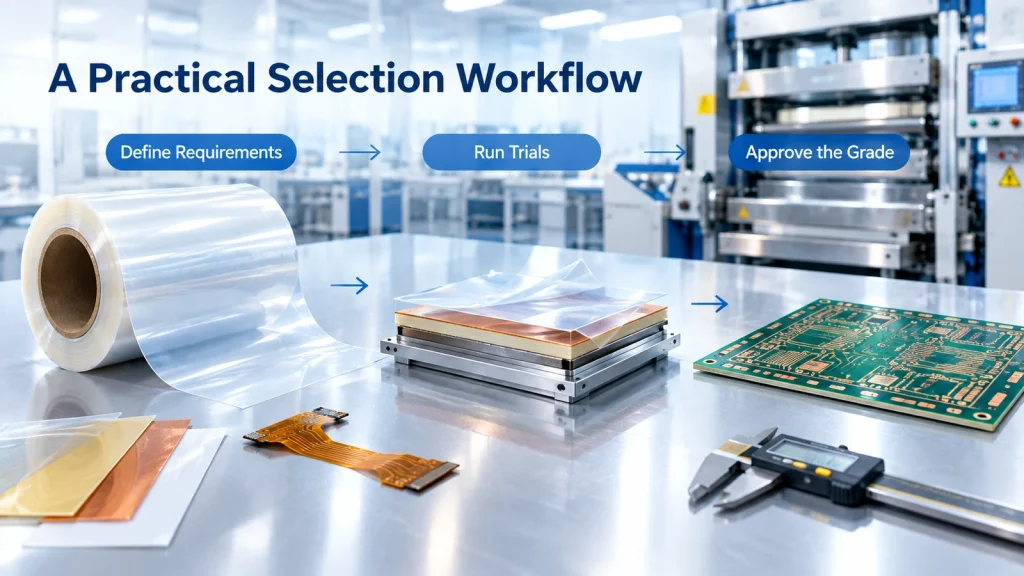
Step 1: Define the process interface
Identify the surfaces contacting the film and the film’s exact role. Clarify whether the requirement is release, separation, protection, surface control, or a combination.
Step 2: Establish mandatory requirements
Document the thermal profile, pressure, chemical exposure, required surface condition, thickness tolerance, dimensions, cleanliness requirements, and removal method.
Separate mandatory requirements from preferences such as color, transparency, packaging, or cost.
Step 3: Screen candidate constructions
Shortlist materials based on the full construction, not the polymer name alone. Review supplier documentation and identify any unknowns requiring confirmation.
Step 4: Obtain samples and define test conditions
Agree on sample dimensions, quantities, test procedures, acceptance criteria, and reporting format before the trial begins.
Step 5: Conduct controlled trials
Use the intended process wherever practical. Compare candidates using the same conditions and document any unavoidable differences.
Step 6: Evaluate defects and repeatability
Inspect release behavior, surface quality, contamination, film integrity, and variation across samples. Investigate root causes rather than relying on a single pass/fail observation.
Step 7: Approve the grade and specification
Record the approved material identity, construction, thickness, tolerances, process conditions, inspection requirements, packaging, and change-control expectations.
Step 8: Establish production controls
Define incoming inspection, traceability, periodic verification, and the process for requalification following material or supplier changes.
10. RFQ Checklist: Information to Provide Your Supplier
A technically complete RFQ reduces quotation ambiguity and helps determine whether a candidate material is suitable.
| RFQ item | Information to provide |
|---|---|
| Application | Rigid PCB, FPC, coverlay, adhesive lamination, or other process |
| Film function | Release, separation, protection, surface control, or another defined role |
| Contacting materials | Resin, prepreg, copper, coverlay adhesive, tooling, or other interface |
| Required construction | Preferred polymer, coating or treatment, or permission to recommend alternatives |
| Thickness | Nominal thickness and tolerance |
| Dimensions | Width, length, sheet size, roll format, core size, and winding requirements |
| Process conditions | Actual or estimated peak temperature, exposure time, pressure, and cooling procedure |
| Surface requirements | Texture, gloss, visual appearance, residue limits, and inspection method |
| Chemical environment | Resin system, adhesives, cleaning chemicals, and relevant restrictions |
| Quality requirements | Traceability, incoming inspection, test reports, and applicable standards |
| Validation | Sample quantity, trial plan, acceptance criteria, and reporting needs |
| Commercial requirements | Estimated order quantity, annual usage, delivery schedule, packaging, and destination |
| Documentation | TDS, applicable test evidence, grade identification, and change-notification requirements |
If the exact material has not yet been selected, provide the process details and ask the supplier to propose candidate constructions for evaluation. A supplier recommendation should remain provisional until the required technical evidence and process trial are complete.
11. Frequently Asked Questions
1. What is a release film used for in PCB lamination?
A release film is a temporary interface material used to support separation from adjacent surfaces and, depending on the process, help control surface transfer or contamination. Its exact role depends on the press stack and manufacturing sequence.
2. What is the difference between PET and PTFE release films?
PET and PTFE have different polymer chemistries and physical characteristics. PET may offer useful handling and dimensional properties in a qualified construction, while PTFE has low surface energy and low friction. Neither material is automatically suitable for every lamination process. Grade, coating, thickness, temperature-time profile, and release behavior must be evaluated.
3. How do you choose a release film for FPC lamination?
Start with the actual flexible-circuit stack, including coverlay and adhesive materials. Define the process temperature, pressure, exposure time, required surface quality, and removal procedure. Then compare candidate films using controlled trials and inspect for sticking, residue, wrinkles, and damage.
4. How does release-film thickness affect lamination?
Thickness can affect handling, flexibility, stack height, conformity, and dimensional stability. The effect depends on the process and the film construction. Specify the nominal thickness, tolerance, measurement method, and whether the value refers to the base film or the complete coated product.
5. Why does a release film stick after pressing?
Possible causes include unsuitable release characteristics, coating interaction, resin or adhesive compatibility, thermal exposure, contamination, and process variation. Review the actual interface and thermal cycle, then compare the film before and after pressing. Sticking should not be attributed to the film without checking other process variables.
6. Can a release film affect PCB surface quality?
Yes. The film’s surface condition and behavior during lamination may influence the interface or contribute to surface transfer. However, surface defects can also arise from tooling, resin flow, pressure distribution, contamination, or other process conditions. Use a controlled comparison to determine the cause.
7. What tests should be completed before approving a release film?
Common evaluation areas include thickness, dimensional stability, thermal exposure, release behavior, residue or contamination, surface quality, and repeatability. The exact methods and acceptance limits should be selected according to the application and agreed before qualification.
8. Can the same release film be reused?
Reuse should not be assumed. It depends on the film construction, process conditions, contamination risk, and the manufacturer’s documented guidance. If reuse is being considered, define the number of cycles, inspection criteria, cleaning method if applicable, and evidence required before approval.
9. What should I include in a release-film RFQ?
Provide the application, contacting materials, process temperature and time, pressure, thickness and tolerance, dimensions, surface requirements, estimated quantity, and any testing or documentation requirements. Drawings, stack-up details, and photographs of the interface can help clarify the application.
10. Does a material’s published temperature rating guarantee suitability for PCB lamination?
No. A temperature rating alone does not establish release performance, coating stability, dimensional behavior, chemical compatibility, or cleanliness under a particular press cycle. Confirm the exact grade and construction, then validate it using representative process conditions.
12. Request a Release Film Evaluation or Quotation
Selecting a release film is a process-engineering decision as much as a material-selection decision. The right solution should provide consistent separation, acceptable surface quality, compatibility with the actual resin or adhesive system, and repeatable performance under the intended lamination conditions.
HighTemp Material supplies polymer film materials and supports converting services including precision slitting and custom lamination. The appropriate construction and available specifications should be confirmed against the customer’s application.
To help evaluate your requirement, please provide:
- PCB or FPC application and film function.
- Contacting materials and laminate or adhesive system.
- Operating temperature, exposure time, pressure, and cooling conditions.
- Required film material, thickness, tolerance, and dimensions.
- Surface-finish, residue, cleanliness, or contamination requirements.
- Drawing, stack-up details, or photographs where available.
- Sample quantity, estimated production volume, and target delivery date.
- Required test methods, acceptance criteria, and documentation.
Contact HighTemp Material to discuss your release-film requirements and request a material review or quotation.
Relevant resources:
- Skived Pure PTFE Film
- Technical Data Sheets
- Custom Slitting Services
- Custom Laminating Services
- Custom Die Cutting Services
For application-specific support, contact info@hightempmaterial.com. Final material suitability, technical specifications, sample availability, and commercial terms should be confirmed before production approval.