



Understanding thermal ratings, material limitations, and qualification requirements for reliable electrical insulation.
A polymer film is advertised as capable of withstanding 260°C. Does that mean it can operate continuously at 260°C for thousands of hours?
Not necessarily.
One of the most common mistakes in high-temperature material selection is treating the maximum temperature listed in a technical data sheet as a guaranteed long-term operating temperature.
In practice, a material that survives a brief soldering process may not maintain its electrical, mechanical, or dimensional properties under prolonged thermal exposure.
For engineers designing electrical insulation systems, PCB manufacturing processes, battery components, and industrial equipment, understanding continuous service temperature vs peak temperature is essential.
This guide explains how to interpret thermal ratings, compare high-performance polymer films, evaluate application-specific risks, and prepare technical requirements for material qualification.
1. Continuous Service Temperature vs Peak Temperature: What Is the Difference?
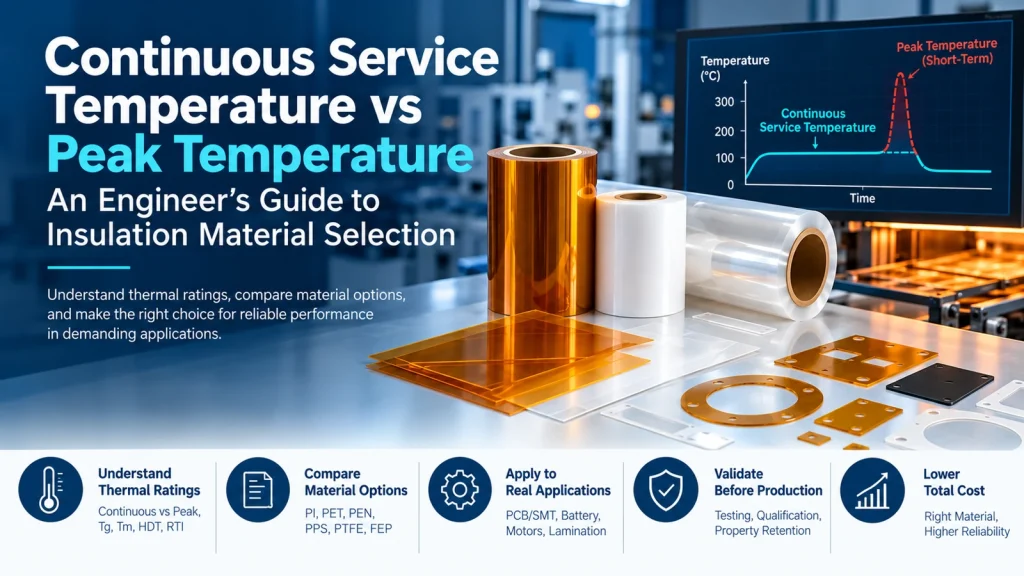
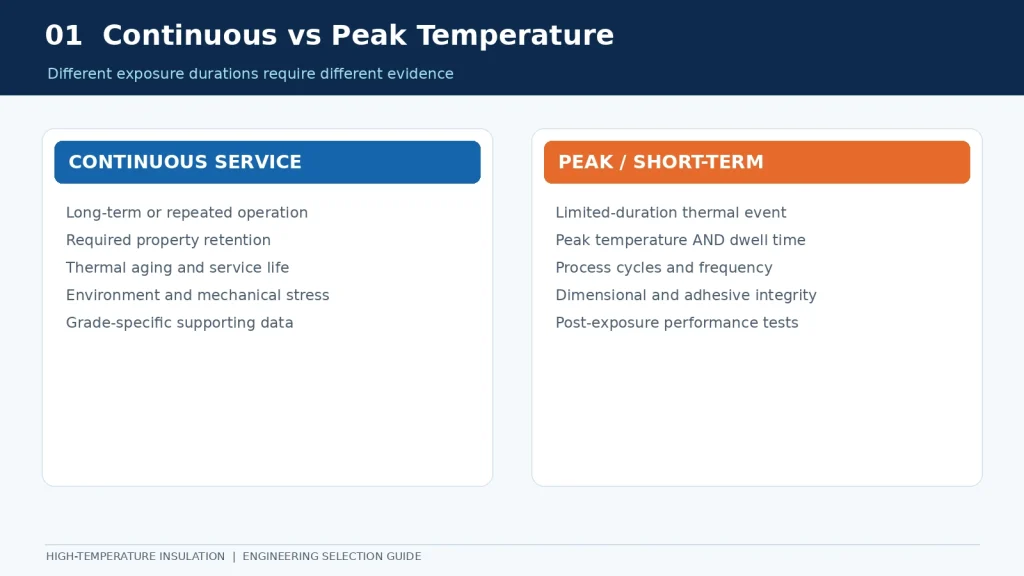
Continuous service temperature and peak temperature describe different thermal exposure conditions.
Both are important, but neither should be evaluated without considering exposure duration, environmental conditions, and required material performance.
What Is Continuous Service Temperature?
Continuous service temperature generally refers to a temperature at which a material is expected to maintain specified functional properties during prolonged use under defined conditions.
Depending on the material and manufacturer, this rating may be based on thermal aging studies, practical experience, or specific qualification methods.
For electrical insulation films, the properties of interest may include:
- Dielectric strength and electrical insulation resistance
- Tensile strength and elongation
- Dimensional stability
- Mechanical flexibility
- Resistance to embrittlement
- Adhesive or laminate integrity
A continuous service temperature rating does not mean that a material can operate indefinitely at that temperature.
Its suitability depends on the required service life and the criteria used to define acceptable performance.
For example, a polymer film used inside electrical equipment may need to maintain insulation performance for several years.
A short-duration heat resistance test cannot establish that long-term reliability.
What Is Peak Temperature?
Peak temperature, sometimes described as short-term temperature resistance, refers to a maximum temperature encountered during a limited exposure.
Examples include:
- Soldering and electronics assembly
- Thermal lamination
- Heat sealing
- Temporary manufacturing heat cycles
- Short process temperature excursions
- Intermittent equipment overheating
A peak temperature rating is meaningful only when the exposure duration and test conditions are known.
For example, surviving 250°C for 10 seconds does not establish suitability for 250°C for 30 minutes.
Repeated exposure may also cause cumulative thermal aging, dimensional changes, or adhesive degradation.
Continuous vs Peak Temperature: Engineering Comparison
| Parameter | Continuous Service Temperature | Peak Temperature |
|---|---|---|
| Exposure duration | Prolonged operation | Limited-duration event |
| Main concern | Long-term property retention | Short-term functional survival |
| Typical applications | Electrical equipment, motors, battery insulation | Soldering, heat sealing, lamination |
| Important factors | Service life, environment, thermal aging | Dwell time, maximum temperature, cycle frequency |
| Potential failures | Embrittlement, electrical degradation, creep | Shrinkage, deformation, delamination |
| Qualification approach | Thermal endurance and application-life evaluation | Defined thermal exposure and post-exposure testing |
Engineering takeaway: The maximum temperature alone cannot determine material suitability. Temperature, time, and required performance must be evaluated together.
2. How Time, Temperature, and Thermal Cycling Affect Material Performance
A real manufacturing or operating environment rarely maintains one constant temperature.
Instead, materials may experience a combination of normal operating temperatures, short-term thermal peaks, cooling periods, and repeated heating cycles.
Understanding a Real Thermal Profile
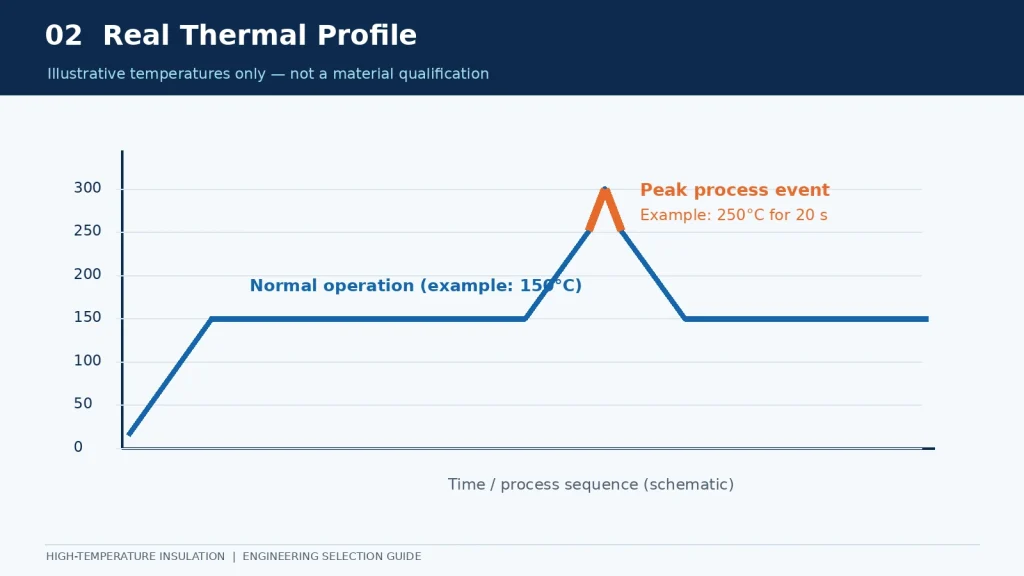
Consider an illustrative electrical insulation application with the following conditions:
| Parameter | Example Requirement |
|---|---|
| Normal operating temperature | 150°C |
| Peak process temperature | 250°C |
| Peak exposure duration | 20 seconds |
| Expected thermal cycles | 500 |
| Required service life | Defined by the equipment manufacturer |
These values are an example of how to describe an application, not a qualification claim for a specific film.
A candidate material must be evaluated for both prolonged exposure at the operating temperature and short-duration exposure during processing.
Why Exposure Time Matters
Thermal degradation often depends on both temperature and time.
At elevated temperatures, polymer materials may experience:
- Oxidation or chemical degradation
- Changes in molecular structure
- Loss of flexibility
- Reduced mechanical strength
- Dimensional shrinkage or deformation
- Changes in electrical properties
However, the rate and mechanism of degradation vary by polymer chemistry, formulation, environment, and temperature range.
A material that performs adequately during a short thermal event may experience unacceptable changes during extended operation.
Why Thermal Cycling Matters
Repeated heating and cooling introduce additional engineering considerations.
Different materials expand and contract at different rates.
When polymer films are bonded to metals, rigid substrates, or adhesive layers, thermal expansion mismatch may generate internal stresses.
Over repeated cycles, these stresses can contribute to:
- Wrinkling or curling
- Adhesive fatigue
- Delamination
- Dimensional misalignment
- Mechanical cracking
For laminated insulation components, engineers should evaluate the complete construction rather than only the base film.
Air, Vacuum, and Chemical Exposure
Thermal ratings may also depend on the surrounding environment.
For example, oxidative aging in air can differ from behavior in vacuum or inert atmospheres.
Chemical exposure, humidity, mechanical loading, and electrical stress can further affect material performance.
A published temperature rating should therefore be interpreted in the context of its test environment.
3. How to Interpret Thermal Ratings in a Technical Data Sheet
Material data sheets often include several thermal properties.
Although these values are useful, they describe different physical phenomena and should not be treated as interchangeable.
Continuous Use Temperature
A manufacturer’s continuous-use temperature may be based on internal testing, established application experience, or a defined thermal endurance evaluation.
Before using this value for design approval, confirm:
- The exact material grade and thickness
- The test method or rating basis
- The exposure duration
- The test environment
- The retained-property requirements
- Whether the rating applies to the base film or complete construction
If the rating methodology is not provided, request clarification from the supplier.
Glass Transition Temperature (Tg)
Glass transition temperature describes a change in molecular mobility within the amorphous regions of a polymer.
Near Tg, a material may experience changes in stiffness, creep, and dimensional stability.
However, Tg is not a universal maximum operating temperature.
Some polymers can operate above Tg under suitable conditions, while other applications require operation well below it.
Melting Temperature (Tm)
Melting temperature relates to the melting of crystalline regions in semicrystalline polymers.
A high melting temperature does not necessarily indicate high long-term mechanical or dimensional stability.
Creep, shrinkage, and other property changes may occur well below the melting point.
Heat Deflection Temperature (HDT)
Heat deflection temperature describes deformation behavior under a specified load and test method.
It is particularly relevant to certain rigid plastic applications.
HDT is not equivalent to the continuous service temperature of a thin electrical insulation film.
Relative Thermal Index (RTI)
Relative Thermal Index is used in the evaluation of long-term thermal endurance of polymeric materials under UL 746B.
Different RTI categories may address electrical properties and mechanical properties, including impact and non-impact characteristics.
RTI values can depend on material grade and thickness.
An RTI value should not be interpreted as a universal operating-temperature approval for every electrical insulation application.
Engineers should verify the relevant material recognition, thickness, property category, and intended use.
Thermal Rating Comparison
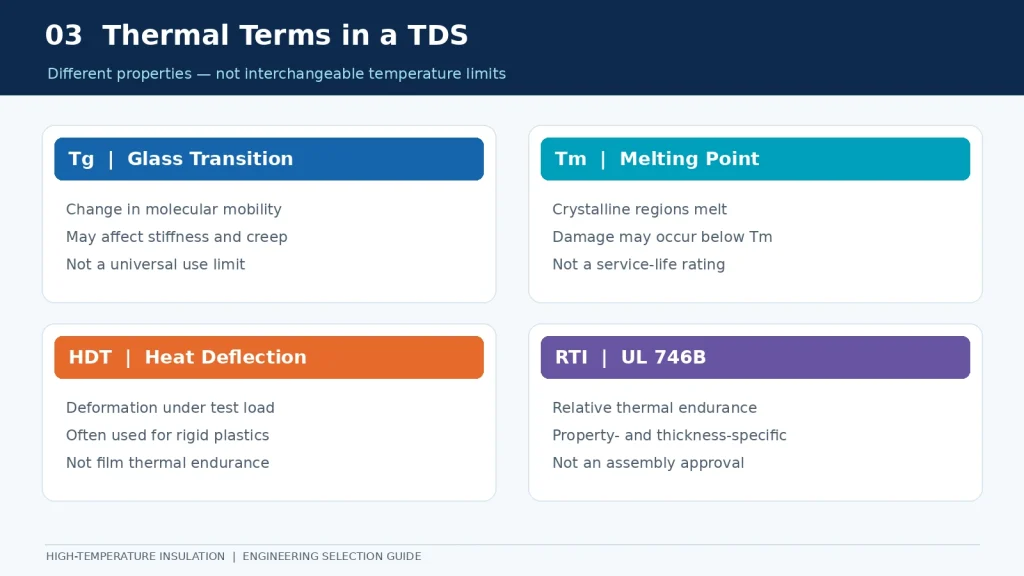
| Property | What It Describes | What It Does Not Establish |
|---|---|---|
| Continuous use temperature | Claimed or evaluated long-term thermal capability | Unlimited lifetime |
| Peak temperature | Limited-duration thermal exposure capability | Long-term service reliability |
| Tg | Change in amorphous polymer mobility | Universal maximum use temperature |
| Tm | Melting of crystalline regions | Acceptable operating temperature |
| HDT | Deformation under specified load | Electrical insulation endurance |
| RTI | Relative long-term thermal endurance for specified properties | Approval of every finished assembly |
Procurement takeaway: Two suppliers may advertise similar maximum temperatures while using different test methods. Request comparable evidence before treating their products as technically equivalent.
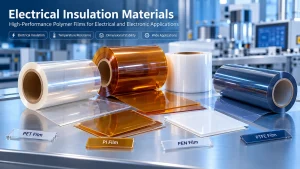
4. PI vs PET vs PEN vs PPS vs PTFE vs FEP: Which Film Should You Consider?
Selecting a high-temperature insulation film requires more than ranking polymers by temperature resistance.
Each polymer family offers a different balance of thermal capability, electrical insulation, chemical resistance, dimensional stability, processing characteristics, and cost.
Engineering Material Selection Matrix
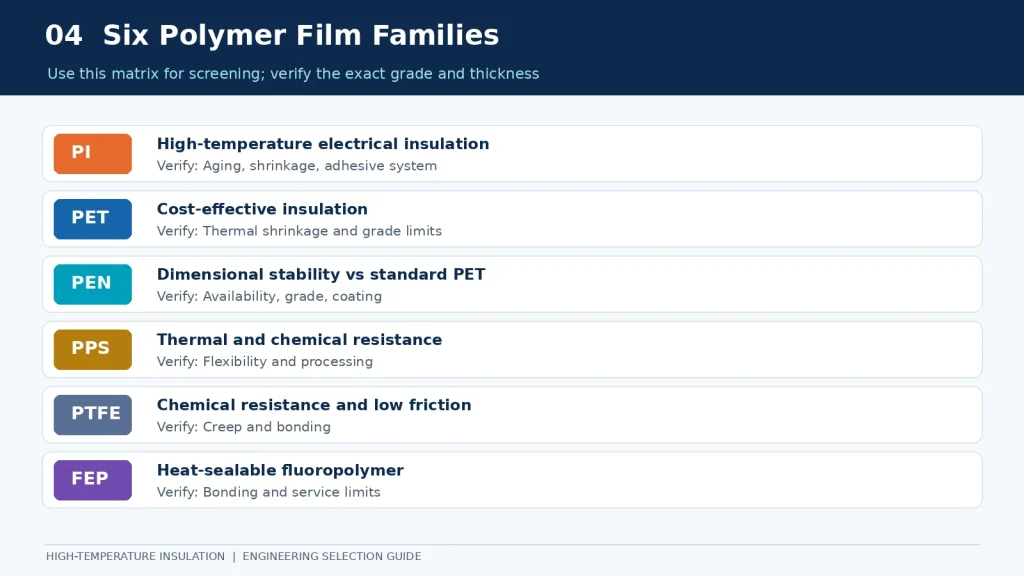
| Material | Main Strengths | Potential Limitations | Applications to Evaluate |
|---|---|---|---|
| PET | Cost-effective insulation, mechanical strength, availability | Thermal aging and shrinkage at elevated temperatures | Electrical barriers, battery insulation, industrial films |
| PEN | Improved thermal and dimensional performance over conventional PET in many grades | Higher cost and more limited availability | Electronics, electrical insulation, precision films |
| PI | High-temperature capability, electrical insulation, flexibility | Higher cost; grade-dependent aging and dimensional behavior | PCB/SMT, flexible circuits, electrical equipment |
| PPS | Thermal and chemical resistance, dimensional performance | Grade-dependent flexibility and processing | Automotive electronics, electrical insulation |
| PTFE | Chemical resistance, low friction, high-temperature capability | Creep, bonding difficulty, dimensional considerations | Industrial insulation, chemical environments |
| FEP | Melt-processability, heat sealing, chemical resistance | Lower thermal capability than many PTFE grades | Heat-sealable films, cable constructions, laminates |
This matrix describes general polymer-family characteristics. It does not provide certified service temperature limits for individual products.
Polyimide (PI) Film
PI film is frequently considered for high-temperature electrical insulation and electronics manufacturing.
Its combination of thermal performance, dielectric properties, and flexibility makes it useful in applications involving elevated process temperatures.
However, PI film performance varies by grade, thickness, and construction.
For adhesive-backed PI tapes, the adhesive system may have a lower temperature capability than the film itself.
Selection priorities: Thermal aging, dielectric properties, dimensional stability, adhesive compatibility, and process-cycle resistance.
Polyester (PET) Film
PET is widely used in electrical insulation because of its cost-performance balance, mechanical properties, and availability.
It may be suitable for applications where the temperature requirements are within the capability of the selected grade.
Specialty PET grades may offer additional characteristics such as flame retardancy or improved thermal stability.
These features should be evaluated separately.
For example, a UL 94 VTM-0 flammability classification does not establish continuous service temperature.
Selection priorities: Thermal shrinkage, electrical properties, film thickness, flammability requirements, and cost.
Polyethylene Naphthalate (PEN) Film
PEN can offer improved thermal and dimensional stability compared with conventional PET.
It may be considered for applications requiring higher thermal performance while retaining a polyester-family film format.
Specific grade selection remains important, especially for coating, laminating, and precision converting.
Selection priorities: Dimensional stability, coating compatibility, thermal aging, and availability.
Polyphenylene Sulfide (PPS) Film
PPS films may be considered for applications requiring thermal resistance, chemical resistance, and electrical insulation.
Their performance depends on film grade, processing history, and construction.
Selection priorities: Electrical reliability, thermal aging, dimensional stability, and mechanical flexibility.
Polytetrafluoroethylene (PTFE) Film
PTFE is valued for its chemical resistance, low-friction characteristics, and high-temperature capability.
However, engineers should also consider creep, dimensional stability, bonding methods, and the behavior of the finished component.
Selection priorities: Thermal endurance, chemical exposure, mechanical loading, and joining requirements.
Fluorinated Ethylene Propylene (FEP) Film
FEP offers chemical resistance together with melt-processability and heat-sealing capability.
It can be useful in laminated constructions where thermal bonding is required.
However, its thermal limits should be verified independently from those of PTFE.
Selection priorities: Heat-sealing temperature, bond integrity, continuous-use requirements, and laminate construction.
A Practical Material Shortlisting Approach
Instead of selecting the polymer with the highest advertised temperature rating, engineers should narrow the options by:
- Actual continuous and peak temperature requirements
- Required electrical and mechanical properties
- Thermal cycling and dimensional tolerance
- Chemical and environmental exposure
- Adhesive or coating compatibility
- Processing format and manufacturing cost
- Available grade-specific technical documentation
This approach can prevent unnecessary over-specification while reducing the risk of selecting an unsuitable material.
5. Application-Based Selection: PCB/SMT, Battery, Motors, and Lamination
Different industries expose insulation materials to very different thermal conditions.
A material suitable for a short soldering cycle may not be appropriate for long-term electrical equipment insulation.
Application A: PCB and SMT Manufacturing
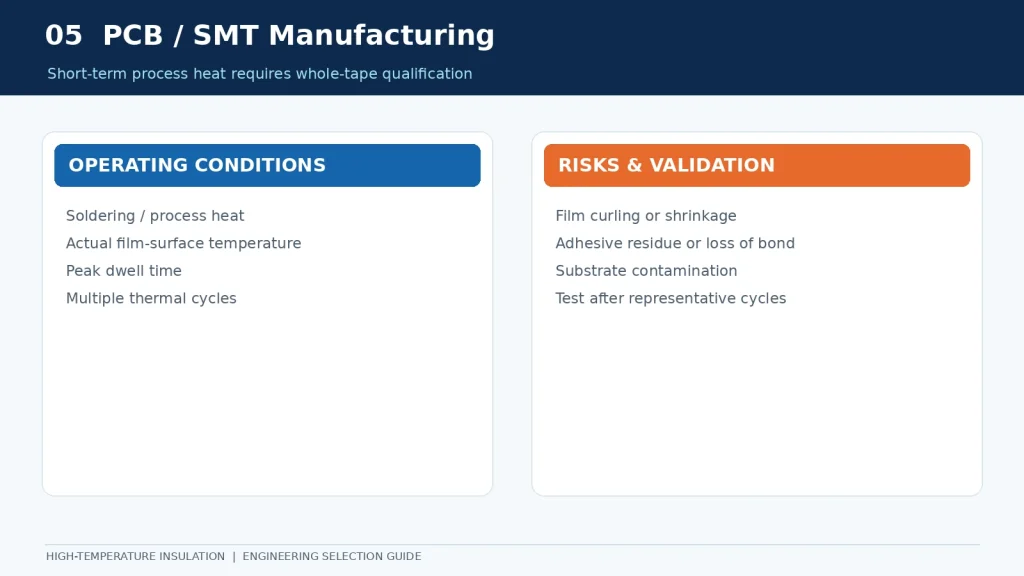
Operating conditions
PCB and SMT manufacturing may involve soldering, masking, bonding, and other thermal processes.
A masking film or tape may encounter elevated temperatures for a short period.
Key risks
- Adhesive residue after removal
- Film shrinkage or curling
- Loss of adhesion during processing
- Substrate contamination
- Repeated-cycle degradation
What engineers should verify
The actual temperature at the film location, peak dwell time, adhesive compatibility, residue requirements, and post-process dimensional stability.
For masking tapes, the complete tape construction should be evaluated.
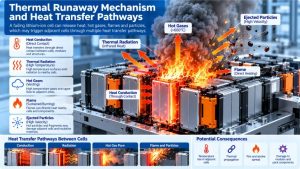
Application B: Battery and Energy Storage Insulation
Operating conditions
Battery insulation films may experience normal operating temperatures, charging-related thermal variation, manufacturing heat exposure, and specified abnormal conditions.
Key risks
- Electrical insulation deterioration
- Mechanical damage
- Thermal aging
- Dimensional instability
- Inadequate performance under fault conditions
What engineers should verify
Dielectric performance, film thickness, long-term thermal stability, mechanical integrity, flammability requirements, and compatibility with the complete battery assembly.
A flame-retardant film classification does not by itself demonstrate thermal runaway protection.
Application C: Motors and Power Electronics
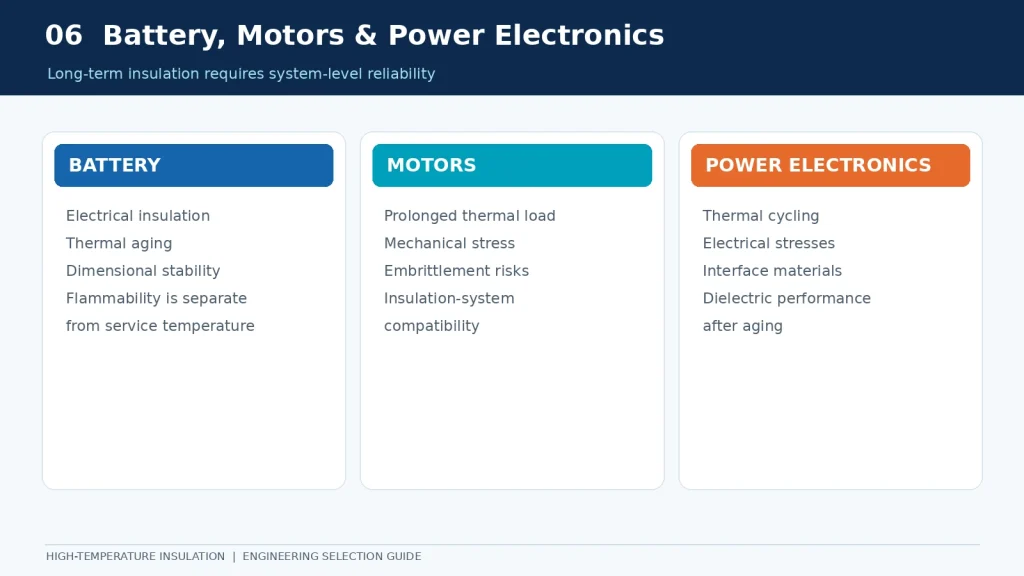
Operating conditions
Motors, transformers, and power electronics may operate at elevated temperatures for prolonged periods.
Electrical and mechanical stresses may occur simultaneously.
Key risks
- Thermal embrittlement
- Electrical insulation degradation
- Mechanical cracking
- Changes in dimensional fit
- Insulation-system incompatibility
What engineers should verify
Long-term thermal endurance, electrical insulation performance, mechanical property retention, and compatibility with the complete insulation system.
The thermal class or rating of an insulation system should not be inferred from one film component alone.
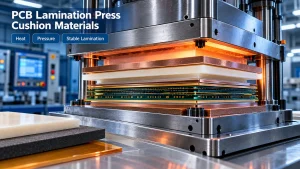
Application D: PCB and CCL Lamination
Operating conditions
Lamination processes can combine elevated temperature, pressure, and extended dwell times.
Reusable cushion materials may also experience repeated thermal-pressure cycles.
Key risks
- Compression-set changes
- Dimensional instability
- Loss of cushioning performance
- Surface contamination
- Reduced performance after repeated cycles
What engineers should verify
The complete lamination temperature-pressure profile, dwell time, number of reuse cycles, dimensional stability, and performance retention.
For reusable cushion pads, qualification must address the complete pad construction rather than a single polymer layer.
6. How to Qualify High-Temperature Insulation Films Before Production
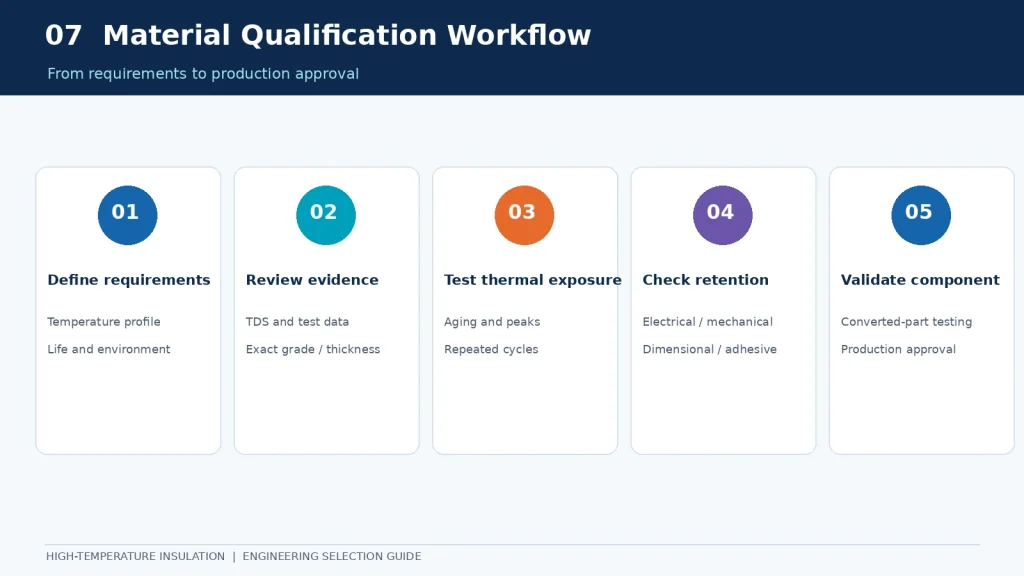
Material selection should be treated as a qualification process rather than a decision based on one technical data sheet value.
A practical evaluation can be organized into five stages.
Stage 1: Define the Application Requirements
Document:
- Continuous operating temperature
- Peak temperature and dwell time
- Number of thermal cycles
- Expected service life
- Electrical and mechanical performance requirements
- Dimensional tolerances
- Environmental conditions
Stage 2: Review Material Documentation
Request relevant information such as:
- Grade-specific technical data sheet
- Applicable thermal endurance data
- Electrical insulation test results
- Mechanical properties
- Dimensional stability data
- Applicable certification or recognition information
- Compliance declarations where required
Documentation availability varies by material and supplier.
Missing data should be identified as a qualification gap rather than replaced with assumptions.
Stage 3: Perform Representative Thermal Testing
Expose candidate materials to conditions representative of the intended application.
Depending on the project, this may include:
- Continuous thermal aging
- Short-term peak exposure
- Repeated thermal cycling
- Thermal-pressure cycling
- Adhesive performance testing
Test conditions should be defined before testing begins.
Stage 4: Evaluate Property Retention
After thermal exposure, evaluate the properties critical to the application.
These may include:
- Tensile strength and elongation
- Dielectric strength
- Insulation resistance
- Dimensional change
- Adhesion
- Visual and mechanical integrity
Acceptance criteria should reflect the product design requirements.
Stage 5: Validate the Finished Component
A film that performs well as a raw material may behave differently after slitting, die-cutting, adhesive lamination, forming, or assembly.
Final qualification should consider the actual component geometry and manufacturing process.
Engineering takeaway: Material-family properties are useful for screening. Grade-specific evidence and application testing are necessary for final approval.
7. What Engineers and Buyers Should Include in a High-Temperature Film RFQ
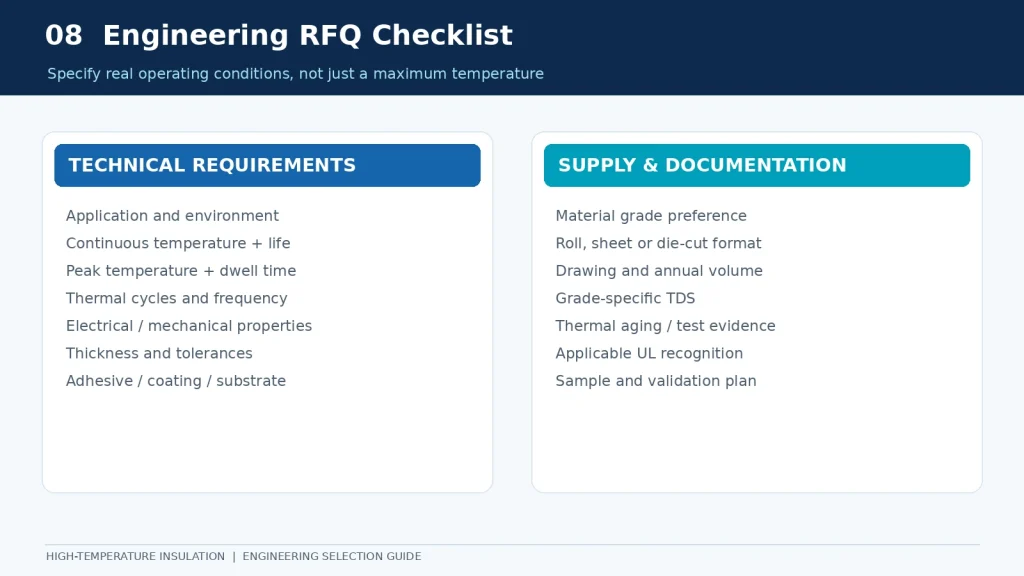
An effective RFQ should describe the actual operating conditions rather than only requesting a material that can withstand a particular temperature.
Engineering RFQ Checklist
| Parameter | Required Information |
|---|---|
| Application | PCB masking, electrical insulation, battery barrier, lamination |
| Continuous temperature | Normal operating temperature |
| Service life | Required operating duration |
| Peak temperature | Maximum short-term exposure |
| Peak dwell time | Seconds, minutes, or hours |
| Thermal cycles | Expected number and frequency |
| Material preference | PI, PET, PEN, PPS, PTFE, FEP, or open to recommendation |
| Thickness | Nominal thickness and tolerance |
| Dimensions | Roll width, sheet size, or die-cut drawing |
| Adhesive | Required or not required |
| Environment | Air, vacuum, humidity, chemicals, pressure |
| Performance | Electrical, mechanical, dimensional, adhesive |
| Documentation | TDS, applicable recognition, test reports |
| Order requirements | Sample quantity, annual volume, delivery location |
Example RFQ for Electrical Insulation Film
Application: Electrical insulation barrier for industrial electronics
Continuous operating temperature: 150°C
Peak process temperature: 250°C
Peak exposure duration: 20 seconds per cycle
Expected thermal cycles: 500
Film thickness: 50 µm
Material preference: Open to technical recommendation
Required properties: Electrical insulation, dimensional stability, mechanical integrity
Documentation: TDS, available thermal-aging information, electrical property data
Supply format: Slit rolls or precision die-cut components
These are illustrative requirements only. No specific material is prequalified for this example.
By providing a complete RFQ, buyers can receive more relevant material recommendations and reduce unnecessary sampling or qualification delays.
8. Common Material Selection Mistakes
Mistake 1: Comparing Maximum Temperature Claims Without Test Conditions
Two products may list similar temperature limits but use different definitions or test methods.
Always verify the underlying rating basis.
Mistake 2: Assuming All Grades of the Same Polymer Are Equivalent
Polymer chemistry provides an initial indication of performance, but grade, thickness, processing, and construction can significantly influence results.
Mistake 3: Ignoring the Adhesive Layer
For adhesive-backed films, the adhesive may determine the practical temperature limitation.
Evaluate the complete construction.
Mistake 4: Overlooking Repeated Thermal Cycles
Passing one high-temperature exposure test does not establish suitability for hundreds of repeated cycles.
Mistake 5: Treating Flammability Ratings as Thermal Endurance Ratings
UL 94 flammability classifications and long-term thermal endurance ratings address different performance characteristics.
Mistake 6: Approving a Material Without Finished-Part Validation
Slitting, die-cutting, lamination, and assembly may introduce additional stresses or failure modes.
Test the finished construction where appropriate.
9. Frequently Asked Questions
What is the difference between continuous service temperature and peak temperature?
Continuous service temperature concerns long-term performance under defined conditions. Peak temperature describes a limited-duration thermal exposure. Both require consideration of exposure time and retained properties.
Can a film rated for 260°C be used continuously at 260°C?
Only if the specific material grade has appropriate supporting data and meets the application’s performance and service-life requirements. A generic 260°C maximum temperature claim is insufficient.
Is RTI the same as maximum continuous operating temperature?
No. RTI is a property-specific relative thermal endurance index evaluated under defined conditions. It should not be treated as an unrestricted application approval.
Is polyimide always better than PET for high-temperature insulation?
Not necessarily. PI often offers greater high-temperature capability, but PET may be a more appropriate and economical option where its verified performance meets the application requirements.
Does material thickness affect temperature performance?
Thickness can influence thermal response, mechanical behavior, dimensional stability, and certain certified properties. Ratings should be verified for the supplied thickness.
Can adhesive-backed films tolerate the same temperature as their base films?
Not automatically. Adhesives, primers, coatings, and backing materials may have different temperature limitations.
What tests should be requested before approving an insulation film?
Testing depends on the application but may include thermal aging, peak-temperature exposure, thermal cycling, dielectric testing, dimensional stability, and mechanical property retention.
What information should I send to a supplier for material selection?
Provide continuous and peak temperatures, exposure durations, thermal cycles, application environment, required properties, thickness, dimensions, and documentation requirements.
10. Conclusion: Select Materials Based on Real Operating Conditions
Understanding continuous service temperature vs peak temperature is fundamental to selecting reliable high-temperature insulation materials.
A material’s maximum advertised temperature does not establish its long-term suitability.
Engineers and buyers should evaluate the complete temperature profile, exposure duration, thermal cycling, environmental conditions, and required property retention.
For PI, PET, PEN, PPS, PTFE, and FEP films, the most effective selection process combines material-family screening with grade-specific technical documentation and representative application testing.
This approach can improve engineering reliability, reduce qualification risk, and support more informed purchasing decisions.
Request an Engineering Material Recommendation
HighTemp Material Co., Limited supplies high-performance polymer films and custom insulation components for industrial applications.
Our material portfolio includes PI, PET, PEN, PPS, PTFE, and FEP films, together with precision slitting and die-cutting solutions.
We support customers working on PCB/SMT manufacturing, battery insulation, electrical equipment, and industrial processing applications.
Need help selecting a suitable insulation film?
Send us your continuous operating temperature, peak exposure conditions, required thickness, application details, and relevant technical requirements.
We can help review potential material options and identify the documentation and testing needed for further evaluation.
Disclaimer: Material selection guidance is provided for preliminary engineering evaluation. Temperature ratings and performance must be confirmed against the exact material grade, applicable documentation, and intended application conditions.