




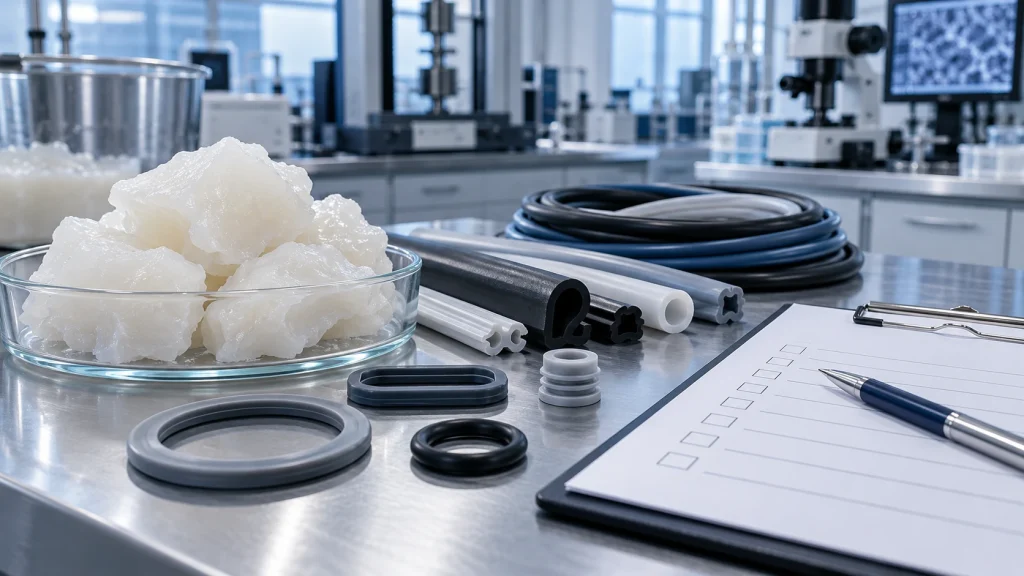
Silicone rubber is widely used where electrical insulation, flexibility and resistance to heat, ozone and weathering must be combined. Typical applications include cable components, flexible profiles, tubes, seals, molded insulation parts and coated technical fabrics.
The material category is now entering a new phase. Buyers in Europe and North America increasingly want to understand not only whether a silicone component will perform, but also where its raw materials came from, whether recycled content is physically present and how any carbon-footprint claim was calculated.
In October 2026, Bluestar Silicones announced a silicone masterbatch containing 33% mechanically recycled silicone. The manufacturer describes it as suitable for extrusion, injection molding and compression molding, with selected partners still validating industrial-scale processing conditions.
This is an important market signal. It is not, however, evidence that every recycled-silicone formulation is ready for electrical insulation, flame-critical assemblies or long-life sealing applications.
Qualification must remain application-specific.
What “Recycled Silicone” Can Mean
The phrase can describe substantially different material routes.
Mechanically recycled silicone
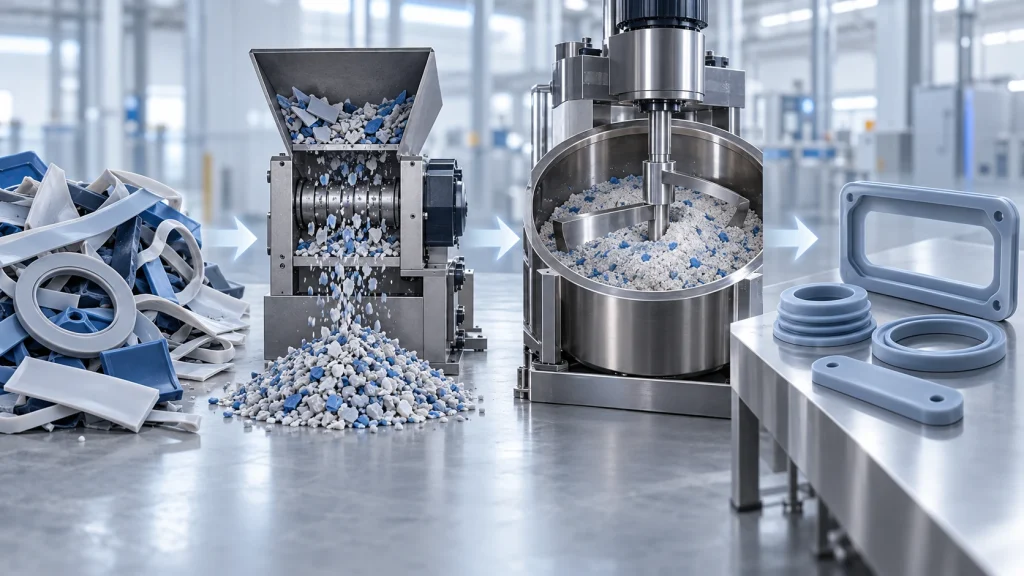
Mechanical recycling generally involves collecting cured silicone, reducing it to a controlled form and incorporating the recovered material into a new compound or masterbatch.
Important variables include:
- Origin and consistency of the recovered material
- Contamination-control method
- Particle size and dispersion
- Percentage of recycled content in the final compound
- Effect on cure behavior and surface quality
- Batch-to-batch variation
A supplier should state whether the quoted recycled percentage applies to a masterbatch, the finished compound or the final molded component. These are not interchangeable claims.
Chemically recycled or circular-feedstock silicone
Other approaches may break silicone waste into chemical intermediates or use certified circular feedstocks. Depending on the system, recycled attribution may be based on physical content or a mass-balance method.
Buyers should therefore ask three separate questions:
- Is recycled material physically present in the delivered product?
- How is recycled content calculated?
- Is the claim supported by supplier traceability or third-party certification?
A percentage without a calculation boundary is not sufficient for a technical specification.
Why Conventional Material Data Cannot Simply Be Assumed
A manufacturer may report that a recycled-content grade delivers mechanical properties comparable with a conventional silicone elastomer. That is useful screening information, but it does not qualify the material for every end use.
Electrical insulation, sealing and thermal-protection applications expose silicone to different failure mechanisms. Depending on the assembly, recycled content could potentially affect:
- Tensile strength and elongation
- Tear resistance
- Hardness stability
- Compression set
- Dielectric strength
- Volume resistivity
- Adhesion to fabric, film, metal or adhesive
- Surface appearance
- Volatile content and outgassing
- Cure consistency
- Long-term heat aging
The correct comparison is not “recycled versus virgin” in the abstract. It is the proposed compound versus the currently approved material under the actual manufacturing process and service conditions.
A Practical Qualification Framework
1. Define the application before selecting a grade
The request should identify whether the material will be used as:
- An extruded cable component
- A flexible tube or profile
- A compression-molded seal
- An injection-molded insulating part
- A coating on fiberglass fabric
- A foam or sponge gasket
- An adhesive-backed converted component
A material suitable for a molded profile is not automatically suitable for coating, foaming or pressure-sensitive adhesive lamination.
2. Establish the operating environment
Specify realistic conditions rather than requesting only a generic “high-temperature” grade:
- Normal and maximum operating temperature
- Duration and frequency of peak exposure
- Thermal cycling
- Outdoor UV, ozone or moisture exposure
- Contact with oils, coolants, electrolyte or cleaning chemicals
- Compression or repeated flexing
- Required service life
- Electrical voltage and insulation geometry
Continuous-use capability must not be inferred solely from a short peak-temperature statement.
3. Request comparable property data
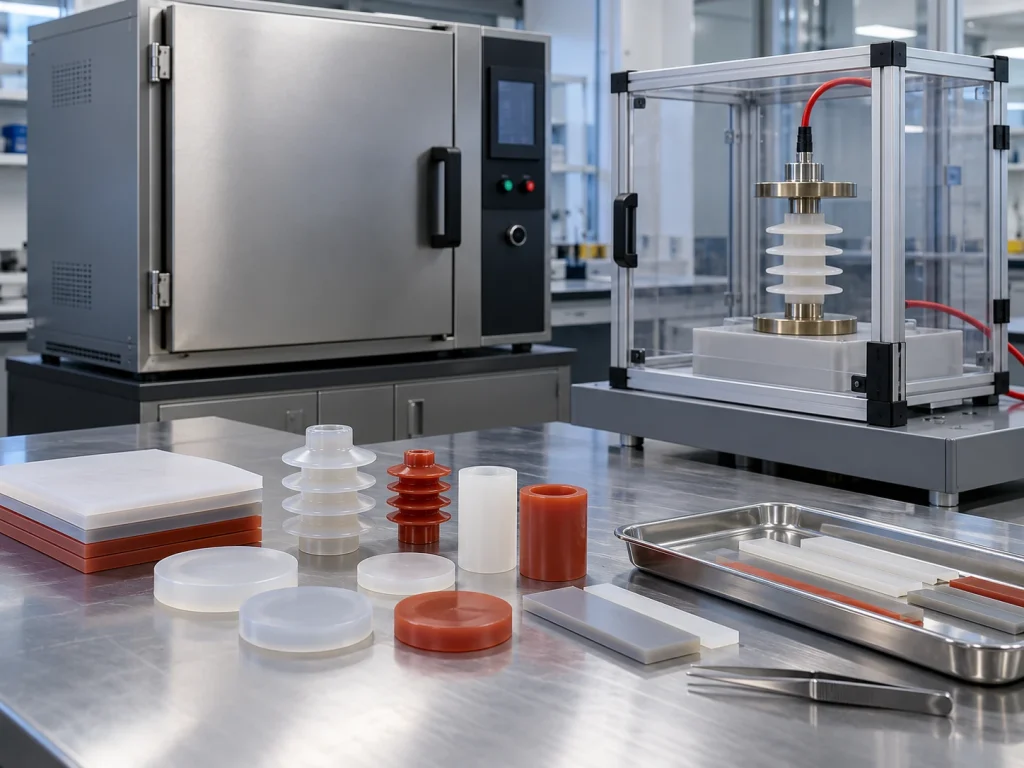
The supplier’s technical data should identify the test method and sample condition. Depending on the application, the review may include:
- Hardness
- Tensile strength
- Elongation at break
- Tear strength
- Density
- Compression set
- Dielectric strength
- Volume resistivity
- Flame-performance classification
- Heat-aging results
- Low-temperature flexibility
- Chemical resistance
- Volatile or outgassing data
Values generated from different specimen thicknesses, cure conditions or test standards should not be treated as directly equivalent.
4. Validate processing behavior
Recycled-content silicone can only create value if it processes consistently.
For extrusion, examine dimensional stability, die swell, surface finish and line speed. For injection or compression molding, review flow, cure time, mold release, flash and shrinkage. For coating or lamination, verify coating uniformity, adhesion and compatibility with primers or pressure-sensitive adhesives.
Pilot production should use the intended tooling and process settings wherever possible.
5. Check electrical and fire requirements separately
“Silicone” does not automatically mean that a product holds a specific UL, IEC, EN or automotive approval.
The qualification package should distinguish among:
- A raw-material test result
- A supplier’s recognized component
- A converted construction
- A customer-approved finished assembly
Changing the compound, thickness, reinforcement, adhesive or manufacturing site may change the applicability of an existing recognition. Buyers should confirm the exact product designation and scope directly in the relevant certification database.
6. Review sustainability claims as technical data
A carbon-footprint reduction claim should identify:
- Product and functional unit
- Reference product
- System boundary
- Geographic and energy assumptions
- Allocation method
- Reporting standard
- Verification status
- Date and version of the assessment
Bluestar Silicones reports that its newly announced recycled-silicone masterbatch may reduce product carbon footprint by up to 30%. This is a manufacturer-specific claim and should not be generalized to unrelated silicone products.
7. Plan for change control
The supply agreement should define which changes require notification. Examples include:
- Recycled-feedstock source
- Recycled-content range
- Formulation or catalyst
- Manufacturing location
- Test method
- Color or filler system
- Packaging and shelf life
This is especially important when recycled input streams may vary more than tightly controlled virgin feedstocks.
Application Considerations
Cables, profiles and tubes
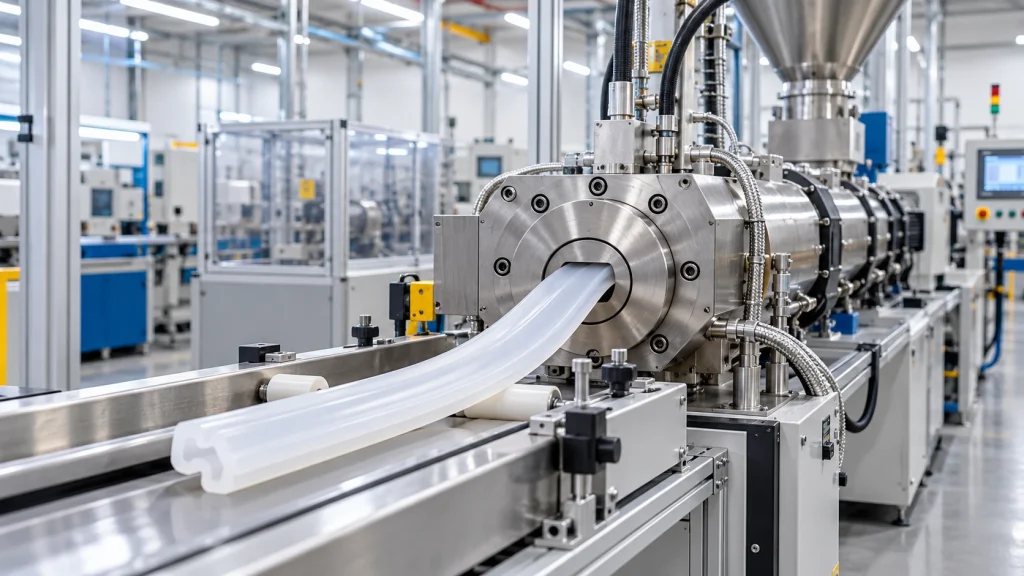
These were among the applications identified for the newly announced masterbatch. Buyers should evaluate extrusion stability, surface defects, tensile and elongation retention after aging, electrical performance where relevant, and consistency across production lots.
Molded seals and gaskets
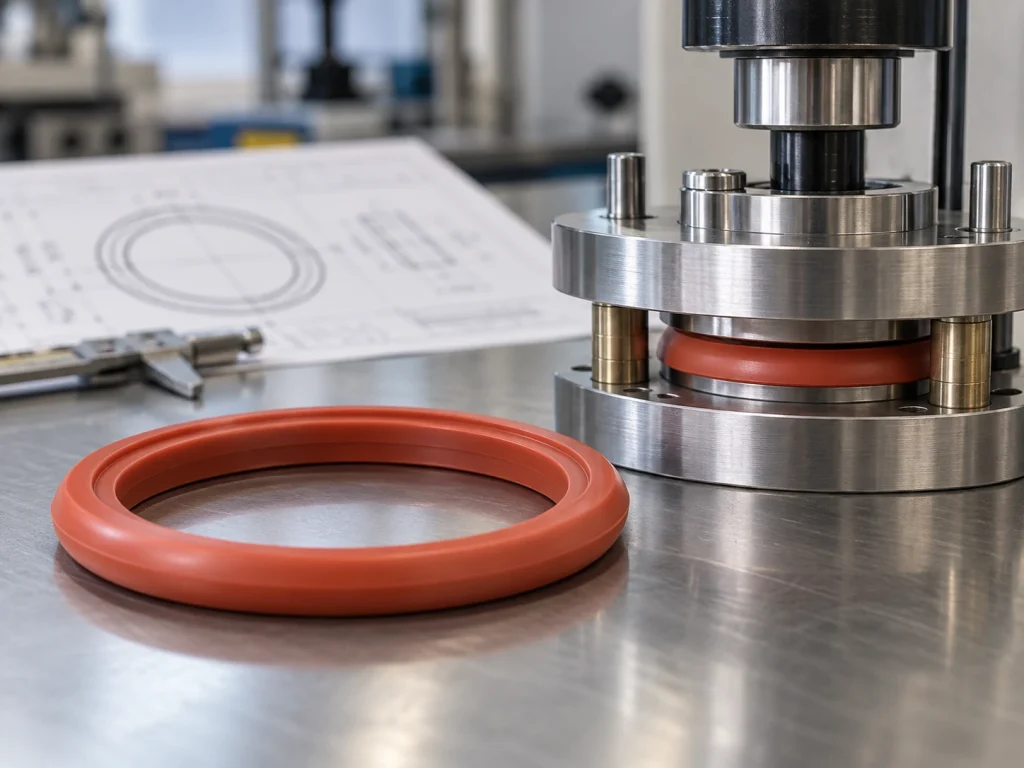
For seals, initial hardness is only the beginning. Compression set, stress relaxation, mating-fluid compatibility and dimensional stability often determine real service life.
Electrical insulation parts
For an insulating pad, sleeve or barrier, the complete construction matters: compound, thickness, geometry, air gaps, contamination, attachment method and operating voltage.
A recycled-content claim must never substitute for dielectric and thermal-aging validation.
Silicone-coated fiberglass fabrics
Coated fabrics are composite constructions. Their performance depends on the silicone coating, fiberglass substrate, coating weight, cure quality and any subsequent adhesive or conversion operation.
A recycled silicone designed for molding or extrusion should not be presented as suitable for coated fabric without coating-process and finished-construction data.
RFQ Checklist for Recycled-Silicone Components

A useful request for quotation should include:
- Part drawing and revision
- Intended application
- Material form and preferred cure system
- Required recycled-content definition
- Thickness, dimensions and tolerances
- Hardness and mechanical targets
- Electrical requirements
- Operating and peak temperature
- Compression, chemical and environmental exposure
- Flame or regulatory requirements
- Color and cosmetic limits
- Annual volume and lot size
- Packaging and cleanliness requirements
- Required certificates and change-notification period
When the requirement is still being developed, representative samples and a clearly documented validation plan are more valuable than a broad “eco-friendly silicone” request.
Conclusion
Recycled silicone is moving from a sustainability concept toward industrial processing. That creates a genuine opportunity for cables, profiles, molded parts and, potentially, other high-temperature components.
The right purchasing approach is to treat recycled content as an additional specification—not as a replacement for thermal, mechanical, electrical and regulatory requirements.
HighTemp Material can support discussions involving silicone-coated technical fabrics and precision-converted insulation or sealing parts. Send the intended construction, operating environment, drawing and required test standards with your RFQ. Material availability, recycled content and compliance scope must be confirmed for the specific product before approval.
FAQ
Is recycled silicone automatically suitable for electrical insulation?
No. Suitability depends on the exact compound, thickness, geometry and test results. Dielectric, aging and regulatory requirements must be verified for the proposed construction.
Does 33% recycled masterbatch mean the finished product contains 33% recycled silicone?
Not necessarily. Buyers must confirm whether the percentage refers to the masterbatch or final compound and how much masterbatch is used.
Can a recycled silicone grade replace an existing grade without testing?
A direct substitution is not recommended. Process trials and application-specific mechanical, thermal and electrical validation are needed.
Is a lower product carbon footprint the same as regulatory compliance?
No. Carbon-footprint reporting and chemical or product compliance are separate evaluations.
Which documents should be requested?
At minimum, request the current TDS, SDS, recycled-content statement, applicable test reports, traceability information and change-control terms.