
An Engineering Guide to Selecting PET, PI, Silicone and Advanced Battery Protection Materials
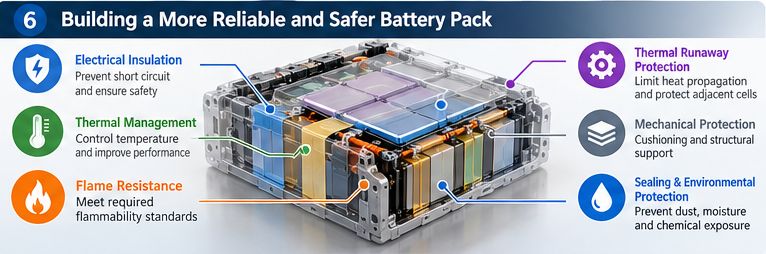
Battery safety is no longer just about selecting a flame-retardant material. Modern electric vehicle (EV) battery packs, energy storage systems (ESS), and power electronics require a carefully engineered combination of electrical insulation, thermal management, flame resistance, mechanical protection, and thermal runaway mitigation.
Although these functions are closely related, they are not interchangeable.
A flame-retardant PET film may provide electrical insulation and meet a specified flammability classification. A thermally conductive silicone compound can help transfer heat away from electronic components. A ceramic-forming silicone coating may provide a protective barrier during extreme thermal events.
However, none of these materials should automatically be considered a complete battery fire protection solution.
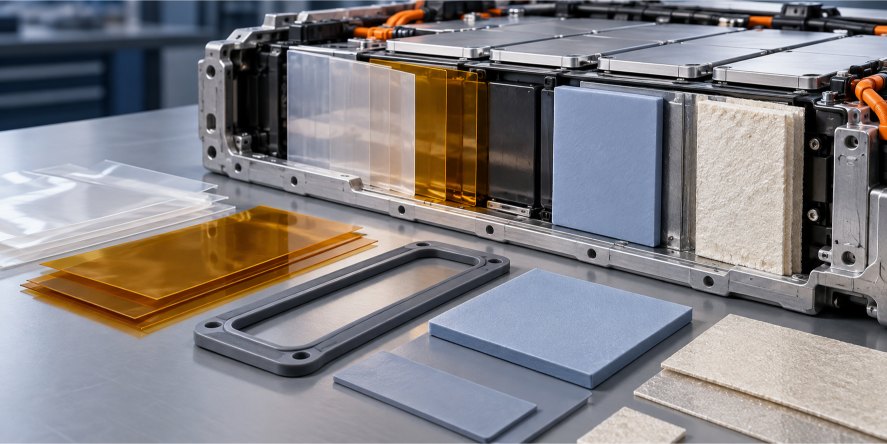
In this guide, we compare commonly used battery insulation materials, explain their different engineering functions, and discuss how manufacturers can select appropriate materials for battery modules, battery packs, and energy storage equipment.
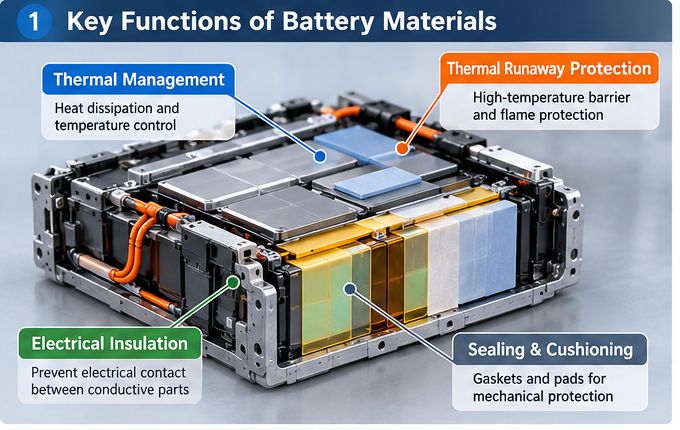
1. Why Battery Safety Requires Different Material Functions
A modern battery pack contains battery cells, busbars, cooling systems, electronic controls, structural components, seals, and electrical connections.
Each component introduces different material requirements.
Electrical Insulation
Electrical insulation materials help prevent unintended electrical contact between conductive components.
Typical applications include:
- Battery cell wrapping and electrical isolation
- Busbar insulation
- Battery module separators
- Insulation between metal housings and electrical components
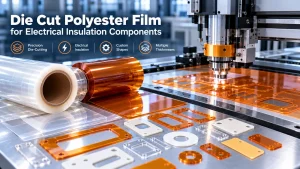
- Die-cut insulation barriers and protective liners
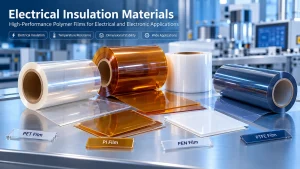
Common materials include PET film, polyimide (PI) film, mica-based insulation, and selected electrical insulation laminates.
Thermal Management
Thermal management materials help control operating temperatures by transferring heat between components and cooling structures.
Applications include:
- Battery module thermal interfaces
- Power electronics cooling
- Heat transfer between battery components and cooling plates
- Thermal potting of electrical assemblies
Typical materials include thermally conductive silicone pads, gap fillers, potting compounds, and thermal interface adhesives.
Flame Resistance
Flame-resistant materials are designed to meet specified flammability performance requirements under defined testing conditions.
For example, selected PET films may achieve UL 94 VTM-0 classification, while certain thicker or differently configured materials may be evaluated under UL 94 V-0.
These classifications are not interchangeable and do not establish that a material can contain battery thermal runaway.
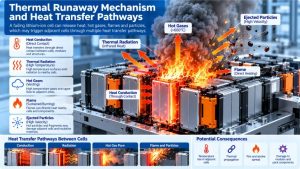
Thermal Runaway Protection
Thermal runaway protection involves limiting the consequences of severe battery failure, including high-temperature exposure, hot gas release, flame propagation, and heat transfer to adjacent cells.
Potential protection materials include engineered mica barriers, ceramic insulation, specialized high-temperature composites, and ceramic-forming silicone systems.
Performance must be evaluated under representative battery pack conditions.
Engineering takeaway: A material that provides excellent electrical insulation is not necessarily suitable for heat dissipation or thermal runaway containment.
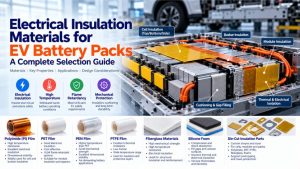
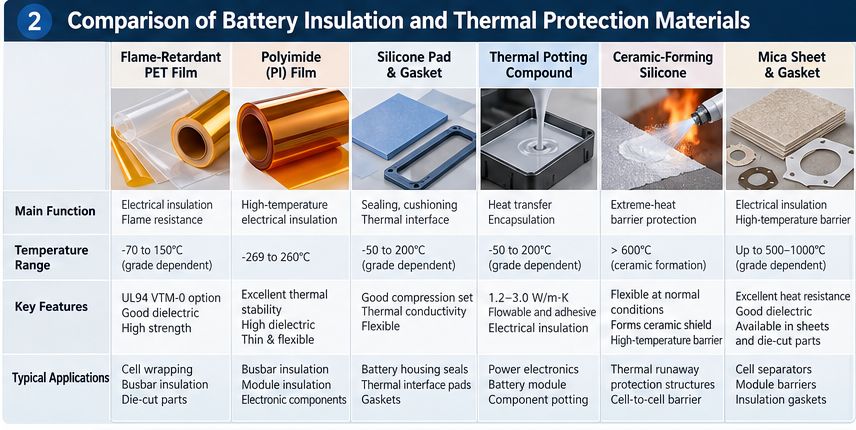
2. Comparison of Battery Insulation and Thermal Protection Materials
The following table provides a functional comparison of major material categories.
| Material | Primary Function | Typical Applications | Key Selection Considerations |
|---|---|---|---|
| Flame-Retardant PET Film | Electrical insulation and specified flame resistance | Cell wrapping, busbar insulation, die-cut liners | Thickness, dielectric strength, UL classification, traceability |
| Polyimide (PI) Film | Heat-resistant electrical insulation | Busbars, electronic assemblies, high-temperature insulation | Temperature exposure, dielectric performance, flexibility, adhesive system |
| Silicone Rubber Pad | Sealing, cushioning or thermal interface, depending on grade | Battery housings, gaskets, compression interfaces | Compression set, hardness, thermal conductivity, aging |
| Thermally Conductive Potting Compound | Heat transfer and encapsulation | Battery electronics, power modules, electrical assemblies | Thermal conductivity, viscosity, cure, adhesion, reworkability |
| Ceramic-Forming Silicone | Extreme-heat barrier protection | Selected thermal runaway protection structures | Ceramic formation, barrier integrity, adhesion, system testing |
| Mica Sheet or Mica Composite | Electrical insulation and high-temperature barrier | Cell separators, module barriers, protective shields | Binder system, thickness, thermal exposure, mechanical integrity |
Important: Material performance depends on the specific grade, formulation, thickness, processing conditions, and final assembly design. This table is intended for preliminary material selection, not certification or final engineering approval.
3. Flame-Retardant PET Film for Battery Electrical Insulation
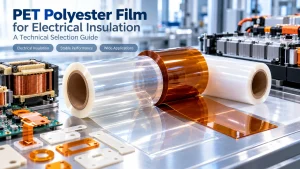
Polyethylene terephthalate (PET) film is widely used in electrical insulation because of its combination of dielectric properties, mechanical strength, dimensional consistency, and converting capability.
For battery applications, flame-retardant PET grades can be particularly relevant where electrical insulation and documented flammability performance are both required.
Key Selection Criteria
Engineers should evaluate:
- Film thickness and thickness tolerance
- Dielectric breakdown performance
- Operating temperature requirements
- UL 94 classification for the exact grade and thickness
- Mechanical flexibility and tear resistance
- Surface characteristics and adhesive compatibility
- Roll dimensions and converting requirements
For thin-film products, UL 94 VTM-0 may be a relevant classification.
However, the exact material designation, minimum recognized thickness, color, and certification information should be verified against the applicable UL recognition record.
A UL classification for one film grade does not automatically apply to other PET films or finished adhesive laminates.
Typical Applications
Flame-retardant PET film may be suitable for:
- Battery cell electrical insulation
- Battery module insulation liners
- Die-cut electrical isolation parts
- Busbar protection
- Insulation between electronic assemblies and housings
For a practical example of material certification requirements, read our UL94 VTM-0 PET Film for Battery Insulation Case Study.
This project demonstrates why UL recognition, film thickness, and laboratory verification should be confirmed before material approval.
The final suitability of any PET film depends on the required temperature, electrical stress, mechanical loading, and regulatory documentation.
4. Polyimide Film for Higher-Temperature Electrical Insulation
Polyimide film is another important material for battery electrical insulation.
Compared with conventional PET films, many PI film grades provide improved resistance to elevated operating temperatures.
PI films are often considered when a design requires:
- Electrical insulation under elevated thermal exposure
- Thin and flexible insulation layers
- Dimensional stability during high-temperature processing
- Insulation around power electronics or conductive components
- Precision die-cut insulating components
PI Film vs PET Film
PET film may offer a practical balance of cost, electrical insulation, and converting performance for applications within its specified operating range.
PI film may be preferred when higher thermal endurance is required.
However, neither PI nor PET film should be selected solely on the basis of a generic maximum temperature figure.
Designers should consider continuous exposure, peak temperature, mechanical stress, dielectric performance, and the presence of adhesives or coatings.
For a detailed introduction to thermal stability, dielectric properties, and typical applications, explore our guide: What Is Polyimide PI Film?.
You can also review our PI Kapton Film Selection Guide for additional information about film properties and selection considerations.
5. Silicone Pads, Gaskets and Thermal Interface Materials
Silicone materials can perform several different functions in battery assemblies.
It is important to distinguish ordinary silicone rubber gaskets from engineered thermal interface materials.
Silicone Gaskets and Sealing Components
Silicone rubber gaskets may be used for:
- Battery enclosure sealing
- Environmental protection
- Vibration isolation
- Compression interfaces
- Mechanical cushioning
Their selection depends on hardness, compression set, temperature exposure, environmental resistance, and compatibility with mating surfaces.
A conventional silicone gasket should not be assumed to provide high thermal conductivity.
Thermally Conductive Silicone Pads
Specialized thermally conductive silicone pads are designed to improve heat transfer across interfaces.
Selection factors include:
- Thermal conductivity
- Contact resistance
- Compression behavior
- Required thickness
- Electrical insulation properties
- Long-term mechanical stability
Thermal conductivity alone does not determine actual cooling performance. Interface contact, pressure, bond-line thickness, and assembly geometry can strongly affect results.
6. What WACKER’s 2026 Silicone Developments Reveal About Battery Material Selection
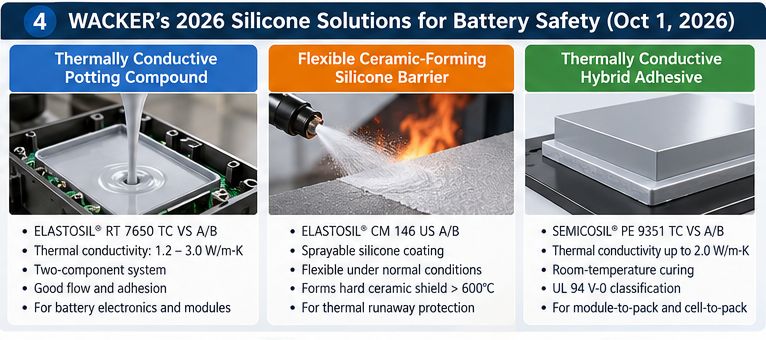
On October 1, 2026, WACKER announced that it would showcase several silicone technologies at The Battery Show 2026.
The announcement highlights the increasing importance of combining thermal performance, manufacturing compatibility, adhesion, and battery safety considerations.
Three technologies illustrate these different material functions.
Thermally Conductive Potting Compound
WACKER described ELASTOSIL® RT 7650 TC VS A/B, a two-component silicone potting material with customizable thermal conductivity of approximately 1.2–3.0 W/m·K.
The announced formulation also emphasizes flow behavior, adhesion, and processing efficiency.
This illustrates why battery electronics manufacturers evaluate more than thermal conductivity when selecting encapsulation materials.
Flexible Ceramic-Forming Silicone Barrier
WACKER also introduced ELASTOSIL® CM 146 US A/B, a sprayable silicone barrier coating.
According to the company’s announcement, the cured material remains flexible under normal conditions and forms a hard ceramic shield when exposed to temperatures above 600°C.
This represents a different protection concept from ordinary silicone pads or electrical insulation films.
The ability to form a ceramic barrier under extreme heat does not, by itself, establish a complete battery pack’s thermal runaway resistance.
Thermally Conductive Hybrid Adhesive
Another announced product, SEMICOSIL® PE 9351 TC VS A/B, offers thermal conductivity up to 2.0 W/m·K, room-temperature curing, and a reported UL 94 V-0 classification.
The product targets changing automotive battery assembly requirements, including module-to-pack and cell-to-pack designs.
What This Means for Material Buyers
These developments reinforce an important engineering principle:
Battery material selection increasingly involves balancing electrical performance, thermal behavior, processing compatibility, mechanical reliability, and safety validation.
Rather than asking whether a material is simply “fireproof,” buyers should define the exact function and test conditions required.
Source: Wacker Chemical Corporation, October 1, 2026. Product specifications summarized from the company’s public announcement. HighTemp Material does not claim to manufacture, distribute, or supply these WACKER products.
7. Why UL 94 V-0 and VTM-0 Are Not Thermal Runaway Certifications
One of the most common misunderstandings in battery material selection is treating a flame-retardant classification as proof of thermal runaway protection.
UL 94 evaluates material flammability under specified laboratory test configurations.
UL 94 V-0 and VTM-0 apply to different specimen configurations and should not be treated as equivalent classifications.
They do not independently establish:
- Battery pack thermal runaway containment
- Resistance to prolonged flame impingement
- Protection against high-temperature vent gases
- Cell-to-cell propagation prevention
- Complete battery system safety compliance
For this reason, material suppliers and battery manufacturers should distinguish between material-level flammability results and battery-system validation.
Where relevant, engineers should also review the applicable battery or energy storage system standards, customer specifications, and test protocols.
8. How to Select the Right Material for Your Battery Application
A practical selection process begins by defining the primary engineering requirement.
| Engineering Requirement | Materials to Evaluate |
|---|---|
| Thin electrical insulation | PET film, flame-retardant PET, PI film |
| Elevated-temperature electrical insulation | PI film, selected mica composites |
| Battery enclosure sealing | Silicone rubber gaskets |
| Thermal interface heat transfer | Thermally conductive silicone pads, gap fillers |
| Electronic component encapsulation | Thermally conductive potting compounds |
| Severe thermal event barriers | Engineered mica, ceramic composites, ceramic-forming systems |
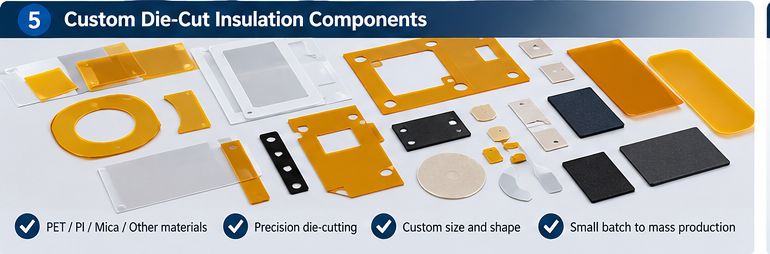
| Custom electrical insulation geometry | Die-cut PET, PI, mica or qualified laminates |
Some applications require multiple materials working together.
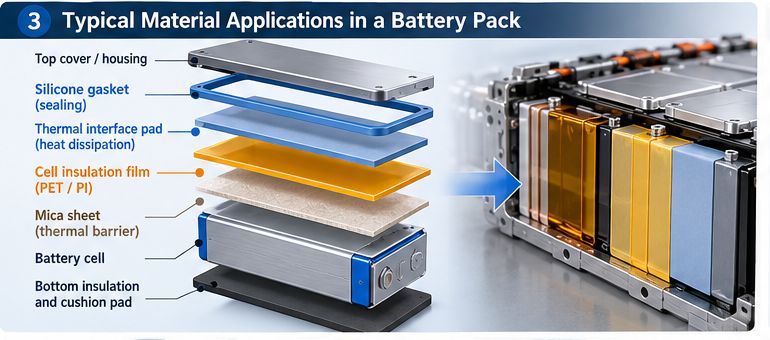
For example, a battery pack may use PET film for electrical isolation, silicone gaskets for enclosure sealing, a thermal interface material for heat dissipation, and a separately validated high-temperature barrier for thermal runaway mitigation.
The best material system is therefore not necessarily a single multifunctional material.
For applications requiring high-temperature electrical insulation or engineered thermal barriers, Mica Sheet & Die Cut Mica Gasket products may be evaluated according to the required material grade, thickness, and testing conditions.
9. Engineering Checklist Before Requesting a Battery Insulation Material Quote
Before requesting samples or pricing, prepare the following information:
- Application: Cell insulation, busbar insulation, enclosure gasket, thermal interface, or barrier.
- Material preference: PET, PI, silicone, mica, or an alternative.
- Dimensions: Thickness, width, length, die-cut geometry, and tolerances.
- Temperature conditions: Normal operating range, processing exposure, and abnormal event requirements.
- Electrical requirements: Dielectric strength, insulation resistance, and relevant test conditions.
- Mechanical requirements: Flexibility, compression, abrasion, and assembly loading.
- Flammability requirements: Required classification and documentation.
- Adhesive requirements: Self-adhesive or non-adhesive, adhesive chemistry, and substrate compatibility.
- Documentation: TDS, SDS where applicable, UL recognition information, RoHS/REACH declarations, and customer-specific reports.
- Commercial requirements: Annual quantity, sample volume, roll format, and delivery schedule.
A well-defined specification helps suppliers evaluate feasibility and avoids selecting materials based on incomplete performance claims.
For projects requiring non-standard insulation shapes, explore our Custom Die Cutting Services.
We support drawing-based evaluation of precision-converted PET, PI, mica, and other suitable insulation materials.
10. Custom Battery Insulation Films and Die-Cut Components from HighTemp Material
HighTemp Material focuses on high-temperature electrical insulation films and custom converting solutions for industrial electronics and energy-related applications.
For battery insulation projects, our relevant product and processing categories include:
- Flame-retardant PET insulation films
- Polyimide electrical insulation films
- Custom die-cut insulation components
- Precision film slitting
- Mica sheets and insulation gaskets
- Application-specific material selection support
We can discuss material selection, dimensions, processing feasibility, and available documentation based on project requirements.
Our primary focus is electrical insulation materials and precision-converted components, rather than claiming that conventional insulation films or gaskets provide complete thermal runaway protection.
Request a Battery Insulation Material Quote
Are you developing an EV battery pack, energy storage module, or electrical insulation component?
Send us your material requirements, drawing, thickness, operating conditions, and estimated annual demand.
We can help review suitable insulation film options and discuss custom slitting or die-cutting requirements.
Contact HighTemp Material to discuss your project requirements.
Frequently Asked Questions
What is the difference between battery insulation and thermal management materials?
Battery insulation materials are primarily designed to prevent unwanted electrical conduction. Thermal management materials are selected to transfer, spread, or control heat. Some specialized products can perform both functions, but each property must be verified.
Can UL94 VTM-0 PET film prevent battery thermal runaway?
No. UL 94 VTM-0 is a material flammability classification under defined test conditions. It does not demonstrate that a PET film can stop battery thermal runaway or prevent propagation between cells.
Is PI film better than PET film for battery insulation?
PI film may offer advantages in higher-temperature applications, while PET film may be a cost-effective choice where its electrical, thermal, and mechanical properties meet the design requirements. Selection depends on the application.
Are silicone rubber gaskets thermally conductive?
Not necessarily. Ordinary silicone rubber gaskets are commonly selected for sealing and cushioning. Thermally conductive silicone grades require specific formulations and verified thermal performance.
What materials are used for battery thermal runaway barriers?
Depending on the battery architecture and test requirements, designers may evaluate mica composites, ceramic materials, specialized insulation structures, and ceramic-forming silicone systems. Final performance must be validated at the relevant component or system level.
Can battery insulation films be custom die-cut?
Yes. Suitable PET, PI, and other insulation films can be slit or die-cut into application-specific shapes, subject to material characteristics, thickness, tolerances, and production feasibility.
Conclusion
Battery insulation, thermal management, flame resistance, and thermal runaway protection are different engineering functions.
WACKER’s October 2026 silicone technology announcement provides a useful example of how advanced battery materials are being developed for more specific thermal and manufacturing requirements.
For battery engineers and purchasing teams, the most effective approach is to identify the required function first, then evaluate materials using relevant technical data, certification documents, and application testing.
For projects involving electrical insulation films, flame-retardant PET, polyimide films, mica components, or custom die-cut insulation parts, HighTemp Material can support preliminary material selection and converting discussions.
Request Material Selection Support from HighTemp Material
Reference
Wacker Chemical Corporation. WACKER to Showcase Advanced Silicone Technologies for Thermal Management and Battery Safety at The Battery Show 2026. October 1, 2026.