
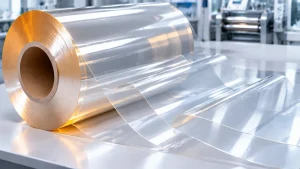
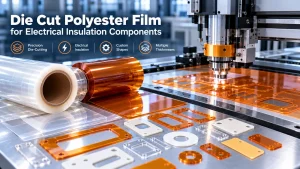
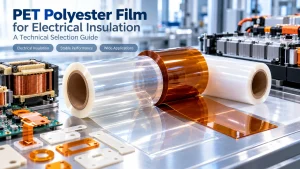


Clear polyester film is widely used in industrial printing, electrical insulation, electronics, laminating, protective layers, and precision die-cut components. Its combination of optical clarity, mechanical strength, dimensional stability, and processability makes it a practical substrate for many engineered applications.
However, not all clear polyester films are interchangeable. Two PET films with the same nominal thickness may differ significantly in haze, surface treatment, thermal shrinkage, adhesion performance, and suitability for downstream converting.
For engineers and technical buyers, choosing the correct film requires more than specifying “clear PET film” on a purchase order.
This guide explains the key properties of clear polyester film, common industrial applications, thickness selection, surface treatment options, testing requirements, and the information needed to request a technically accurate quotation.
What Is Clear Polyester Film?
Clear polyester film is a transparent thermoplastic film commonly manufactured from polyethylene terephthalate (PET).
Many industrial polyester films are produced using a biaxial orientation process. During manufacturing, the film is stretched in the machine direction (MD) and transverse direction (TD), improving its mechanical properties and dimensional consistency.
Biaxially oriented PET film is commonly referred to as BOPET.
Depending on its formulation and manufacturing process, clear polyester film can provide:
- High tensile strength relative to its thickness
- Good optical transparency
- Dimensional stability under controlled conditions
- Electrical insulating properties
- Resistance to many oils, greases, and industrial chemicals
- Compatibility with coating, printing, laminating, slitting, and die cutting
Clear PET film is available in different grades, including general-purpose, optically enhanced, surface-treated, and heat-stabilized films.
The correct grade depends on the end-use environment rather than transparency alone.
Clear Polyester Film vs. Clear PET Film
In industrial material specifications, the terms clear polyester film and clear PET film are often used interchangeably.
PET refers to the polymer, while polyester describes the broader polymer family.
The terms Mylar® and Melinex® are also frequently encountered in industrial film sourcing. However, these are registered product brands rather than generic technical classifications.
A buyer requesting “clear Mylar film” should confirm whether a specific branded grade is required or whether an equivalent PET film can be evaluated against the same performance requirements.
Key Properties of Clear Polyester Film
1. Optical Clarity, Light Transmission, and Haze
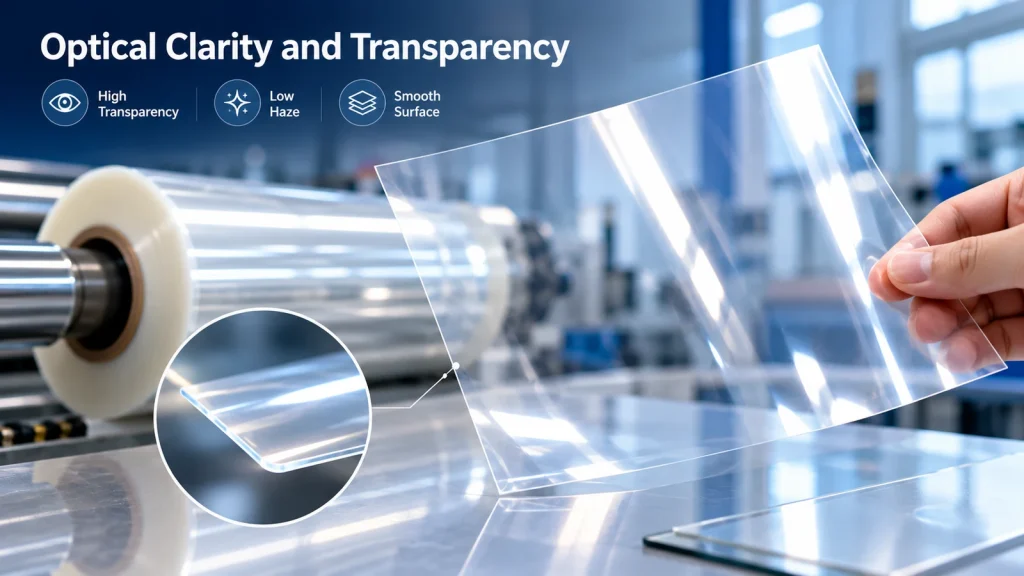
Optical performance is often the first consideration when selecting transparent polyester film.
Three characteristics are particularly important:
Light transmission describes the amount of visible light passing through the film.
Haze describes the scattering of transmitted light, which can make a film appear cloudy even when its total light transmission is relatively high.
Surface appearance includes gloss, scratches, surface texture, and visible defects.
A film may have good light transmission but still be unsuitable for a high-clarity display overlay because of haze, surface imperfections, or optical distortion.
For optical applications, engineers should evaluate:
- Total luminous transmittance
- Haze percentage
- Surface roughness and gloss
- Visible inclusions and scratches
- Optical distortion
- Appearance after coating or lamination
ASTM D1003 is a commonly used method for evaluating haze and luminous transmittance in transparent plastics.
Selection tip: Specify measurable optical acceptance criteria rather than relying solely on descriptions such as “crystal clear” or “high transparency.”
2. Tensile Strength and Mechanical Durability
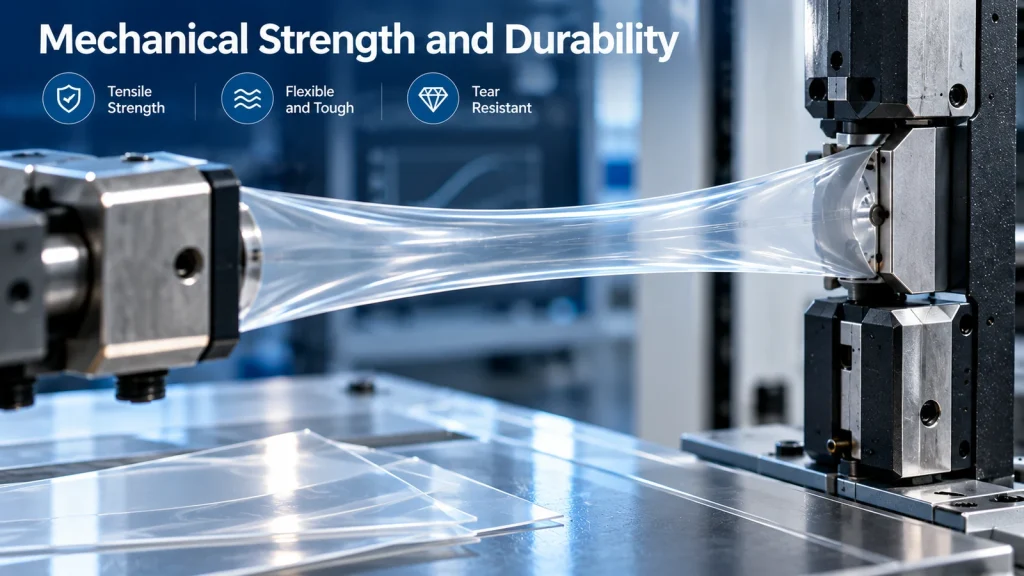
Clear polyester film provides useful mechanical strength for its thickness, making it suitable for converting operations that involve web tension, cutting, handling, and lamination.
Important mechanical properties include:
- Tensile strength
- Tensile modulus
- Elongation at break
- Tear resistance
- Puncture resistance
- Flexibility and stiffness
Film orientation can create different mechanical behavior in the MD and TD directions.
These differences may influence cutting performance, dimensional accuracy, and resistance to tearing during installation.
ASTM D882 is commonly used to evaluate the tensile properties of thin plastic films.
For precision converting, engineers should request directional mechanical data where available.
3. Dimensional Stability and Thermal Shrinkage
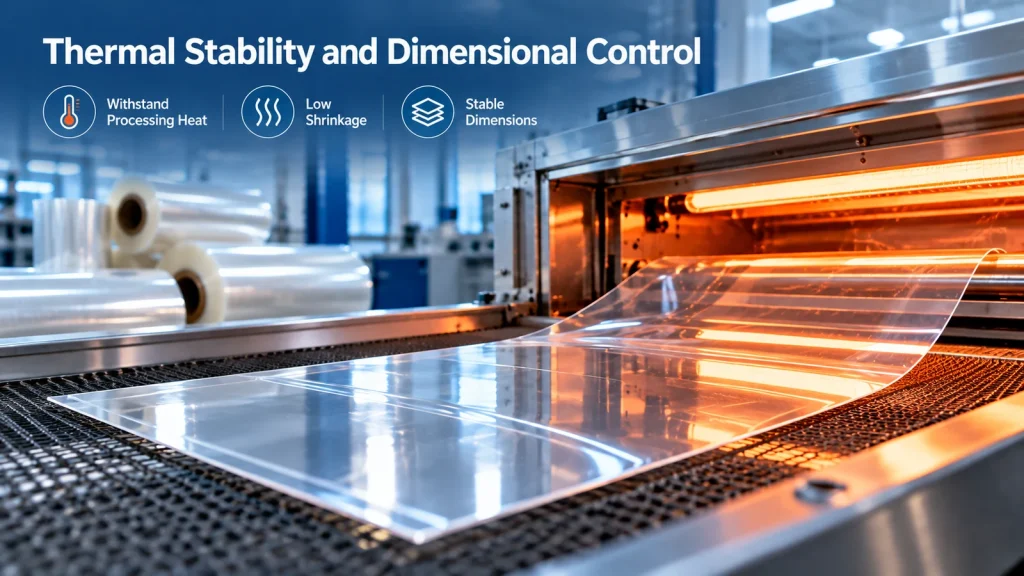
Dimensional stability is particularly important for printed graphics, registration-sensitive components, electrical insulation, and multilayer laminates.
PET film may change dimensions when exposed to elevated temperatures, especially if residual manufacturing stresses are released.
Thermal shrinkage depends on several factors:
- Film grade and orientation
- Heat stabilization process
- Exposure temperature
- Exposure duration
- MD and TD orientation
- Mechanical constraint during heating
General-purpose PET film and heat-stabilized PET film should not automatically be considered equivalent.
For temperature-sensitive applications, engineers should request shrinkage data measured under conditions relevant to the actual manufacturing process.
Engineering example: A printed PET film may pass room-temperature dimensional inspection but develop registration errors after a thermal curing operation. Selecting a film with verified shrinkage performance at the actual curing temperature can help reduce this risk.
4. Temperature Resistance
Clear polyester film can perform well in many industrial thermal environments, but temperature resistance must be defined carefully.
A film’s melting temperature does not represent its maximum recommended continuous service temperature.
Similarly, surviving a short thermal exposure does not establish suitability for prolonged operation at that temperature.
Engineers should distinguish between:
- Continuous operating temperature
- Short-term peak exposure
- Thermal shrinkage during processing
- Mechanical performance at temperature
- Thermal aging
- Electrical insulation requirements at temperature
A clear PET film suitable for a short drying cycle may not be appropriate for continuous service at the same temperature.
For elevated-temperature applications, the actual grade’s technical data sheet and application-specific validation should determine suitability.
5. Electrical Insulation Properties
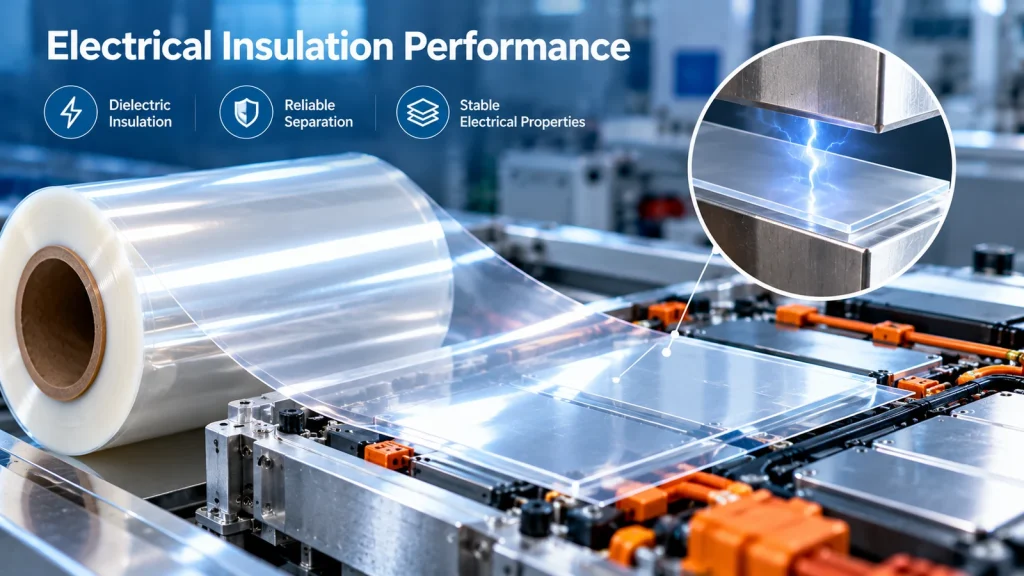
Polyester film is widely used in electrical and electronic insulation systems.
Relevant properties include:
- Dielectric strength
- Volume resistivity
- Surface resistivity
- Dielectric constant
- Dissipation factor
- Thickness uniformity
- Thermal aging behavior
Dielectric strength is particularly relevant when the film is used as a barrier between conductive components.
However, a nominal dielectric strength value should not be used as the sole basis for electrical insulation design.
Actual performance may be influenced by moisture, contamination, film defects, operating temperature, voltage waveform, and mechanical stress.
For safety-critical electrical systems, the complete insulation design and applicable standards must be evaluated.
A transparent film should not be assumed to have a particular UL recognition, flame classification, or electrical thermal class without grade-specific documentation.
6. Chemical and Moisture Resistance
PET film offers useful resistance to many common oils, greases, and industrial contaminants.
Nevertheless, chemical compatibility depends on the specific chemical, concentration, exposure temperature, and duration.
Some solvents, alkaline environments, or aggressive processing chemicals can adversely affect PET or its surface coatings.
In industrial laminates, the adhesive or coating may fail before the PET substrate itself.
Chemical compatibility should therefore be evaluated at the complete material-system level.
Clear Polyester Film Thickness Guide
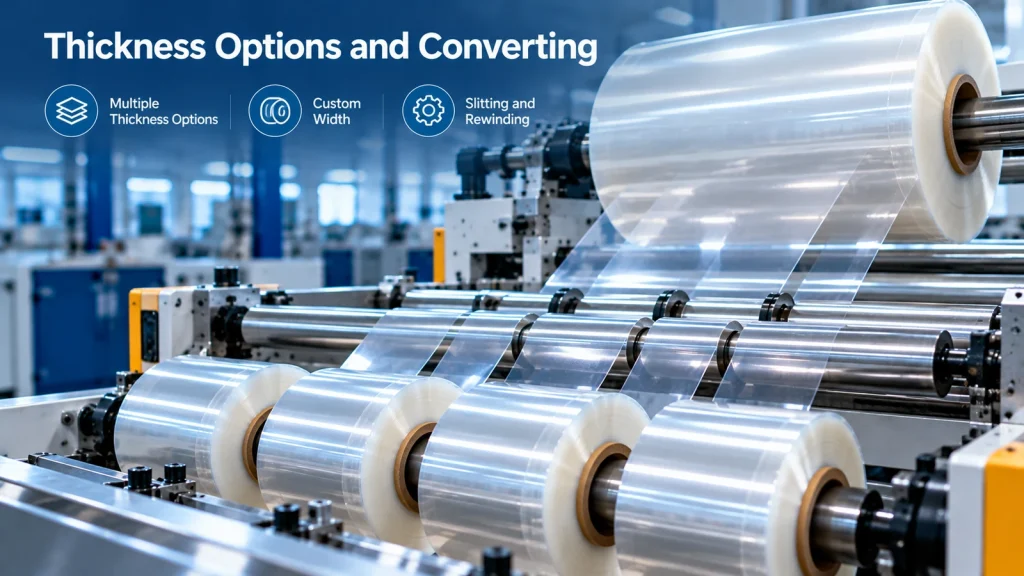
Film thickness influences flexibility, stiffness, handling, mechanical durability, and electrical insulation performance.
Clear polyester film may be supplied in thin flexible gauges or thicker, more rigid constructions.
The following table provides an application-oriented starting point. It is not a declaration of HighTemp Material’s stock availability.
| Nominal Thickness | Approximate Mil | Potential Applications | Main Selection Consideration |
|---|---|---|---|
| 12 µm | 0.5 mil | Thin laminating substrates, lightweight protective layers | Handling and web tension |
| 25 µm | 1 mil | Printing substrates, lightweight industrial laminates | Flexibility and surface quality |
| 50 µm | 2 mil | Die-cut films, printing, insulating layers | Balance of flexibility and strength |
| 75 µm | 3 mil | Industrial overlays, laminated components | Dimensional consistency |
| 100 µm | 4 mil | Die-cut components, protective layers, electrical insulation | Stiffness and thickness tolerance |
| 125 µm | 5 mil | Industrial insulation, spacers, fabricated components | Mechanical rigidity |
| 175–250 µm | 7–10 mil | Thicker insulating and structural film components | Formability and converting capability |
These thicknesses are illustrative industry selection points. Grade availability, tolerances, optical performance, and suitability must be confirmed before ordering.
How to Choose the Right Thickness
Start by identifying the primary engineering requirement.
For flexible laminates, thinner film may be preferable.
For die-cut components that must retain their shape during handling, a thicker film may offer advantages.
For electrical insulation, thickness must be selected according to the validated electrical design rather than simply increasing thickness until a desired nominal dielectric value is reached.
For optical overlays, thickness also influences handling, flatness, and the appearance of the finished laminate.
Clear Polyester Film Surface Treatments
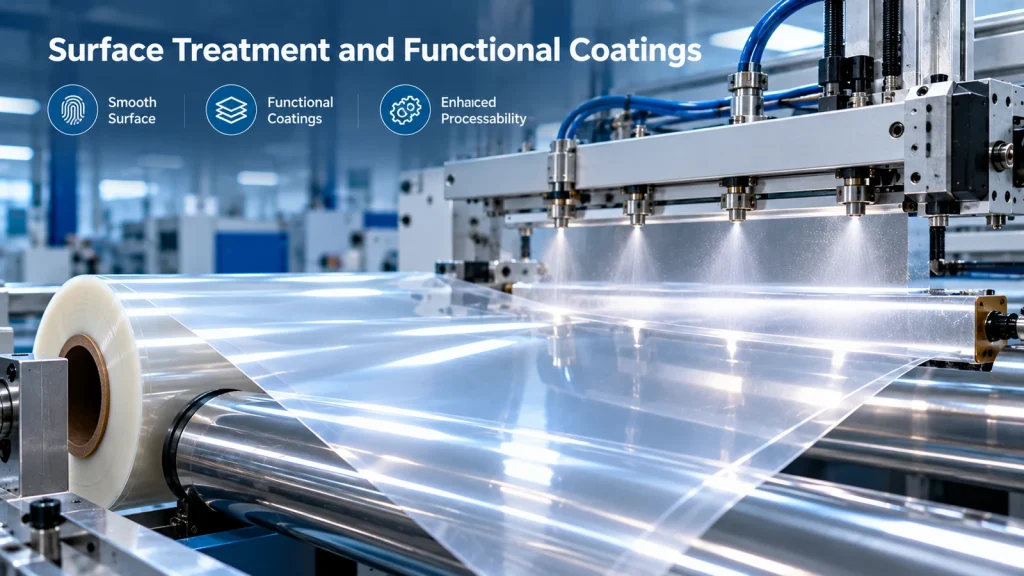
Surface treatment is one of the most overlooked factors in PET film selection.
Untreated PET film may not provide sufficient adhesion for certain inks, coatings, or adhesives.
Common surface options include:
Untreated Clear PET Film
Suitable for applications where the film’s existing surface properties are sufficient.
Potential uses include mechanical separators, selected insulating layers, and components that do not require special coating adhesion.
Corona-Treated PET Film
Corona treatment modifies the film surface to improve wetting and potentially enhance adhesion.
It is commonly considered for printing, coating, and lamination processes.
However, corona treatment does not guarantee compatibility with every ink or adhesive system.
Surface treatment effectiveness can also change during storage.
Chemically Treated or Primer-Coated PET Film
Specialized coatings or primers may be used to improve compatibility with specific inks, adhesives, or functional coatings.
These grades may be useful for demanding printed-electronics and industrial graphic applications.
Heat-Stabilized Clear PET Film
Heat-stabilized grades are designed to improve dimensional stability under specified thermal conditions.
They may be appropriate for processes involving printing, curing, laminating, or precision registration.
Heat stabilization and surface treatment are separate specifications. A film may require both.
Industrial Applications of Clear Polyester Film
1. Electrical and Electronic Insulation
Clear polyester film can be used in selected electrical insulation components, including insulating barriers, spacers, laminated insulation structures, and die-cut insulating parts.
Key requirements include dielectric performance, thickness consistency, thermal endurance, and resistance to mechanical damage.
The exact film grade should be evaluated against the insulation system’s operating requirements.
2. Industrial Printing and Graphic Overlays
Clear PET film is used as a substrate for printed graphics, labels, overlays, and other converted products.
Important requirements include optical clarity, surface treatment, print adhesion, dimensional stability, and surface appearance.
Printing processes may include screen printing, flexographic printing, or other compatible industrial methods.
Ink adhesion must be validated with the selected film surface and curing process.
3. Precision Die-Cut Components
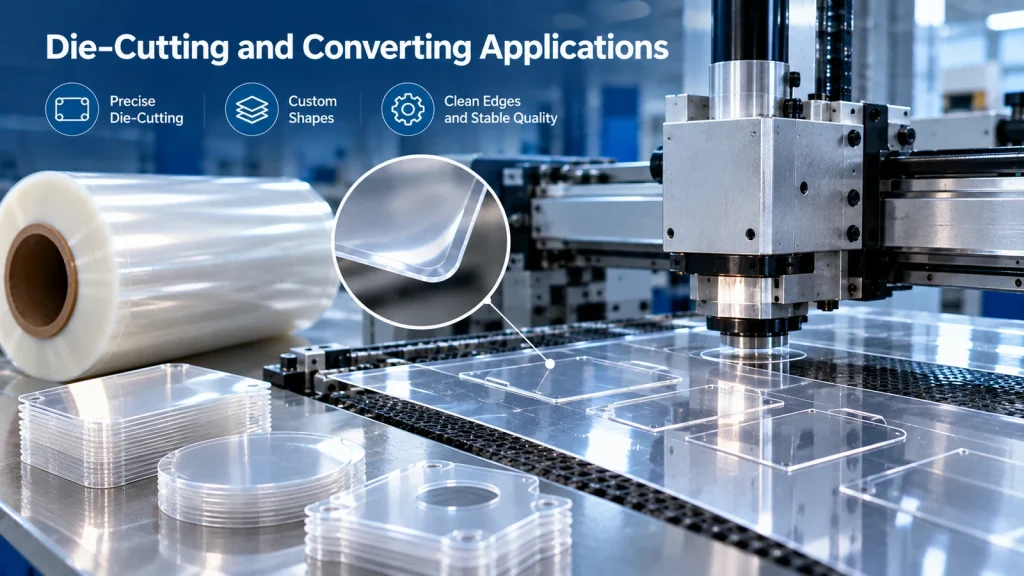
Clear polyester film can be converted into custom shapes for industrial assembly.
Potential applications include:
- Transparent protective layers
- Die-cut insulating barriers
- Spacers and separators
- Laminated film components
- Industrial identification and overlay parts
Important considerations include cut-edge quality, dimensional tolerance, static control, film handling, and contamination prevention.
4. Laminating and Adhesive Constructions
Clear PET film can function as a carrier or structural layer within a multilayer laminate.
Applications may involve pressure-sensitive adhesives, functional coatings, or other polymer layers.
The film must be compatible with the lamination temperature, pressure, adhesive chemistry, and subsequent environmental exposure.
5. Electronics and Industrial Protective Layers
Transparent PET film may be used where visual inspection, mechanical separation, or protection of underlying components is required.
Requirements can include surface cleanliness, scratch resistance, dimensional stability, and compatibility with assembly processes.
A standard clear PET film should not be assumed to provide antistatic, hard-coated, optical-grade, or cleanroom-controlled performance unless these features are specifically documented.
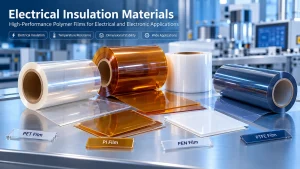
Clear PET Film vs. Other Transparent Films
| Material | General Advantages | Key Limitations | Typical Selection Driver |
|---|---|---|---|
| Clear PET | Mechanical strength, clarity, dimensional stability, converting versatility | Limited suitability for prolonged high-temperature exposure | General industrial films and electrical insulation |
| Polycarbonate (PC) | Toughness, impact resistance, forming potential | Grade-dependent chemical resistance and processing behavior | Durable overlays and formed parts |
| Polypropylene (PP) | Low density, moisture resistance, flexible film options | Lower thermal and mechanical stiffness in many constructions | Packaging and flexible layers |
| PEN Film | Potential for improved thermal and dimensional performance versus conventional PET | Higher cost and grade-dependent availability | More demanding electronic film applications |
| Polyimide (PI) Film | High-temperature performance and electrical insulation capability | Many conventional grades are amber rather than optically clear | High-temperature electronic insulation |
The final choice should be based on the exact commercial grade, not broad polymer-family comparisons alone.
Common Selection Mistakes
Mistake 1: Assuming All Clear PET Films Have the Same Optical Quality
Clear appearance does not establish a specific haze or transmission specification.
Prevention: Request optical data and evaluate production-representative samples.
Mistake 2: Ignoring Surface Treatment
A film may look suitable but exhibit poor ink or adhesive adhesion.
Prevention: Confirm the surface treatment, treated side, treatment age, and compatibility with the intended process.
Mistake 3: Selecting Film Based Only on Thickness
Films with the same nominal thickness can have different shrinkage, mechanical properties, and surface characteristics.
Prevention: Specify grade-dependent performance requirements.
Mistake 4: Confusing Short-Term Heat Resistance with Continuous Service
A film that survives a brief process temperature may still be unsuitable for continuous use.
Prevention: Validate exposure time, temperature, and required performance after heating.
Mistake 5: Ignoring Converting and Handling Requirements
Film curl, static attraction, contamination, or edge defects can affect downstream production.
Prevention: Conduct a converting trial before approving the production material.
Testing and Validation Checklist
| Property | Potential Test Method | Engineering Purpose |
|---|---|---|
| Haze and luminous transmission | ASTM D1003 | Verify optical requirements |
| Tensile properties | ASTM D882 | Evaluate mechanical performance |
| Thickness | Appropriate calibrated thickness measurement | Confirm dimensional consistency |
| Dielectric breakdown | ASTM D149, where applicable | Evaluate electrical insulation performance |
| Thermal shrinkage | Grade-specific controlled heat-exposure test | Assess dimensional change |
| Surface wetting | Contact angle or appropriate surface-energy evaluation | Support coating and printing selection |
| Adhesion | Application-specific peel, crosshatch, or other qualified test | Validate ink, coating, or adhesive bonding |
| Die-cut quality | Dimensional and edge inspection | Assess converting suitability |
Test methods must be selected according to the finished application, applicable specification, and material construction.
A supplier’s standard TDS may not cover every property required for the final product.
Step-by-Step Clear Polyester Film Selection Process
Step 1 — Define the application. Determine whether the film will serve as an optical layer, electrical insulator, printed substrate, protective component, or laminate carrier.
Step 2 — Establish critical performance requirements. Identify mandatory properties such as haze, shrinkage, dielectric strength, or adhesion.
Step 3 — Select a preliminary thickness. Balance stiffness, flexibility, handling, and finished-part dimensions.
Step 4 — Confirm surface requirements. Determine whether untreated, corona-treated, chemically treated, or coated film is necessary.
Step 5 — Evaluate temperature exposure. Document continuous service conditions and processing temperature cycles separately.
Step 6 — Review converting requirements. Specify roll dimensions, slitting, cutting, winding, cleanliness, and tolerance requirements.
Step 7 — Request technical documentation and samples. Compare available grade-specific data and conduct application testing.
Step 8 — Approve the production specification. Finalize the agreed grade, acceptance criteria, packaging, and change-control requirements.
RFQ Checklist: Information to Send Your Polyester Film Supplier
For a more accurate technical evaluation and quotation, provide:
- Application and end-use industry
- Clear PET film grade or reference specification
- Required thickness and tolerance
- Roll width, roll length, or sheet dimensions
- Optical clarity, haze, or transmission requirements
- Surface treatment and required treated side
- Operating and processing temperatures
- Required thermal shrinkage performance
- Electrical or mechanical performance requirements
- Slitting, die-cutting, or laminating requirements
- Estimated order quantity and annual consumption
- Required documentation, testing, and delivery destination
If a branded film grade is specified, state whether alternatives may be considered.
Frequently Asked Questions
Is clear polyester film the same as clear PET film?
In most industrial film applications, clear polyester film refers to transparent PET film. However, the exact resin, film orientation, surface treatment, and commercial grade should be confirmed.
Is clear polyester film heat resistant?
PET film can tolerate elevated temperatures under certain conditions, but allowable temperature depends on the grade, exposure duration, mechanical loading, and required properties. A universal continuous-service rating should not be assumed.
What is the difference between clear PET film and optical-grade PET film?
Optical-grade PET typically has more tightly controlled optical requirements, which may include haze, transmission, surface defects, or optical distortion. The exact acceptance limits depend on the grade.
Can clear polyester film be printed?
Yes, suitable PET film grades can be used in industrial printing. Surface treatment, ink chemistry, curing conditions, and adhesion testing are important.
Can clear polyester film be die cut?
Yes. PET film is commonly used in precision converting. Cut quality depends on thickness, tooling, process conditions, and dimensional tolerances.
Is clear PET film suitable for electrical insulation?
Certain PET film grades are used for electrical insulation. Suitability must be verified against the application’s voltage, temperature, aging, and safety requirements.
What thickness of clear polyester film should I choose?
The correct thickness depends on the required flexibility, stiffness, insulation design, converting process, and finished-part tolerances.
What is the difference between untreated and corona-treated PET film?
Corona treatment modifies surface characteristics to improve wetting and potentially adhesion. Untreated film may be appropriate when enhanced surface adhesion is unnecessary.
Does clear polyester film shrink when heated?
PET film may shrink under heat exposure. The amount depends on the grade, manufacturing history, temperature, and exposure duration. Heat-stabilized grades may provide improved dimensional control.
Can clear polyester film be supplied in rolls or sheets?
Industrial PET film is commonly sourced in roll or sheet form. Actual dimensions, availability, slitting, and custom converting options should be confirmed with the supplier.
Request Clear Polyester Film for Your Application
Selecting clear polyester film requires balancing optical performance, mechanical durability, dimensional stability, thermal exposure, surface compatibility, and downstream processing requirements.
HighTemp Material supports technical discussions for industrial polymer film sourcing and application selection.
If you are evaluating clear PET film for electrical insulation, industrial printing, laminating, or die-cut components, share your application requirements and target specifications with our team.
Request a Clear Polyester Film Quote
Send your required thickness, dimensions, application, surface treatment, quantity, and technical specifications to HighTemp Material.
Website: https://www.hightempmaterial.com/
Final material grade, technical performance, availability, and converting requirements are subject to confirmation before quotation and production approval.