


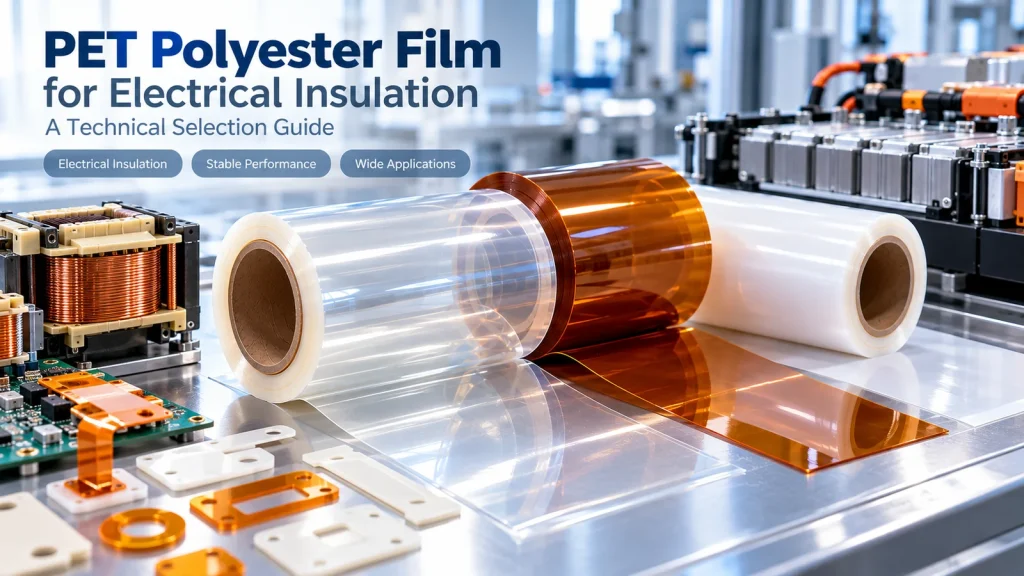
Engineering focus: material grade selection, dielectric design, thermal aging, thickness, converting, testing and purchasing qualification.
PET polyester film is widely considered for thin, flexible electrical insulation components because it combines useful dielectric behavior, mechanical integrity and compatibility with common film-converting processes. Yet the term “PET film” covers many formulations and constructions. A clear packaging film, a heat-stabilized industrial film and a flame-retardant electrical grade should never be assumed equivalent.
For engineers designing insulation barriers, motor components, electronics assemblies and battery isolation parts, the important question is not whether PET is an insulator in general. It is whether a specific grade, thickness and converted construction remains suitable throughout manufacturing and service life.
This guide provides a qualification-oriented framework for evaluating PET electrical insulation film, comparing alternatives, preventing failure and preparing a useful technical RFQ. All material descriptions are general engineering guidance, not grade-specific HTM performance claims.
1. How PET Film Provides Electrical Insulation
Polyethylene terephthalate (PET) is a polyester thermoplastic that can be manufactured into thin films. In an electrical assembly, a PET layer acts as a dielectric barrier between conductive surfaces, limiting unwanted current flow and helping maintain electrical separation.
Actual performance is governed by the entire insulation system: film thickness, edge geometry, voids, contaminants, applied waveform, temperature, humidity, mechanical loading and the effects of processing. An isolated laboratory breakdown result cannot by itself establish a safe working voltage or an insulation category under an equipment standard.
Common constructions include uncoated film, treated film, laminated structures, adhesive-backed insulation and precision-cut components. An adhesive or coating changes the construction and may introduce separate aging, bonding or electrical concerns.
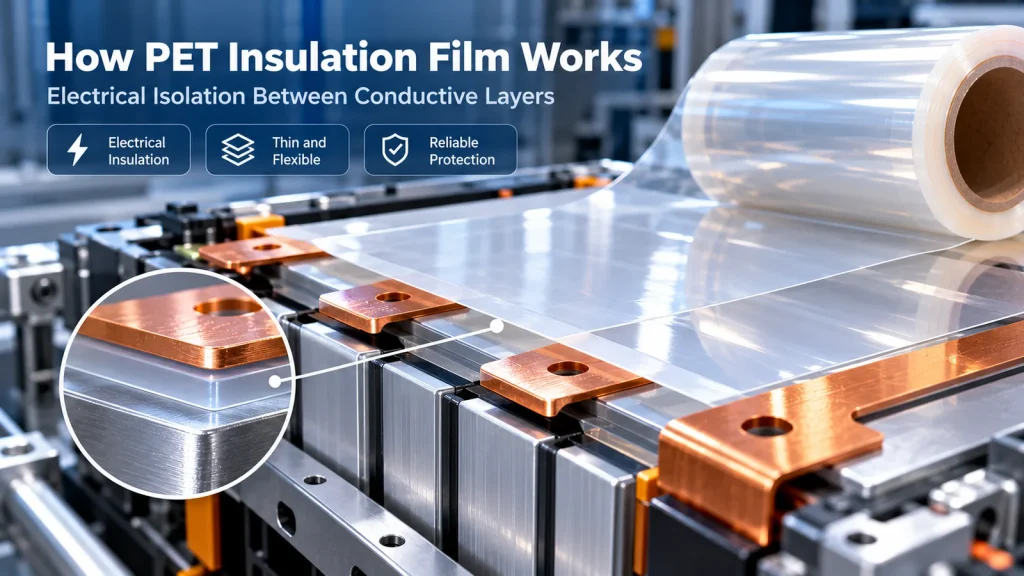
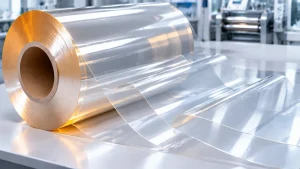
Conceptual PET film barrier between conductive components; not a validated design. Alt text: PET electrical insulation film separating conductive components in a conceptual assembly
2. Properties That Matter in PET Electrical Insulation Selection
2.1 Dielectric breakdown strength
Dielectric breakdown strength characterizes breakdown under a defined test configuration. Values depend on film grade, thickness, conditioning, electrode arrangement, ramp rate and environment. The simplified average electric-field expression, E = V/t, is useful for understanding field intensity but is not a stand-alone method for specifying safe operating voltage.
2.2 Volume resistivity and surface resistivity
Volume resistivity relates to conduction through the bulk material; surface resistivity concerns conduction along the surface. Both can be affected by moisture, temperature, surface contamination and conditioning. A clean, dry laboratory specimen may not represent a field-exposed assembly.
2.3 Relative permittivity and dielectric loss
Relative permittivity and dissipation factor matter when film is used near high-frequency conductors, capacitive structures or electrically stressed assemblies. Compare data measured at relevant frequencies and temperatures, not unrelated values copied from different data sheets.
2.4 Tensile, tear and puncture behavior
Die-cutting, winding, forming and assembly introduce mechanical stresses. Check tensile behavior, elongation, tear initiation, puncture risk, edge quality and the effect of small holes or tight corner radii. Mechanical damage may create a local electrical weakness long before the nominal film area fails.
2.5 Thermal aging and dimensional stability
Short-term process exposure and long-term service temperature are distinct. PET may undergo dimensional change, shrinkage, embrittlement or property loss after prolonged or repeated thermal exposure. Thermal class or continuous-use suitability cannot be assigned from the polymer name alone; review the grade and, where relevant, the qualified insulation system.
2.6 Moisture, hydrolysis and chemical compatibility
Hot, humid conditions may accelerate hydrolytic deterioration in susceptible polyester constructions. Cleaning agents, flux residues, oils and battery-related chemicals also warrant compatibility evaluation. Consider exposure duration, concentration and mechanical stress together.
2.7 Flammability and compliance
Do not infer UL 94 classification, UL recognition, RoHS/REACH status or other compliance from the description “electrical-grade PET.” Request documentation for the exact grade, thickness and construction. A supplier’s generic brochure is not evidence of a specific tested rating.
3. Selecting PET Film Grade, Thickness and Construction
Standard PET versus engineered electrical grades
Film grades may differ in resin chemistry, orientation, thermal stabilization, additives, surface treatment, coatings and cleanliness. Ask suppliers to identify the precise grade and its supporting TDS rather than accepting “PET polyester film” as a complete specification.
How to determine thickness
Start with the applicable insulation coordination and equipment requirements, then account for electric-field concentration, puncture resistance, assembly tolerances and process damage. Validate the selected thickness in the final construction. Doubling film thickness does not necessarily double safe operating voltage.
Rolls, sheets, adhesive-backed films and die-cut parts
Choose the supply format around the actual manufacturing workflow. Roll stock may suit automated converting; sheets may suit prototype evaluation; adhesive-backed parts can simplify assembly but require bond and aging qualification; die-cut parts demand verified tolerances and clean edges.
| Selection dimension | Engineering question | Evidence to request |
|---|---|---|
| Grade identity | Which exact PET formulation and construction? | Grade-specific TDS and change-control information |
| Electrical | What stresses and insulation function apply? | Relevant electrical tests and system validation |
| Thickness | Can the barrier withstand real geometry and handling? | Thickness tolerance, breakdown and puncture evaluation |
| Thermal | What are service and process exposures? | Aging and dimensional-stability evidence |
| Environmental | Humidity, fluids, residues or chemicals? | Compatibility and conditioned test results |
| Converting | Can it be cut, laminated or bonded reliably? | Sample parts and process qualification |
| Compliance | What declarations or classifications are mandatory? | Exact-grade supporting documents |
4. PET vs PI, PEN and PTFE for Electrical Insulation
PET is one candidate within a broader family of polymer insulation films. The best option depends on the application rather than a single headline property. For background on fluoropolymer behavior, see HTM’s PTFE film properties and industrial applications.
| Film | Potential selection advantage | Critical limitation to verify | Typical decision trigger |
|---|---|---|---|
| PET | Versatile thin-film converting and balanced mechanical/electrical behavior | Thermal aging, moisture exposure and grade variability | General-purpose industrial film insulation with validated conditions |
| PI | Often considered for more demanding temperature environments | Specific grade, moisture behavior, cost and mechanical needs | Process or service temperature exceeds qualified PET capability |
| PEN | May offer a different thermal/dimensional balance from conventional PET | Grade data, availability and process compatibility | Need to evaluate a polyester alternative |
| PTFE | Useful chemical resistance and low surface energy | Bonding difficulty, creep and dimensional behavior | Specialized chemical or dielectric environment |
Qualitative comparison only. No temperature limits, dielectric values or certified classifications are implied.
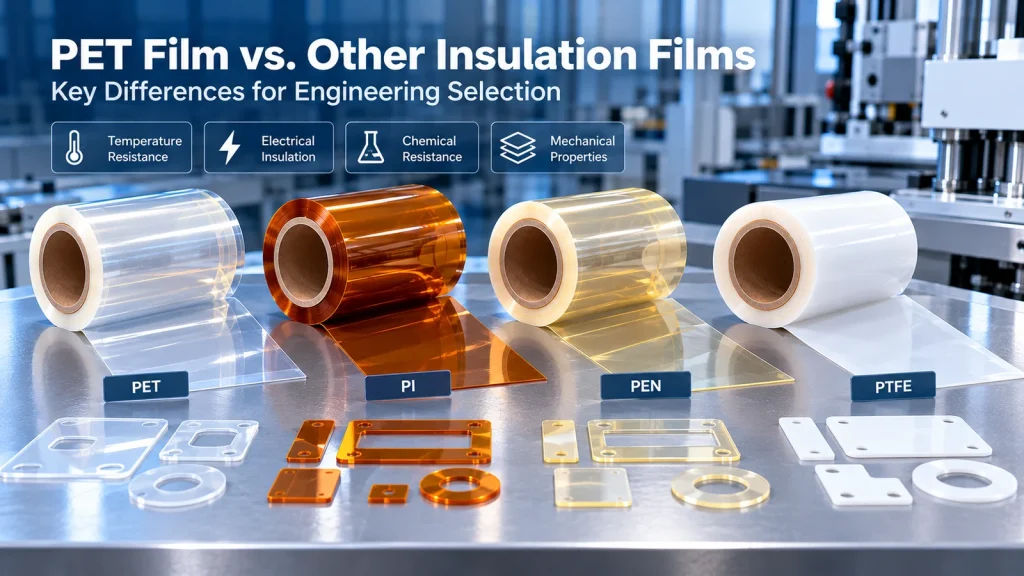
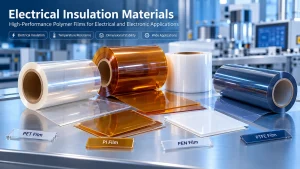
Conceptual visual comparison of polymer film families; verify properties by grade. Alt text: PET PI PEN and PTFE electrical insulation film material comparison
5. Industrial Applications and Design Considerations
PCB and electronic assemblies
PET film may serve as a barrier, protective layer or converted insulator in selected assemblies. Review proximity to soldering heat, electrical spacing, surface residues, assembly compression and potential contact with sharp leads. PET should not automatically be used in processes whose thermal conditions exceed its qualified capability.
Battery modules and busbar insulation
Possible uses include electrically isolating metal surfaces and forming custom insulating components. Voltage transients, vibration, compression, electrolyte exposure and temperature cycling should be assessed. Electrical isolation is not the same as thermal runaway propagation protection. For a broader system-level discussion, see HTM’s EV battery insulation materials selection guide.
Motors, transformers and wound components
PET may be considered for slot, phase, interlayer or composite insulation where permitted by the design and qualification system. Evaluate winding abrasion, impregnation compatibility, heat aging and the requirements of the complete insulation system.
Industrial controls and power electronics
Thin films may separate conductors, brackets or enclosures, but their role in functional, basic, supplementary or reinforced insulation must be established under the applicable product standard. Mechanical retention and creepage/clearance remain separate design concerns.
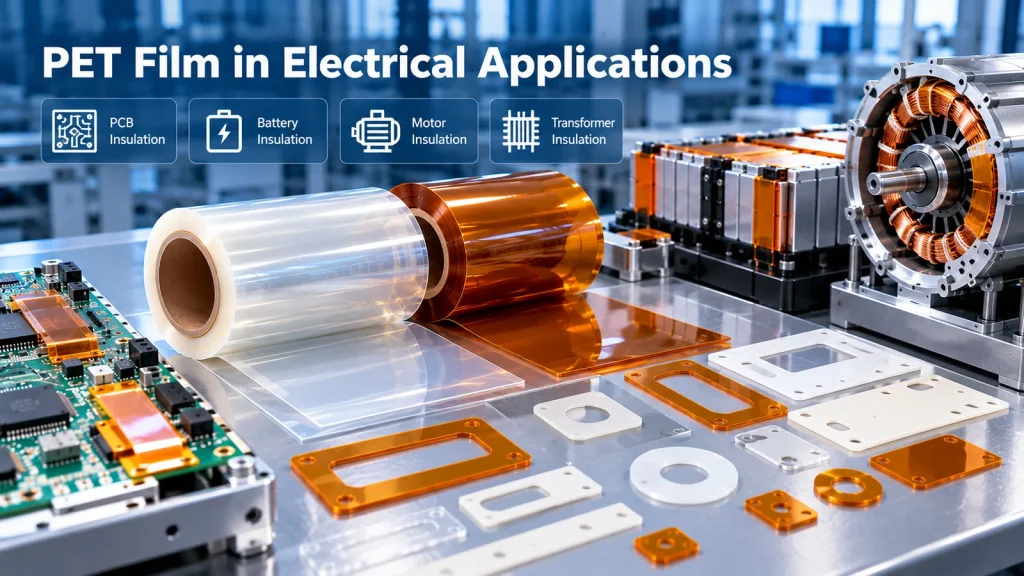
Illustrative application environments where grade-qualified PET film may be evaluated. Alt text: PET insulation film concepts for PCB battery motor and transformer assemblies
6. Custom Die-Cut PET Insulation Components
Die-cut PET insulation can be shaped into pads, washers, barriers, frames and other parts, provided the chosen grade and processing method are suitable. Procurement drawings should specify nominal thickness, thickness tolerance, overall dimensions, hole locations, minimum web width, corner radius, edge cleanliness and any adhesive or release-liner construction.
Common risks include burr-related puncture, incomplete cuts, deformation, static attraction of debris, poor registration and adhesive contamination. Evaluate prototype parts in the real assembly before authorizing production. Die-cutting capability, achievable tolerance and available constructions must be confirmed for each supplier and project.
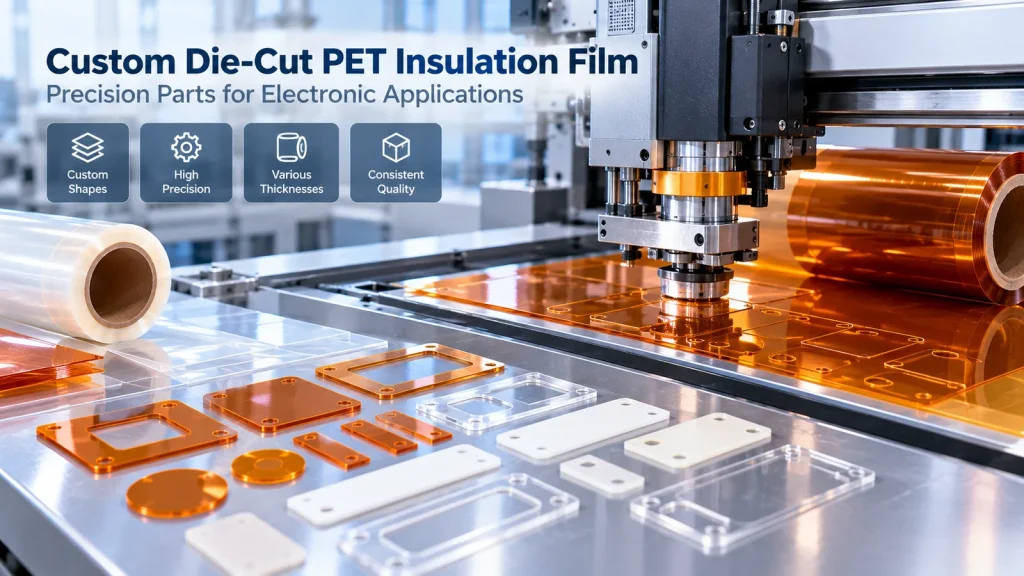
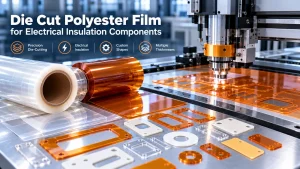
Conceptual converting setup for custom-shaped PET electrical insulation components. Alt text: Conceptual precision die cutting of PET electrical insulation film components
7. Failure Modes, Root Causes and Prevention
| Failure mode | Potential cause | Recommended control |
|---|---|---|
| Electrical breakdown | Local field concentration, voids, defects or excessive stress | Assembly-level dielectric qualification and edge design review |
| Puncture or tearing | Burrs, sharp corners, handling or compressive loading | Mechanical protection, edge inspection and fit testing |
| Thermal shrinkage | Process temperature, tension or grade instability | Conditioned dimensional testing under representative cycle |
| Embrittlement | Long-term thermal or environmental aging | Accelerated aging with retained-property criteria |
| Moisture-related degradation | Heat/humidity exposure and hydrolysis | Humidity aging and electrical/mechanical retesting |
| Delamination | Adhesive mismatch, contamination or thermal cycling | Peel, aging and substrate compatibility tests |
| Surface leakage | Contamination, condensation or residues | Cleaning controls and conditioned resistance testing |
For adhesive-backed constructions, HTM’s high-temperature adhesive tape failure modes guide provides additional background on bond-related failure mechanisms.
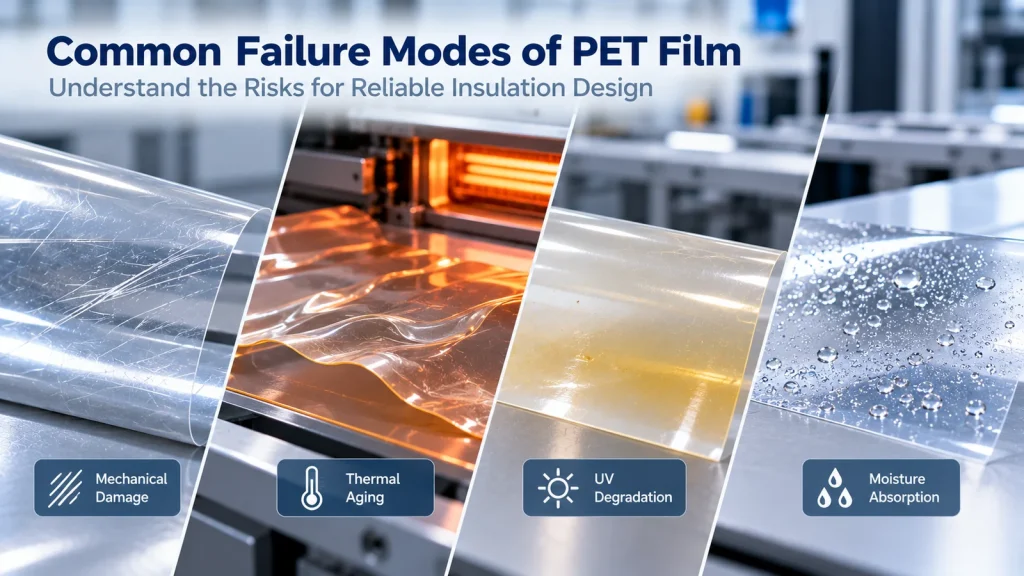
Illustrative potential failure mechanisms; not test evidence or proof of grade-specific degradation. Alt text: Conceptual PET film scratches heat distortion yellowing and moisture exposure
8. Testing Methods and Qualification Plan
Standards should be selected based on the actual property, specimen and end-use requirements. The examples below are possible methods, not claims that HTM products have passed them.
| Property | Example method | What to check |
|---|---|---|
| Dielectric breakdown | ASTM D149 / IEC 60243-1 | Electrodes, thickness, conditioning and voltage method |
| Volume/surface resistivity | ASTM D257 / applicable IEC 62631 methods | Humidity, temperature, electrification time |
| Tensile properties | ASTM D882 | Machine/transverse direction, thickness and conditioning |
| Thermal transitions | Applicable DSC methods, e.g. ISO 11357 series | Test protocol and interpretation for the actual grade |
| Dimensional change | Agreed heat-exposure protocol | Direction, restraint, duration and temperature |
| Flammability | UL 94, if relevant | Specific grade, thickness and tested classification |
| Adhesive performance | Appropriate peel/aging protocol | Substrate, dwell, temperature and failure mode |
Suggested validation sequence
- Identify exact grade and obtain current technical documentation.
- Define pass/fail criteria tied to the actual equipment design.
- Screen sample film for electrical, mechanical and dimensional properties.
- Convert representative parts using the intended manufacturing process.
- Test assembled parts with realistic edges, adhesives and fasteners.
- Apply relevant thermal, humidity and mechanical aging conditions.
- Re-test critical properties after exposure and document traceability.
- Approve supply specification and a process for material changes.
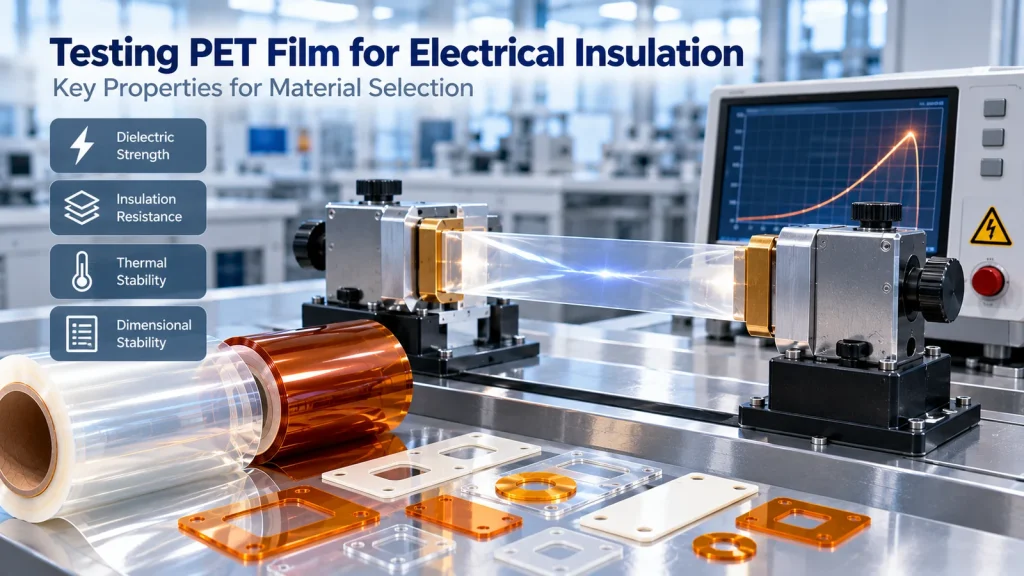
Illustrative test environment; not a real HTM laboratory test or measurement. Alt text: Conceptual PET electrical insulation film testing laboratory setup
9. Step-by-Step PET Film Engineering Selection Workflow
- Define insulation function: working and transient voltages, waveform, frequency and governing product standard.
- Map exposure: service life, continuous and peak temperatures, processing heat, humidity and chemical contact.
- Set geometry: thickness, edge protection, holes, bends, compression and allowable assembly clearance.
- Compare grades: review documented electrical, thermal, mechanical and converting properties.
- Prototype: request representative roll/sheet samples or die-cut trial parts.
- Qualify: complete electrical, mechanical, environmental and process testing.
- Release specification: agree on tolerances, inspection, packaging, traceability and change notifications.
Do not use nominal polymer chemistry as a substitute for application qualification. If PET does not meet the requirement, revisit the design or evaluate alternatives such as PI, PEN or PTFE.
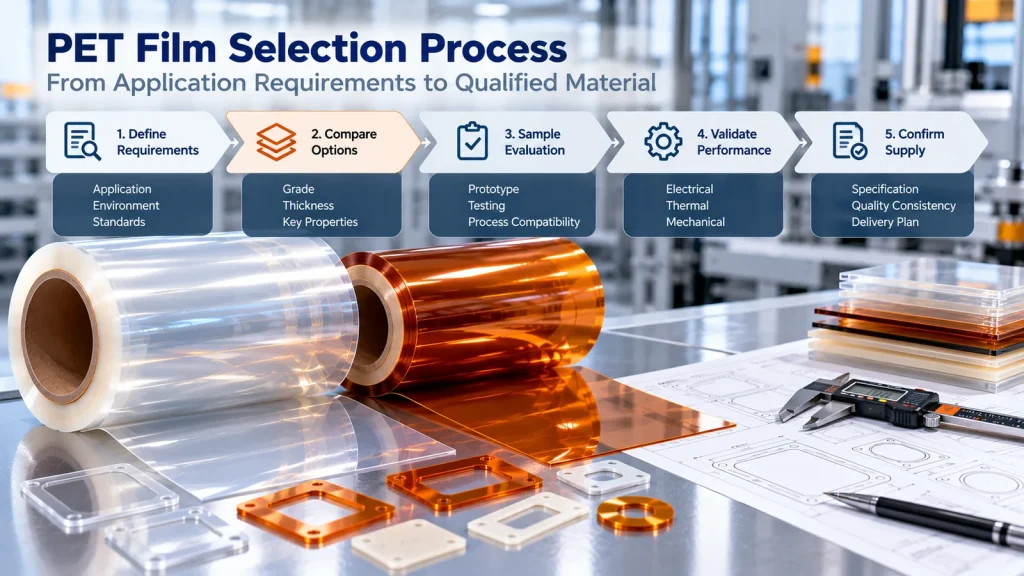
Engineering workflow from requirements and candidate selection to sample qualification. Alt text: PET electrical insulation film selection workflow from requirements to qualification
10. RFQ Checklist for PET Electrical Insulation Film
| RFQ field | What to provide |
|---|---|
| Material | PET film; preferred grade or approved equivalents |
| Application | Assembly function, insulation location and end product |
| Electrical | Working/transient voltage, insulation function, test standard |
| Thermal | Continuous/peak service and processing exposure |
| Environment | Humidity, chemicals, cleaning agents and mechanical loading |
| Film | Nominal thickness, tolerance, color, surface treatment |
| Format | Roll, sheet, adhesive-backed or die-cut component |
| Dimensions | Width, length, ID/OD, drawing and critical tolerances |
| Quantity | Samples, pilot quantity and annual estimate |
| Documentation | TDS, applicable test reports, declarations, traceability |
| Delivery | Destination, packaging and target schedule |
For procurement comparison, ask each supplier to quote the same grade specification, thickness, tolerance, supply format and documentation scope. A lower unit price is not necessarily a lower total cost if converting yield, rework or qualification risks differ.
11. Frequently Asked Questions
Is PET polyester film suitable for electrical insulation?
PET film is used in many electrical insulation applications, but suitability depends on the exact grade, thickness, electrical stress, temperature, environment and system qualification.
What is the difference between PET film and polyester film?
PET is a type of polyester. In industrial film sourcing, “polyester film” often refers to PET, but buyers should confirm the polymer and grade rather than assuming all polyester films are identical.
How do I choose PET insulation film thickness?
Use the relevant equipment insulation requirements, real assembly geometry, mechanical damage risk and grade-specific electrical testing. Do not calculate a safe working voltage from a single dielectric-strength number.
Can PET film withstand high temperatures?
Its thermal suitability is grade- and time-dependent. Continuous service, short process peaks and aging exposure require separate evaluation; do not infer a universal temperature rating.
Is PET film flame retardant or UL certified?
Not automatically. Request exact-grade and thickness-specific evidence for any required flammability classification, recognition or certification.
Is PET better than polyimide for electrical insulation?
Neither is universally better. PET may be attractive for certain converted insulation components, while PI is often evaluated for more demanding thermal conditions. Compare verified grades and total system requirements.
Can PET film be die-cut into custom insulation parts?
Many PET films can be die-cut, subject to grade, thickness, geometry and process capability. Validate edge quality, dimensions, cleanliness and assembly performance.
What testing should I request for PET electrical insulation film?
Request testing relevant to your design, potentially including dielectric breakdown, resistivity, tensile properties, dimensional stability, thermal aging and construction-specific adhesive tests.
Can PET film be used in EV battery packs?
PET may be considered for certain electrical isolation functions where qualified. Battery voltage, vibration, compression, chemicals and thermal conditions must be evaluated; electrical isolation is not proof of thermal runaway barrier performance.
What details are needed for a PET insulation film quotation?
Provide application, required grade, electrical and thermal conditions, thickness, dimensions, roll/sheet/die-cut format, drawings, testing requirements and estimated quantities.
12. Request PET Electrical Insulation Film Samples or a Quote
HighTemp Material works with industrial polymer film and insulation-material inquiries. If you are evaluating PET polyester film for an electrical application, share the operating conditions and your drawing or target specification so the proposed grade and supply format can be reviewed.
Please include: application, required electrical isolation, continuous and peak temperature, film thickness, dimensions, converting requirements, testing/documentation needs and estimated order quantity.
Any material recommendation, availability, processing capability or compliance statement must be confirmed for the specific grade and project.