

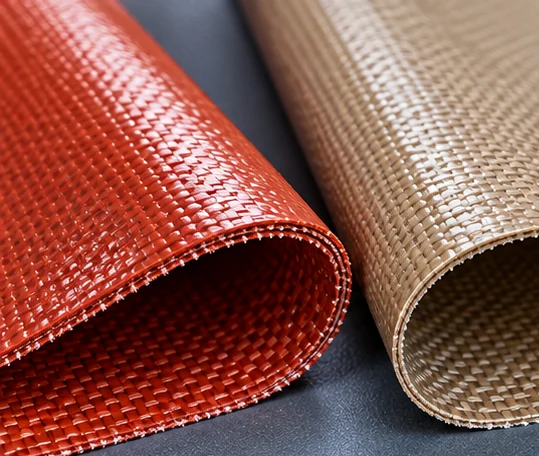
Compare temperature resistance, flexibility, non-stick performance, chemical resistance and industrial applications before choosing your coated fiberglass material.
Silicone-coated fiberglass and PTFE-coated fiberglass are two widely used high-temperature industrial fabrics. Both combine woven glass fiber reinforcement with a protective polymer coating, but they are designed to solve different engineering problems.
Silicone-coated fiberglass fabric is commonly selected for flexible insulation jackets, protective covers, expansion joints and industrial sealing applications. Its elastomeric surface can be useful where repeated handling, movement and environmental protection are important.
PTFE-coated fiberglass fabric, by contrast, is especially valuable for non-stick surfaces, low-friction contact, chemical resistance, heat-sealing machinery and industrial conveyor systems.
The difference is not simply which material withstands a higher temperature. Engineers must also consider surface performance, mechanical movement, chemical exposure, processing requirements and the construction of the finished component.
This guide explains the differences between silicone-coated fiberglass and PTFE-coated fiberglass fabric, including practical selection criteria for industrial buyers, engineers and equipment manufacturers.
1. What Are Silicone-Coated and PTFE-Coated Fiberglass Fabrics?
Both materials begin with a woven fiberglass substrate.
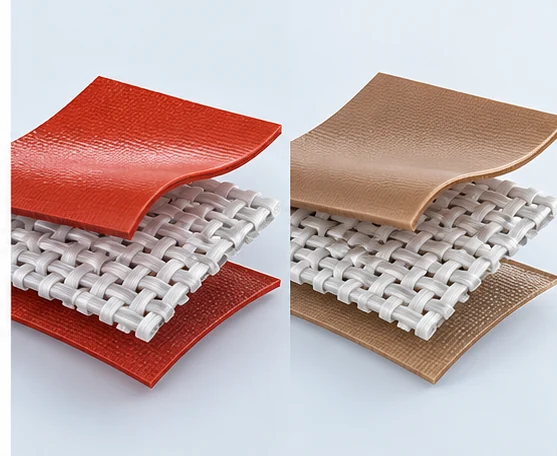
The fiberglass reinforcement contributes tensile strength, dimensional stability and heat resistance. A coating is then applied to provide additional surface properties.
However, the coating chemistry has a major influence on how the finished fabric performs.
What Is Silicone-Coated Fiberglass Fabric?
Silicone-coated fiberglass fabric consists of woven glass fiber cloth coated or impregnated with a silicone rubber formulation.
Depending on the grade, the silicone coating may be applied to one side or both sides of the fiberglass substrate.
The resulting material combines the mechanical reinforcement of fiberglass with the flexibility and protective characteristics of silicone rubber.
Typical characteristics include:
- Flexible, rubber-like coated surface
- Good handling and conformability
- Resistance to moisture and weathering in suitable grades
- Useful performance in protective covers and flexible components
- Options for cutting, sewing and custom fabrication
- High-temperature capability subject to the coating formulation
Silicone-coated fiberglass is frequently used in removable thermal insulation jackets, equipment covers, flexible duct connections and selected industrial protective textiles.
What Is PTFE-Coated Fiberglass Fabric?
PTFE-coated fiberglass fabric consists of woven fiberglass cloth impregnated or coated with polytetrafluoroethylene (PTFE).
PTFE has low surface energy and a low coefficient of friction, making it particularly useful where materials must slide or release cleanly from a processing surface.
Typical characteristics include:
- Excellent non-stick and release performance
- Low surface friction
- Broad chemical resistance
- Dimensional stability from fiberglass reinforcement
- Heat-resistant processing surfaces
- Availability in different thicknesses, coating weights and fabric structures
PTFE-coated fiberglass is commonly used in heat-sealing machinery, release sheets, conveyor belts, composite processing and industrial equipment liners.
For a related product example, see our High Temp PTFE Adhesive Tape, which uses PTFE-coated fiberglass fabric with a pressure-sensitive adhesive system.
Important distinction: PTFE-coated fiberglass fabric and PTFE adhesive tape are not identical products. The adhesive-backed construction has additional performance limitations determined by its adhesive and liner system.
2. Silicone-Coated Fiberglass vs PTFE-Coated Fiberglass: Key Differences
The following comparison provides a practical starting point for material selection.
| Property | Silicone-Coated Fiberglass | PTFE-Coated Fiberglass |
|---|---|---|
| Reinforcement | Woven fiberglass | Woven fiberglass |
| Coating material | Silicone rubber | PTFE fluoropolymer |
| Surface characteristics | More rubber-like and relatively grippy | Smoother, lower-friction surface |
| Primary advantage | Flexibility and protective handling | Non-stick release and low friction |
| Repeated folding | Often suitable for flexible fabricated products | Depends on coating and fabric construction |
| Non-stick performance | Grade dependent; not usually its main advantage | Generally excellent |
| Chemical resistance | Good for selected industrial environments | Broad resistance to many chemicals |
| Moisture resistance | Good in suitable constructions | Generally very good |
| Outdoor applications | Commonly selected for flexible protective covers | Possible when surface function and construction are appropriate |
| Abrasion performance | Depends on silicone formulation and coating weight | Depends on coating thickness, surface wear and contact conditions |
| Typical applications | Insulation jackets, covers, connectors, expansion joints | Release sheets, heat-sealing surfaces, conveyor belts, liners |
| Custom fabrication | Cutting, sewing and selected die-cutting | Slitting, cutting, die-cutting and belt fabrication |
| Key limitation | Less suitable where very low adhesion is essential | Creasing, coating wear and bonding can require special attention |
These are general material characteristics rather than guaranteed specifications.
Actual performance depends on fiberglass weave, coating formulation, thickness, coating weight, surface finish and operating conditions.
Which Material Is Better?
Neither material is universally better.
If your application requires a flexible protective cover that is repeatedly installed and removed, silicone-coated fiberglass may be the more practical starting point.
If your application requires a smooth, non-stick surface for heat sealing or lamination, PTFE-coated fiberglass is usually the stronger candidate.
The correct choice depends on the dominant function of the finished component.
3. Temperature Resistance: Which Coated Fiberglass Performs Better?
Temperature resistance is often the first specification buyers compare.
However, a single maximum-temperature figure can be misleading.
Both silicone-coated and PTFE-coated fiberglass contain at least two different material systems:
- The fiberglass reinforcement.
- The polymer coating.
The finished fabric must be evaluated according to the limitations of the complete construction.
Silicone-Coated Fiberglass Temperature Resistance
Many standard silicone-coated fiberglass products are specified for continuous temperatures around 200–230°C, while some specially formulated grades may support different or higher temperature limits.
The actual rating depends on:
- Silicone formulation
- Coating weight
- Fiberglass substrate
- Exposure duration
- Airflow and oxidation conditions
- Mechanical stress
- Contact with chemicals or contaminants
A fabric that withstands brief exposure to a higher temperature should not automatically be approved for continuous operation at that temperature.
PTFE-Coated Fiberglass Temperature Resistance
Many PTFE-coated fiberglass grades are commonly evaluated for continuous service up to approximately 260°C.
However, this is not a universal rating for every PTFE-coated fiberglass product.
Actual operating limits may be affected by:
- Coating construction
- Contact pressure
- Mechanical tension
- Repeated bending
- Surface wear
- Chemical exposure
- Fabric seams or belt joints
For adhesive-backed PTFE fiberglass tape, the adhesive may determine the usable service temperature before the PTFE coating or fiberglass substrate reaches its own limit.
Continuous Temperature vs Peak Temperature
When specifying coated fiberglass, distinguish between:
Continuous operating temperature: The temperature experienced during normal operation over extended periods.
Intermittent peak temperature: A higher temperature reached for a limited duration.
Fabric surface temperature: The actual temperature of the coated fabric, which may differ from the heater, process gas or surrounding equipment temperature.
Thermal cycling: Repeated heating and cooling that can affect coating integrity and mechanical durability.
Engineering recommendation: Never select a coated fiberglass material solely from the maximum temperature of the fiberglass base cloth. Request the technical data sheet for the complete coated product.
For additional material information, explore our Technical Data Sheets Resource Center.
4. Industrial Applications: When to Choose Silicone or PTFE Coated Fiberglass
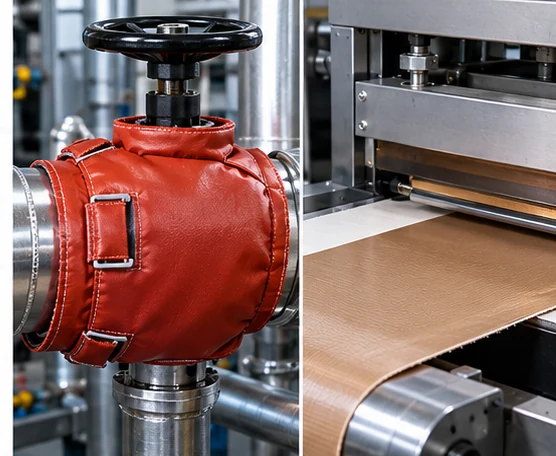
The most useful way to compare these materials is by application.
Silicone-Coated Fiberglass for Removable Insulation Jackets
Removable insulation jackets are used around valves, flanges, pumps, pipelines and industrial equipment requiring periodic inspection or maintenance.
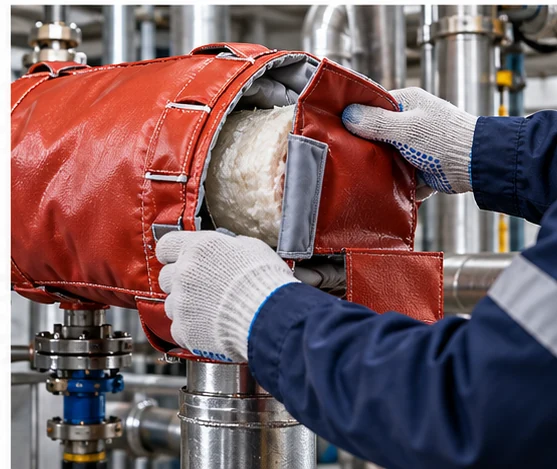
Silicone-coated fiberglass may be selected as an outer protective fabric because it can provide:
- Flexible handling
- Resistance to selected environmental contaminants
- A protective outer surface
- Suitability for fabricated covers and jackets
- Repeated installation and removal in appropriately designed products
The overall thermal performance of an insulation jacket depends on the internal insulation material, jacket construction, seams and operating conditions.
The silicone-coated fabric itself should not be treated as the entire thermal insulation system.
Silicone-Coated Fiberglass for Flexible Connectors
Flexible duct connectors and expansion-joint components may experience vibration, movement and temperature fluctuations.
Silicone-coated fiberglass can be considered where a flexible, reinforced protective textile is required.
Selection should account for movement amplitude, operating pressure, temperature, chemical exposure and attachment design.
PTFE-Coated Fiberglass for Heat-Sealing Machines
Heat-sealing equipment requires surfaces that tolerate repeated heat contact while minimizing sticking.
PTFE-coated fiberglass is commonly used because its low-adhesion surface can help release processed materials from heated equipment.
Potential applications include:
- Plastic packaging machinery
- Heat-sealing bars
- Bag-sealing equipment
- Laminating equipment
- Guide surfaces and protective liners
The exact PTFE-coated fabric should be selected according to temperature, dwell time, pressure and required surface smoothness.
For adhesive-backed solutions, review our High Temp PTFE Adhesive Tape.
PTFE-Coated Fiberglass for Conveyor Belts
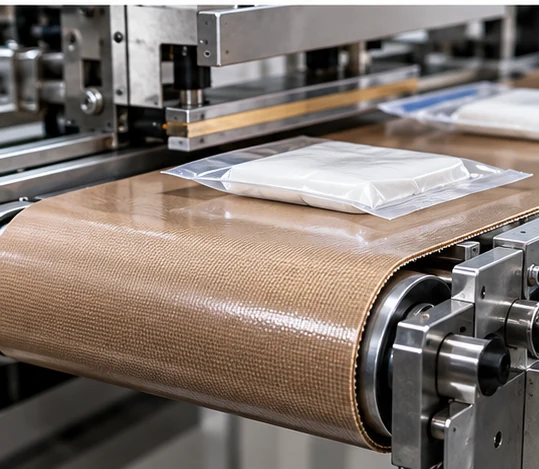
PTFE-coated fiberglass is also used in selected high-temperature conveyor and drying systems.
Its advantages can include:
- Low-adhesion processing surfaces
- Reduced material buildup
- Dimensional stability
- Chemical resistance
- Compatibility with continuous heat-processing equipment
Conveyor belt design also requires consideration of tensile loading, tracking, edge reinforcement, belt joints and repeated flexing.
PTFE-coated fiberglass may be supplied as solid fabric or specialized open-mesh constructions, depending on the process.
PTFE-Coated Fiberglass for Lamination and Release Surfaces
In composite processing, heat pressing and selected PCB-related manufacturing processes, PTFE-coated fiberglass may be considered where release performance and dimensional stability are important.
However, the appropriate release material depends on the resin chemistry, lamination temperature, pressure, surface finish and contamination requirements.
For additional examples of materials used in electronics manufacturing, read our guide to Materials for SMT High-Temperature Protection.
5. Chemical Resistance, Surface Friction and Mechanical Durability
Beyond temperature, coating behavior can determine whether a material performs successfully.
Chemical Resistance
PTFE is widely recognized for its resistance to many chemicals.
It is often considered for equipment exposed to aggressive processing environments.
However, chemical compatibility must be assessed against the specific substance, concentration, temperature and exposure duration.
Silicone-coated fiberglass can also be suitable for selected industrial environments, but silicone rubber should not be assumed to resist every solvent, oil or chemical.
Non-Stick Performance
PTFE-coated fiberglass generally offers a major advantage where low adhesion is required.
Examples include:
- Hot adhesive contact
- Polymer processing
- Heat-sealing equipment
- Release sheets
- Industrial conveyor surfaces
Silicone-coated fiberglass may provide a cleanable protective surface, but it should not be treated as a direct substitute for PTFE in demanding release applications without testing.
Flexibility and Repeated Handling
Silicone-coated fiberglass often provides an elastomeric surface that is well suited to flexible fabricated covers.
PTFE-coated fiberglass can also be flexible, particularly in lighter constructions.
Nevertheless, repeated folding and sharp creasing may affect coating integrity or release performance.
The correct material should be evaluated using the actual bend radius, handling frequency and finished-part geometry.
Abrasion Resistance
Abrasion performance cannot be ranked reliably by coating chemistry alone.
A heavier silicone-coated fabric may perform differently from a thin PTFE-coated fabric, and vice versa.
Coating thickness, reinforcement structure, contact pressure and abrasive media must all be considered.
Where abrasion is a critical failure mode, request application-relevant test data or conduct sample trials.
6. Coated Fiberglass Fabric Specifications: What Buyers Should Confirm
Industrial buyers often receive quotations based only on fabric thickness or weight.
This may not be sufficient to compare different suppliers.
The following information should be confirmed before approving a coated fiberglass fabric.
| Specification | Why It Matters |
|---|---|
| Base fiberglass construction | Influences reinforcement, flexibility and dimensional stability |
| Coating chemistry | Determines major surface properties |
| Single-sided or double-sided coating | Affects exposure protection and surface function |
| Total thickness | Important for equipment clearance and assembly fit |
| Fabric weight (g/m²) | Helps describe the overall material construction |
| Coating weight | Influences surface characteristics and durability |
| Width and roll length | Affects converting and production efficiency |
| Continuous operating temperature | Establishes normal thermal suitability |
| Peak temperature and duration | Helps evaluate temporary thermal excursions |
| Tensile and tear performance | Important for mechanical loading |
| Chemical compatibility | Critical in chemically demanding environments |
| Surface finish | Influences release, friction and process contact |
| Flammability documentation | Required for projects with defined fire-performance specifications |
| Regulatory documentation | May include RoHS, REACH or application-specific declarations |
| Converting requirements | Determines suitability for slitting, cutting and finished parts |
Why Fabric Weight Alone Is Not Enough
Two coated fiberglass products with the same nominal weight may have different performance.
One may use a heavier fiberglass substrate with a lighter coating, while another may use a lighter substrate with more coating material.
These differences can affect flexibility, tensile strength, surface behavior and service life.
For repeat production, the approved construction should be documented rather than purchasing solely by nominal GSM or thickness.
7. Custom Slitting, Cutting and Converting Options
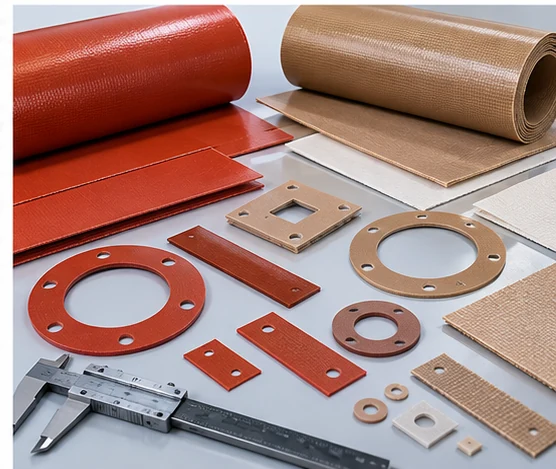
Industrial customers often require coated fiberglass materials in formats other than standard master rolls.
Depending on the construction and application, possible converted formats include:
- Narrow-width rolls
- Custom-length sheets
- Rectangular insulation pieces
- Die-cut protective components
- Adhesive-backed strips
- Fabricated insulation parts
- Gaskets and shaped barriers
- Equipment-specific protective liners
Precision Slitting
Slitting converts wide master rolls into narrower rolls for industrial equipment and assembly operations.
Important factors include:
- Material thickness and stiffness
- Coating surface condition
- Edge quality
- Finished width tolerance
- Roll tension and winding stability
- Core size and roll diameter
HighTemp Material provides Precision Slitting Services for various industrial films, tapes and coated fiberglass materials, subject to project evaluation.
Custom Cutting and Die-Cutting
Some applications require custom-shaped fiberglass components rather than continuous rolls.
A technical review should consider:
- Part dimensions and tolerances
- Fiberglass edge fraying
- Coating integrity at cut edges
- Tooling feasibility
- Adhesive or liner requirements
- Expected production volume
For more information, visit our Precision Converting Services page.
Adhesive-Backed Constructions
Some PTFE-coated fiberglass products are supplied with silicone pressure-sensitive adhesive for mounting to equipment surfaces.
Adhesive-backed silicone-coated fiberglass may also be considered for certain projects, depending on bonding requirements and material compatibility.
The adhesive must be evaluated separately from the fiberglass and surface coating.
See our Custom Adhesive Coating Services for project-specific converting options.
Note: Final feasibility, available grades, achievable tolerances and minimum order quantities require confirmation before quotation.
8. How to Choose: Practical Material Selection Matrix
Use the following matrix as an initial screening tool.
| Application Requirement | Recommended Starting Point | Confirm Before Approval |
|---|---|---|
| Removable industrial insulation jacket | Silicone-coated fiberglass | Surface temperature, flexing, seams and exposure |
| Flexible duct or expansion-joint cover | Silicone-coated fiberglass | Movement, pressure, temperature and chemical media |
| Heat-sealing release surface | PTFE-coated fiberglass | Release performance, dwell time and contact pressure |
| Industrial conveyor belt | PTFE-coated fiberglass | Belt tension, joints, tracking and flex fatigue |
| Chemical-facing process liner | PTFE-coated fiberglass | Specific chemicals, concentration and temperature |
| Protective equipment cover | Silicone-coated fiberglass | Handling, abrasion, moisture and thermal exposure |
| Low-friction sliding surface | PTFE-coated fiberglass | Load, wear and required coefficient of friction |
| Custom adhesive-backed equipment strip | PTFE-coated fiberglass tape or evaluated alternative | Adhesive temperature, bond strength and removal |
| Custom die-cut insulation component | Evaluate both materials | Dielectric, mechanical and thermal requirements |
Five Questions to Ask Before Selecting
1. What is the primary function?
Is the fabric intended to protect equipment, provide a non-stick surface, resist chemicals or accommodate movement?
2. What temperature does the fabric actually experience?
Distinguish the material surface temperature from the heater or process temperature.
3. Will the material move or fold repeatedly?
A stationary release sheet and a removable insulation jacket have different mechanical requirements.
4. Does the fabric contact chemicals or adhesives?
Specify the actual substances and exposure conditions.
5. What finished format is required?
Rolls, sheets, adhesive-backed tape and fabricated components may have different material and processing requirements.
9. Common Purchasing Mistakes to Avoid
Mistake 1: Comparing Only Maximum Temperature
The fiberglass substrate may withstand higher temperatures than the polymer coating.
Always confirm the operating limit of the complete coated material.
Mistake 2: Assuming Silicone and PTFE Have Similar Release Properties
Both materials can be used in high-temperature equipment, but their surface characteristics are different.
PTFE should generally be evaluated first where low adhesion is the main requirement.
Mistake 3: Ignoring Coating Weight and Fabric Construction
Similar thicknesses do not guarantee equivalent tensile strength, flexibility or surface durability.
Mistake 4: Overlooking Adhesive Limitations
Adhesive-backed constructions may have lower service limits than the uncoated or non-adhesive material.
Mistake 5: Assuming All Coated Fiberglass Is Flameproof
High-temperature resistance and flammability classification are not the same.
Request documentation relevant to the actual grade and applicable test method.
Mistake 6: Ordering Without a Sample Trial
For demanding applications, evaluate representative production samples under actual temperature, pressure, chemical and mechanical conditions.
10. Request Silicone-Coated or PTFE-Coated Fiberglass Material Support
HighTemp Material supplies high-temperature materials and precision-converting solutions for industrial manufacturing applications.
For projects involving coated fiberglass materials, our relevant service areas include:
- Material sourcing and specification review
- PTFE-coated fiberglass tape
- Custom-width slitting
- Sheet cutting and shaped components
- Adhesive-backed material evaluation
- Drawing-based precision converting
- Sample and production feasibility discussions
We work with customers in electronics manufacturing, industrial equipment, electrical insulation and related high-temperature applications.
What to Include in Your RFQ
To help us evaluate your project, please provide:
- Required material: silicone-coated or PTFE-coated fiberglass
- Application and equipment type
- Thickness and fabric weight, if known
- Required width, length or drawing
- Operating and peak temperatures
- Chemical or adhesive contact conditions
- Single-sided or double-sided coating
- Adhesive-backed or non-adhesive construction
- Estimated annual usage
- Required technical and regulatory documents
Contact HighTemp Material to discuss your coated fiberglass material or custom converting requirements.
Frequently Asked Questions
What is the main difference between silicone-coated fiberglass and PTFE-coated fiberglass?
Silicone-coated fiberglass is often selected for flexible protective covers, insulation jackets and industrial sealing applications. PTFE-coated fiberglass is generally preferred for non-stick release, low friction and chemical-resistant processing surfaces.
Which material has better temperature resistance?
The answer depends on the exact material grade and construction. Many PTFE-coated fiberglass products are evaluated for continuous service up to approximately 260°C, while standard silicone-coated fiberglass grades may have lower continuous ratings. However, higher-temperature silicone formulations and different composite constructions are available. Always confirm the supplier’s technical data.
Is PTFE-coated fiberglass more flexible than silicone-coated fiberglass?
Not necessarily. Silicone-coated fiberglass often has a more elastomeric surface and can be a practical choice for repeatedly handled protective components. PTFE-coated fiberglass can also be flexible, but its performance depends on thickness, coating and weave.
Which fabric is better for heat-sealing equipment?
PTFE-coated fiberglass is commonly preferred because of its low-adhesion surface and resistance to sticking during heat-processing operations.
Can silicone-coated fiberglass be used for removable insulation jackets?
Yes. Suitable grades are commonly used as protective outer fabrics for removable insulation jackets. The complete jacket construction must be evaluated for its operating conditions.
Can PTFE-coated fiberglass fabric be supplied with adhesive?
Yes. Certain PTFE-coated fiberglass products are available with pressure-sensitive adhesive, commonly silicone-based. The adhesive system must be selected according to the required temperature, substrate and removal conditions.
Can coated fiberglass fabric be slit or die-cut?
Many coated fiberglass constructions can be converted into custom rolls, sheets and shaped parts. Feasibility depends on thickness, coating integrity, edge quality and dimensional tolerances.
Does PTFE-coated fiberglass contain PFAS?
PTFE is a fluoropolymer and is generally included within broad chemical definitions of PFAS. Regulatory requirements vary by jurisdiction, product category and intended use. Buyers should request relevant declarations and assess the applicable requirements rather than assuming all PTFE applications are prohibited.
Conclusion
Choosing between silicone-coated fiberglass and PTFE-coated fiberglass fabric requires more than comparing heat resistance.
Silicone-coated fiberglass is often the practical choice for flexible insulation jackets, protective covers and fabricated components requiring repeated handling.
PTFE-coated fiberglass is particularly valuable for heat-sealing equipment, non-stick release surfaces, conveyor belts and chemical-facing processing applications.
The best material is the one that meets the specific thermal, mechanical, chemical and manufacturing requirements of the finished component.
For coated fiberglass materials, PTFE adhesive tapes, precision slitting or custom converted insulation parts, HighTemp Material can help review your specifications and discuss suitable supply options.
Request a Quote from HighTemp Material
Technical References and Further Reading
- HighTemp Material — Technical Data Sheets
- Saint-Gobain — SG26 PTFE-Coated Glass Cloth Tape
- HighTemp Material — Materials for SMT High-Temperature Protection
Technical note: Material descriptions and indicative operating temperatures are intended for preliminary selection. Final approval should be based on the exact grade’s technical documentation, relevant test results and actual application conditions.