
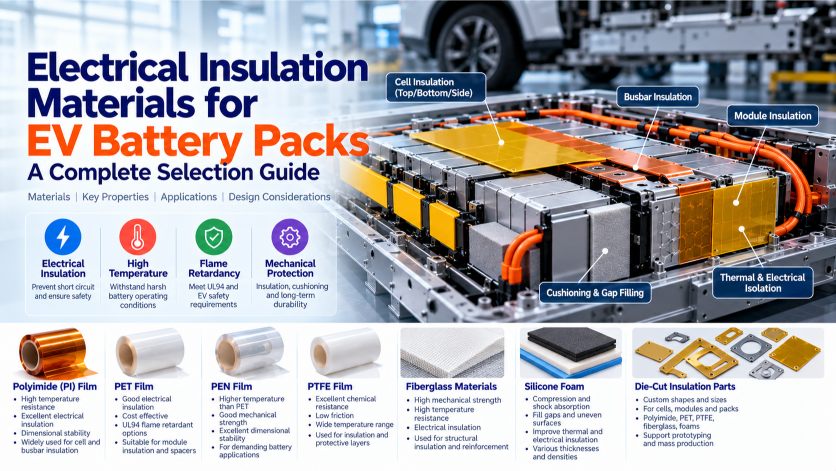
An Engineering Guide to Cell, Busbar, Module and Pack Insulation, Material Properties, Testing and Custom Die-Cut Components
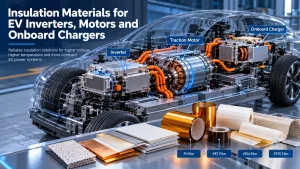
Electric vehicle battery packs combine high electrical energy, tightly packaged components, changing temperatures and demanding mechanical conditions. The insulation materials used within these systems must do more than prevent direct contact between conductive surfaces.
Depending on their location, insulation components may need to withstand electrical stress, resist abrasion, accommodate dimensional movement, maintain coverage during thermal cycling and remain compatible with automated manufacturing processes.
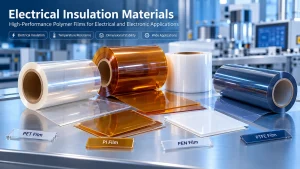
Polyimide (PI), polyester (PET), polyethylene naphthalate (PEN), polytetrafluoroethylene (PTFE), mica-based materials and selected insulating foams may all be considered in battery-related designs. However, they serve different functions and are not interchangeable.
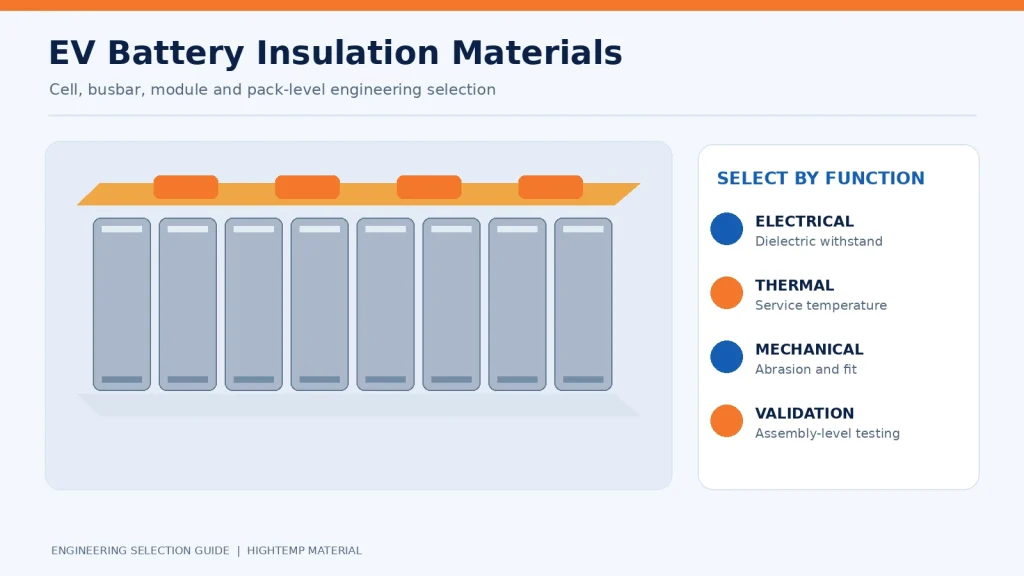
A material with excellent dielectric strength is not automatically a suitable thermal runaway barrier. A flame-retardant film is not automatically capable of stopping thermal propagation. And a high-temperature polymer is not necessarily the best material for every battery insulation component.
This guide explains how engineers and technical buyers can evaluate electrical insulation materials at cell, busbar, module and pack levels, compare material families and establish practical qualification requirements.
1. Why Electrical Insulation Is Critical in EV Battery Packs
An EV battery pack contains multiple conductive and structural components operating in close proximity.
Depending on the battery architecture, these may include cells, terminals, busbars, sensing circuits, cooling structures, module frames and pack enclosures.
Insulation materials help maintain the intended separation between conductive components and adjacent structures.
Their functions may include:
- Preventing unintended electrical contact
- Maintaining dielectric barriers
- Protecting conductive surfaces from abrasion
- Providing insulation around busbars and terminals
- Supporting dimensional separation between components
- Accommodating assembly and operating tolerances
- Reducing the risk of damage from vibration and thermal movement
The appropriate insulation design depends on the cell chemistry, cell format, pack architecture, voltage class and relevant safety requirements.
Material-Level Performance vs System-Level Safety
A film datasheet may report dielectric strength, temperature resistance or a flammability classification.
These properties are useful, but they do not establish the safety of the finished battery pack.
System-level performance also depends on installation geometry, mechanical retention, electrical clearances, interfaces, environmental exposure and validated pack design.
For critical battery applications, material selection must be followed by qualification of the actual component and assembly.
2. Where Electrical Insulation Materials Are Used in an EV Battery Pack
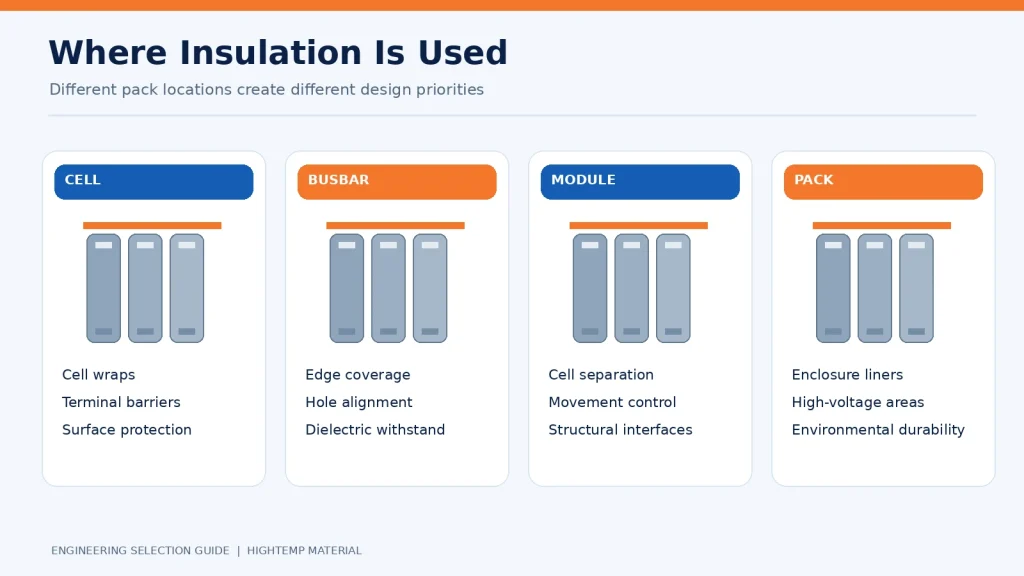
Insulation requirements change significantly from the individual cell to the completed pack.
Cell-Level Insulation
Cell-level components may include external wraps, top and bottom insulating pieces, terminal-area barriers and protective films.
Depending on cell design, these components can provide:
- Electrical separation
- Protection against abrasion
- Controlled coverage of conductive surfaces
- Compatibility with cell handling and assembly
The required materials differ for cylindrical, prismatic and pouch-cell architectures.
Busbar and Terminal Insulation
Busbars and electrical interconnections require particular attention because conductive features may have sharp edges, holes, bends and closely spaced surfaces.
Insulation options can include formed barriers, film laminates, coatings, sleeves and custom die-cut parts.
Key concerns include dielectric withstand, edge coverage, dimensional accuracy and long-term mechanical retention.
Module-Level Insulation
Module insulation may separate cells, structural components, electrical connections and neighboring assemblies.
Materials must be selected according to their actual function.
For example, an electrically insulating spacer may not provide meaningful thermal runaway protection, while a specialized thermal barrier may require additional electrical qualification.
Pack-Level Insulation
Pack-level components may include insulating sheets, barriers, protective liners and electrical isolation parts around the enclosure and high-voltage components.
Important considerations include mechanical durability, moisture exposure, service life, installation constraints and the applicable pack-level qualification requirements.
Design Principle
Specify the insulation function and installation location before choosing the material family.
A thin PET liner, a PI busbar insulator and a mica-based thermal barrier may all appear in the same battery system, but they should not be selected using identical criteria.
3. Electrical Insulation, Thermal Management and Thermal Runaway Protection Are Different Functions
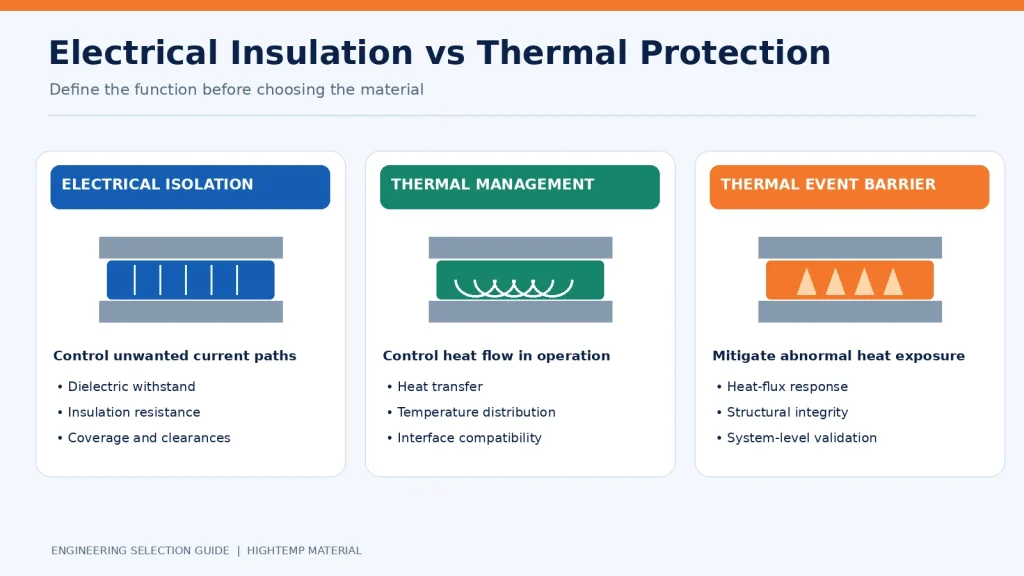
These three functions are closely related but must be distinguished.
Electrical Insulation
Electrical insulation is intended to control electrical conduction and maintain separation between conductive parts.
Relevant properties may include:
- Dielectric strength
- Insulation resistance
- Volume resistivity
- Thickness
- Mechanical integrity
- Environmental durability
Thermal Management
Thermal management controls heat transfer and operating temperature.
It may involve cooling plates, thermal interface materials, heat spreaders or insulating layers.
A thermally conductive material may be electrically insulating, electrically conductive or application-specific.
The required combination must be verified.
Thermal Runaway and Propagation Protection
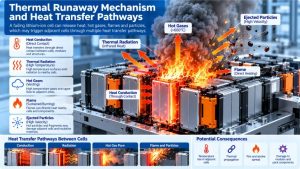
Thermal runaway protection concerns abnormal events involving intense heat, hot gases, mechanical effects and potential propagation between cells or modules.
A material suitable for normal operating temperatures may not withstand these events.
Thermal barrier selection may require testing for:
- High-temperature exposure
- Heat-flux resistance
- Structural integrity
- Flame or hot-particle exposure
- Gas and venting interactions
- System-level propagation behavior
Why the Distinction Matters
A UL 94 flammability classification does not by itself demonstrate resistance to battery thermal runaway.
Likewise, high dielectric strength does not prove that a thin polymer film can protect adjacent cells from severe thermal exposure.
Engineers should request evidence relevant to the intended safety function.
For more detail, see our Battery Insulation vs Thermal Management Guide.
4. Common Insulation Failure Risks in EV Battery Assemblies
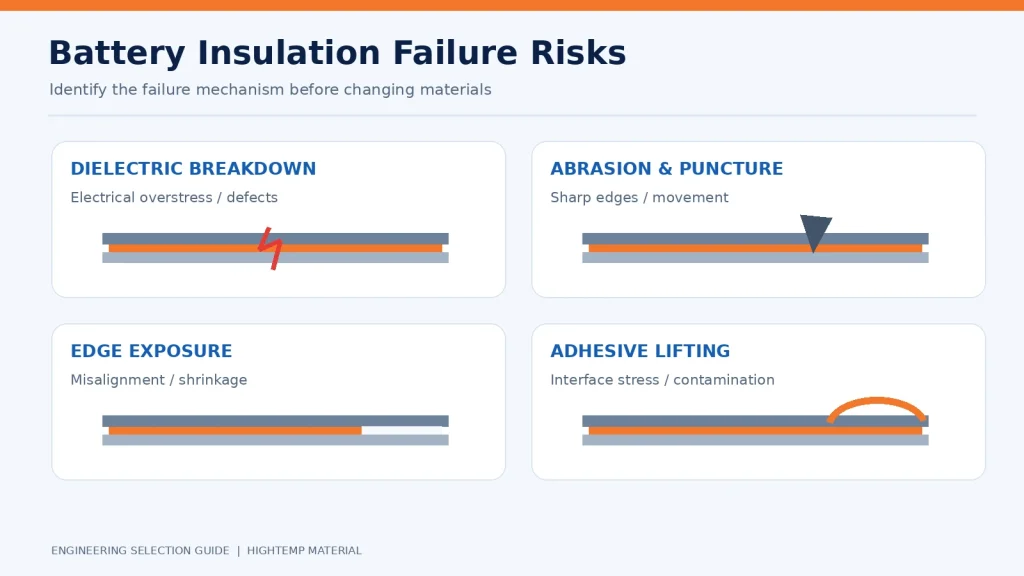
Insulation reliability depends on the complete installed construction.
Electrical Breakdown
An insulating layer may fail under excessive electric stress or because of local defects, damage or environmental degradation.
A published dielectric strength value is not equivalent to an allowable operating voltage.
Abrasion and Puncture
Sharp metal edges, vibration and relative movement can damage thin polymer films.
Puncture and abrasion resistance may be particularly important near busbars, terminals and enclosure features.
Loss of Insulation Coverage
Shrinkage, curling, displacement or poor dimensional control can expose conductive areas.
This risk should be considered for precision die-cut parts and films installed near complex geometries.
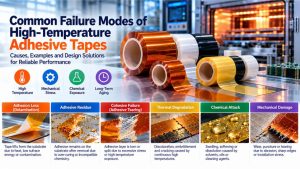
Adhesive Delamination
Adhesive-backed insulation can lift or separate because of surface contamination, thermal expansion mismatch, unsuitable adhesive selection or mechanical stress.
Thermal Aging and Cycling
Repeated heating and cooling can contribute to dimensional changes and interface stress.
The actual temperature profile, not merely the maximum stated temperature, should be used for qualification.
Moisture and Contamination
Humidity, condensation, electrolyte exposure and process contamination may influence insulation performance.
Chemical compatibility must be assessed for the specific material and exposure conditions.
Failure Analysis
When evaluating an existing problem, record the failure location, operating conditions, material grade and observed damage before selecting a replacement.
A thicker film or higher-temperature polymer does not necessarily correct an interface or geometry-related failure.
5. Key Properties for EV Battery Insulation Material Selection
Dielectric Strength
Dielectric strength describes electrical breakdown behavior under specified test conditions.
It is commonly expressed in kV/mm.
Results depend on film thickness, electrodes, voltage waveform, conditioning and temperature.
Engineers should not convert a datasheet breakdown field directly into a permissible service voltage without the applicable design and safety assessment.
Volume Resistivity and Insulation Resistance
Volume resistivity describes resistance to current flow through the material bulk.
Installed insulation resistance also depends on geometry, interfaces, contamination and environmental conditions.
Both may be relevant, but they are not interchangeable.
Continuous and Peak Temperature Exposure
A short manufacturing or fault-related temperature excursion is different from continuous service at the same nominal temperature.
Request temperature data for the exact grade and construction.
Flammability Performance
Where flame performance is required, identify the exact test method, specimen thickness, grade and classification.
For example, a UL 94 classification must not be assumed to apply to all thicknesses or variants of a polymer family.
Flammability testing does not replace battery-system safety validation.
Mechanical Strength
Depending on the location, useful properties may include:
- Tensile strength
- Elongation
- Tear resistance
- Puncture resistance
- Abrasion resistance
- Flexibility
- Compression behavior
Dimensional Stability
Heat-related shrinkage, film orientation, moisture response and thermal expansion can affect part positioning.
For precision-cut films, consider machine-direction and transverse-direction properties where relevant.
Adhesion and Surface Compatibility
Adhesive-backed components require evaluation of the complete construction.
Test the adhesive against the actual metal, coating or polymer substrate after representative environmental exposure.
Chemical Compatibility
Potential exposure to electrolyte-related chemicals, cleaning agents, oils or other substances should be considered where applicable.
The chemical resistance of the film backing does not automatically establish compatibility of its adhesive.
6. Comparing PI, PET, PEN, PTFE, Mica and Insulating Foams
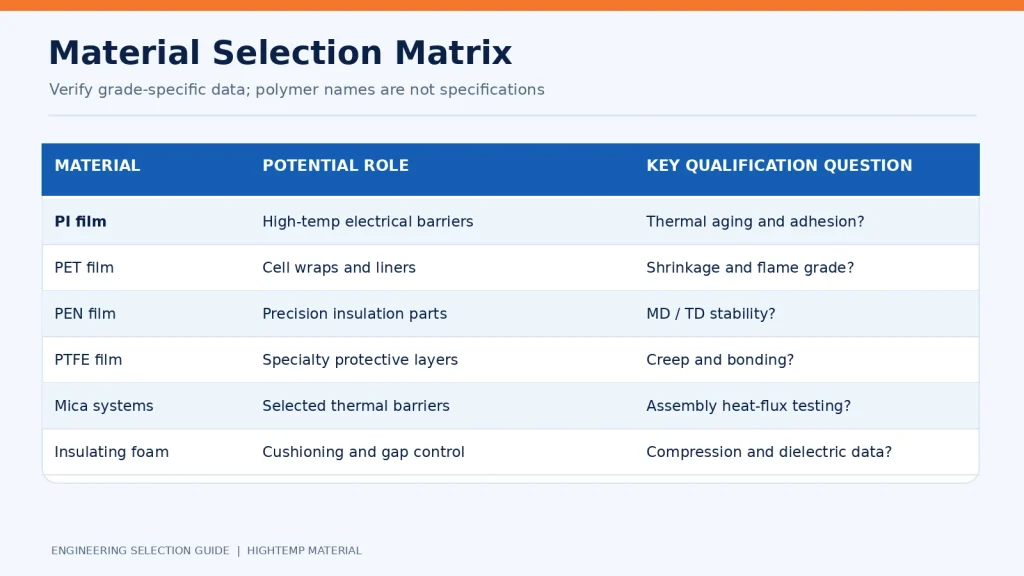
No single material is best for every EV battery insulation location.
The following comparison provides engineering selection considerations rather than universal performance rankings.
| Material | Potential Advantages | Important Limitations or Questions | Possible Battery-Related Uses |
|---|---|---|---|
| PI film | Elevated-temperature electrical insulation in suitable grades | Grade-specific thermal, electrical and mechanical data | Terminal barriers, busbar insulation, precision die-cut parts |
| PET film | Economical, widely available, good converting options | Temperature limit, shrinkage, flame classification | Cell wraps, liners, module insulation |
| PEN film | Useful thermal and dimensional properties in selected grades | Availability, orientation, qualification data | Precision insulation films and selected battery components |
| PTFE film | Chemical resistance and low-friction characteristics | Creep, expansion, adhesion and cost | Specialized protective or insulating layers |
| Mica-based materials | Potential high-temperature barrier performance in suitable constructions | Brittleness, handling, thickness and grade-specific testing | Selected thermal/electrical barriers |
| Insulating foams | Compression, gap accommodation and cushioning | Compression set, thermal exposure, flammability and electrical properties | Spacers, cushioning and gap management |
Polyimide (PI) Film
PI films are frequently considered for high-temperature electrical insulation.
Suitable grades may provide useful combinations of flexibility, electrical performance and heat resistance.
For battery applications, evaluate the exact film grade, thickness, dimensional stability and adhesive construction.
Not every PI grade has the same temperature rating or electrical properties.
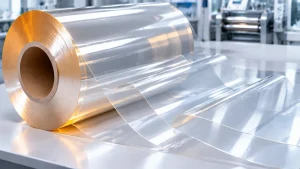
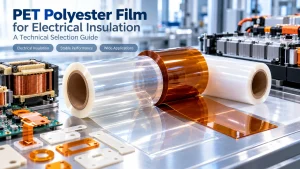
PET Film
PET is a common candidate for insulation components where cost, availability and converting efficiency are important.
It can be supplied in rolls, sheets and custom-cut geometries.
However, temperature exposure and dimensional stability must be reviewed carefully.
If a project requires flame-retardant PET, specify the exact grade, thickness and required classification.
Standard PET must not be assumed to meet a particular flame classification.
PEN Film
PEN may offer a useful alternative to PET in selected applications involving demanding thermal or dimensional requirements.
Its suitability depends on the actual grade and qualification data.
A generic statement that PEN is always superior to PET is not sufficient for engineering selection.
PTFE Film
PTFE offers chemical resistance and low-friction properties.
However, it can present challenges involving creep, thermal expansion and adhesive bonding.
For precision-converted insulation parts, these limitations may be important.
Mica-Based Materials
Mica-based constructions may be considered where higher-temperature thermal or electrical barrier performance is needed.
Their actual suitability depends on the mica grade, binder, reinforcement, thickness and assembly configuration.
A mica sheet is not automatically a qualified thermal runaway barrier.
Insulating Foams and Cushioning Materials
Selected foams may help accommodate gaps, compression and mechanical movement.
However, electrical insulation, thermal resistance, flame behavior and compression-set performance must be verified separately.
A cushioning material should not be treated as a substitute for a dedicated electrical or thermal barrier without supporting evidence.
Material Selection Recommendation
Start with the required function, operating environment and acceptance criteria.
Then compare verified grade-specific data and evaluate the complete installed construction.
For a broader polymer comparison, see our PI vs PET Film Guide.
7. Busbar Insulation and Die-Cut Part Design
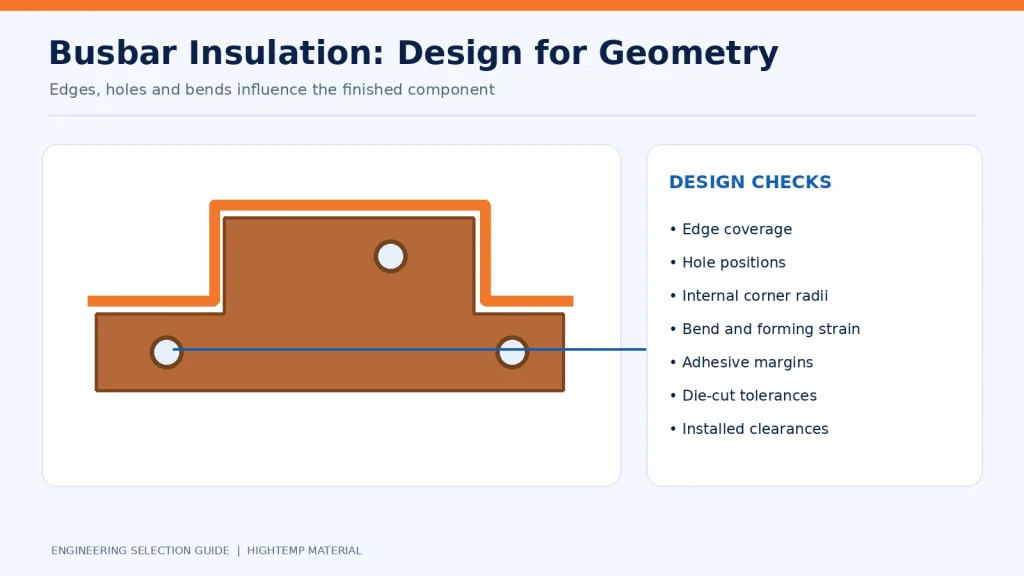
Busbar insulation is a practical example of why geometry matters as much as polymer selection.
A film may provide adequate dielectric properties in a flat laboratory specimen but become vulnerable when installed over sharp edges or complex features.
Edge Coverage
Conductive edges should remain adequately covered under expected tolerances and movement.
The necessary coverage must be determined from the actual electrical and mechanical design.
Holes and Cutouts
Mounting holes and cutouts may create local stress concentrations.
Their position, diameter, spacing and edge distances should be reviewed during design.
Internal Corner Radii
Sharp internal corners can increase tearing risk.
Rounded corners may improve mechanical durability where compatible with the design.
Bends and Forming
Films applied over bends may experience stretching, wrinkling or localized thinning.
The forming method and minimum bend geometry should be validated for the actual material.
Adhesive Margins
Adhesive coverage should be selected according to bonding requirements, exposed edges, electrical constraints and assembly conditions.
An adhesive margin that works on a flat test coupon may behave differently on a formed busbar.
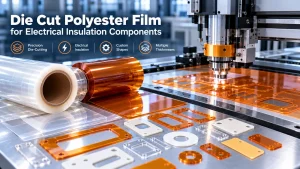
Precision Converting
Custom die-cut parts can improve consistency and assembly efficiency when properly designed.
For detailed design considerations, see our Die-Cut Insulation Parts Design Guide.
HighTemp Material can discuss drawing-based Custom Die Cutting and Precision Converting requirements.
8. Thickness, Adhesive Construction and Production Format
Choosing Film Thickness
Thickness selection must balance electrical, mechanical and manufacturing requirements.
A thicker film may provide greater physical separation, but it can also affect flexibility, fit, weight and converting behavior.
Do not assume that dielectric strength scales linearly with thickness.
Adhesive-Backed vs Non-Adhesive Films
Adhesive-backed parts may simplify installation and positioning.
However, the adhesive introduces additional thermal, chemical and mechanical considerations.
Non-adhesive films may be appropriate where mechanical retention is available or adhesive contamination is undesirable.
Rolls, Sheets or Die-Cut Parts?
Rolls may suit continuous converting and automated production.
Sheets may be convenient for prototyping and selected fabrication processes.
Die-cut parts may reduce in-house processing and simplify assembly for defined geometries.
The best format depends on volume, material utilization, tooling, dimensional requirements and total installed cost.
Production Consistency
For repeatable battery assembly, consider:
- Material lot identification
- Thickness control
- Part dimensions
- Film orientation
- Surface cleanliness
- Packaging and handling
- Traceability requirements
The appropriate level of documentation should be agreed with the customer and supplier.
9. Testing and Qualification of EV Battery Insulation Materials
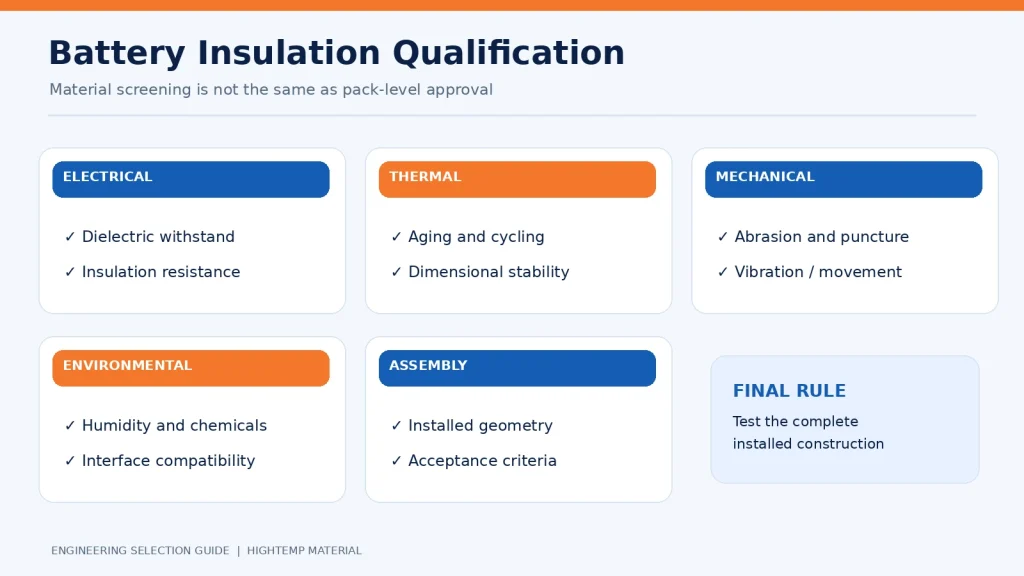
Qualification should reflect the actual insulation function and relevant product requirements.
Electrical Testing
Depending on the design, testing may include:
- Dielectric withstand
- Insulation resistance
- Breakdown characterization
- Surface or volume resistivity
- Partial discharge assessment where applicable
Material-level dielectric tests and pack-level insulation tests serve different purposes.
Thermal Testing
Relevant evaluations may include:
- Thermal aging
- Temperature cycling
- Dimensional change
- Adhesion retention
- Exposure to process temperatures
Mechanical Testing
Depending on the application:
- Tensile or tear properties
- Puncture resistance
- Abrasion
- Compression behavior
- Vibration-related durability
- Installation damage assessment
Environmental and Chemical Testing
Evaluate relevant humidity, contamination and chemical exposure.
The test conditions should reflect the actual battery assembly and service environment.
Flame and Thermal Barrier Testing
Where required, verify the exact material grade, specimen thickness, test method and classification.
Battery thermal propagation or thermal runaway protection must be assessed using relevant component- or system-level procedures.
Standards and Regulatory Context
Depending on the target market and vehicle or battery category, relevant references may include:
- UNECE Regulation No. 100 — Electric power train safety requirements for relevant vehicle approvals
- ISO 6469-3 — Electrical safety specifications for electrically propelled road vehicles
- UL 2580 — Batteries for use in electric vehicles
- IEC 62660 series — Performance and reliability testing of secondary lithium-ion cells for propulsion
- UN 38.3 — Transport testing of lithium batteries
These documents have different scopes. None should be interpreted as a universal certification for a particular insulation film.
The applicable requirements and current editions must be determined for the intended vehicle, battery system and market.
Why Representative Assembly Testing Matters
A flat film specimen does not reproduce every risk associated with a formed busbar, adhesive interface or mechanically constrained battery module.
Where possible, evaluate samples with representative:
- Substrates
- Geometry
- Installation methods
- Adhesive systems
- Electrical stresses
- Thermal profiles
- Mechanical loads
A material is not fully qualified simply because its supplier datasheet contains favorable typical values.
10. Common Mistakes in EV Battery Insulation Material Selection
Mistake 1: Choosing Only by Dielectric Strength
Dielectric strength is important, but it does not establish complete electrical safety.
Better approach: Review the applicable electrical design, environmental exposure and assembly-level tests.
Mistake 2: Treating Flame Retardancy as Thermal Runaway Protection
A flammability classification does not prove resistance to thermal propagation.
Better approach: Define and test the actual thermal protection function.
Mistake 3: Selecting by Maximum Temperature Alone
Continuous service, peak exposure and abnormal-event temperatures are different conditions.
Better approach: Define the full temperature profile and exposure duration.
Mistake 4: Ignoring Die-Cut Geometry
Poor hole placement, sharp corners or inadequate edge coverage can undermine an otherwise suitable material.
Better approach: Review the actual drawing and installed condition.
Mistake 5: Assuming the Adhesive Has the Same Rating as the Film
The adhesive may be the limiting layer.
Better approach: Evaluate the complete laminate and actual substrate.
Mistake 6: Assuming All Grades of a Polymer Are Equivalent
Material properties vary with formulation, thickness and processing.
Better approach: Specify the exact grade and obtain relevant documentation.
Mistake 7: Using a Material-Level Test as Pack-Level Approval
Passing a material test does not establish pack compliance.
Better approach: Separate material screening from component and system qualification.
11. Practical EV Battery Insulation Selection Workflow
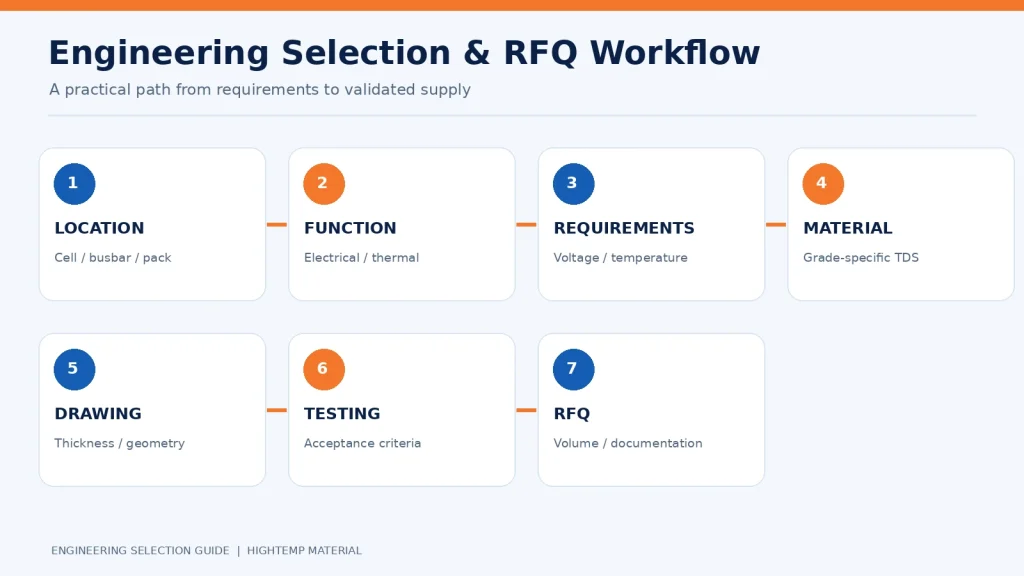
A structured selection process helps reduce technical uncertainty before production.
Step 1: Identify the Insulation Location
Define whether the component is used at cell, terminal, busbar, module or pack level.
Step 2: Define the Required Function
Determine whether the component must provide electrical isolation, mechanical protection, cushioning, thermal management or thermal event protection.
Multiple functions may require a multilayer construction.
Step 3: Establish Electrical Requirements
Specify operating voltage, transient conditions and the applicable insulation acceptance criteria.
Step 4: Establish Thermal and Environmental Requirements
Define continuous temperature, peak exposure, cycling, humidity and relevant chemical conditions.
Step 5: Review Mechanical and Dimensional Requirements
Provide drawings, thickness, bending conditions, edge features, tolerance requirements and installation method.
Step 6: Shortlist Material Grades
Compare PI, PET, PEN, PTFE, mica-based materials or insulating foams according to verified data for the intended function.
Step 7: Evaluate Manufacturing Feasibility
Review slitting, sheet cutting, die-cutting, adhesive lamination, packaging and expected production volume.
Step 8: Qualify the Complete Component
Test representative specimens against the project’s defined acceptance criteria.
Step 9: Confirm Supply and Documentation
Agree on grade identification, inspection requirements, available reports, traceability and change control before volume production.
12. RFQ Checklist for EV Battery Insulation Materials
When requesting a material recommendation or quotation, provide the following information.
| RFQ Requirement | Information to Share |
|---|---|
| Battery application | Cell, busbar, module or pack |
| Insulation function | Electrical, mechanical, thermal or combined |
| Cell format | Cylindrical, prismatic or pouch, where relevant |
| Voltage | Operating, maximum and transient conditions |
| Temperature | Continuous, peak and cycling profile |
| Material preference | PI, PET, PEN, PTFE, mica, foam or open |
| Thickness | Nominal thickness and tolerance |
| Electrical criteria | Required withstand or resistance testing |
| Mechanical requirements | Puncture, abrasion, flexibility or compression |
| Flame requirements | Exact standard, grade and thickness requirements |
| Adhesive | Adhesive-backed or non-adhesive; substrate details |
| Drawing | PDF, DXF or other controlled drawing |
| Dimensions | Critical dimensions, holes, radii and tolerances |
| Supply format | Roll, sheet or die-cut component |
| Qualification | Test methods and acceptance criteria |
| Documentation | TDS, test reports, declarations and traceability |
| Volume | Prototype quantity and annual demand |
If a customer requires a particular certification or test report, the requirement should be stated explicitly during the RFQ stage.
Do not assume that a polymer family or a supplier’s general product description establishes compliance.
13. EV Battery Insulation Film and Custom Converting Support
HighTemp Material supplies high-temperature polymer films and supports precision converting discussions for electrical insulation applications.
Relevant material categories include:
- Polyimide (PI) films
- PET electrical insulation films
- PEN films
- PTFE films
- Selected adhesive-backed insulation materials
Relevant converting services include:
Material grades, available documentation and converting feasibility should be confirmed for each project.
Request EV Battery Insulation Material Support
Are you developing cell insulation, busbar barriers, module liners or custom die-cut insulation parts?
Send us your application, material preference, operating temperature, electrical requirements, thickness, drawing and estimated quantity.
Where qualification is required, include the test standards and acceptance criteria.
Contact HighTemp Material to discuss suitable electrical insulation materials and converting options.
Frequently Asked Questions
What materials are used for electrical insulation in EV battery packs?
Depending on the application, engineers may consider PI, PET, PEN, PTFE, mica-based constructions, insulating foams and other specialized materials. The appropriate choice depends on the required function and qualification criteria.
Is polyimide better than PET for EV battery insulation?
Not universally. PI may be suitable for more demanding thermal applications, while PET may offer cost and converting advantages where its properties meet the requirements. The exact grades must be compared.
Can flame-retardant PET be used for battery insulation?
Potentially, where the specific PET grade meets the project’s electrical, thermal, mechanical and flame-performance requirements. Grade- and thickness-specific evidence is necessary.
Is dielectric strength enough to select a battery insulation film?
No. Electrical insulation design must also consider geometry, operating conditions, environmental durability, mechanical protection and applicable safety requirements.
What is the difference between battery insulation and thermal runaway protection?
Electrical insulation controls unwanted electrical conduction. Thermal runaway protection addresses severe abnormal thermal events and propagation risks. Different materials and tests may be required.
Are mica sheets suitable for battery thermal barriers?
Certain mica-based constructions may be considered for high-temperature barrier applications. Their suitability depends on the exact construction and validated component or system performance.
Can adhesive-backed insulation films be used on busbars?
Yes, in suitable designs, but adhesive compatibility, edge coverage, dielectric requirements and environmental durability must be qualified.
How do engineers choose insulation film thickness?
Thickness is selected based on electrical requirements, mechanical protection, geometry, tolerances and manufacturing constraints. Datasheet dielectric strength should not be used as the only design input.
Why are custom die-cut insulation parts used in battery manufacturing?
Die-cut parts can provide repeatable shapes, holes and cutouts for defined assembly locations, potentially simplifying installation and reducing in-house converting operations.
What information should be included in an EV battery insulation RFQ?
Include the application location, electrical requirements, temperature profile, material preference, thickness, drawing, adhesive requirements, qualification criteria and expected quantity.
Conclusion
Electrical insulation materials are essential components of EV battery design, but their suitability cannot be determined by polymer type or a single datasheet value.
PI, PET, PEN, PTFE, mica-based materials and insulating foams provide different combinations of electrical, thermal and mechanical characteristics.
The correct selection depends on where the material is installed, what function it must perform and how the complete component will be qualified.
For battery engineers and technical buyers, a reliable process begins with clear requirements, continues through grade-specific material comparison and ends with representative component and system testing.
Contact HighTemp Material for electrical insulation film and custom converting discussions.
Technical References
- UNECE Regulation No. 100 — Electric Power Train Safety
- ISO 6469-3 — Electrically Propelled Road Vehicles: Electrical Safety
- UL 2580 — Batteries for Use in Electric Vehicles
- IEC 62660 Series — Secondary Lithium-Ion Cells for the Propulsion of Electric Road Vehicles
- UN Manual of Tests and Criteria, Subsection 38.3 — Lithium Battery Transport Tests
- ASTM D149 — Dielectric Breakdown Voltage and Dielectric Strength
- ASTM D257 — DC Resistance or Conductance of Insulating Materials
Engineering disclaimer: This article provides general selection guidance. It does not establish product-specific temperature ratings, UL classifications, certification status, thermal runaway performance or supplier qualification. All critical properties and compliance requirements must be confirmed for the exact material grade, component and application.